REVIEW · FULL-DAY
Full Day Private Tour in Évora and Arraiolos
Book on Viator →Operated by abc Travel · Bookable on Viator
Ancient Évora feels close, not rushed. This private full-day outing pairs UNESCO-listed Évora with Arraiolos in one smooth day, starting with hotel pickup and finishing back in Lisbon by air-conditioned minivan. You get a guided, structured look at the big landmarks without feeling herded.
I especially like the way the day balances major sights with breathing room, including standout stops like the Roman Temple of Diana and the Cathedral area. I also love the Arraiolos side, where the name behind the famous rugs comes from the place itself, and you get to see the craft linked to local history.
One consideration: the schedule packs a lot into about 8 hours, and some monument entries (like the Cathedral and Chapel of Bones) are not included, so you’ll want a little extra budget for admissions.
In This Review
- Key highlights at a glance
- Leaving Lisbon Comfortably: how the day runs in an air-conditioned minivan
- First look at UNESCO Évora: walls, hilltop streets, and the big picture
- Temple of Diana: a Roman landmark that changed jobs for centuries
- São Francisco Church: Gothic-Manueline style tied to Portugal’s seafaring era
- Évora Cathedral and Rua 5 de Outubro: medieval scale plus handy craft streets
- Chapel of Bones: the memento mori you won’t forget
- Arraiolos Rug Center: the craft and the story behind the name
- Arraiolos Castle: circular architecture and 360-degree plain views
- Igreja da Misericordia in Arraiolos: baroque mood and XVIII-century tile panels
- Value, pacing, and who this private tour really suits
- Should you book this tour?
- FAQ
- How long is the full-day private tour?
- What is the meeting time?
- Is hotel pickup and drop-off included?
- Is transportation included?
- Is this a private tour?
- Are tickets included for all stops?
- Is lunch included?
- How many people are allowed per booking?
- Does the tour run in bad weather?
- What’s the cancellation policy?
Key highlights at a glance
- Private pace, small group size: you explore with just your party, with a max booking size noted by the operator
- UNESCO World Heritage focus in Évora: built-in context for why this hilltop city matters
- Temple of Diana stop: a Roman landmark that survived by reinventing itself over centuries
- Chapel of Bones timing: enough time to experience it without turning it into a sprint
- Arraiolos rugs up close: see the rug tradition through an interpretive center connection
- 360-degree viewpoint from Arraiolos Castle: hilltop walls plus big Alentejo plain views
Leaving Lisbon Comfortably: how the day runs in an air-conditioned minivan
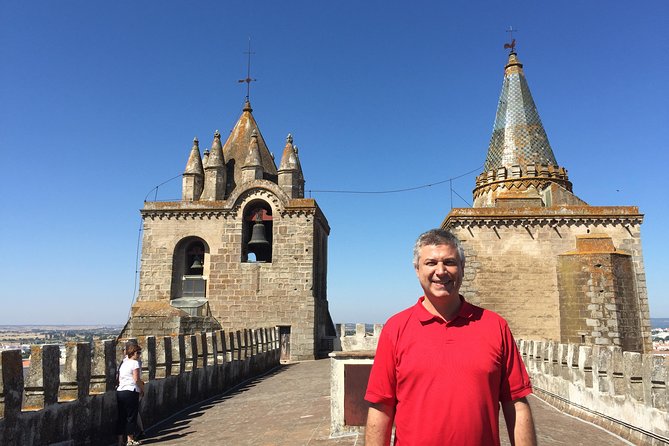
This tour is designed for people who want a lot of Southern Portugal without the stress of renting a car or figuring out intercity timing. Pickup happens at your Lisbon hotel, then you head out in an air-conditioned minivan. The whole structure matters: a private guide and driver means you’re not watching the clock just to keep pace with a big group.
Your day is also weather-aware. The tour is described as operating in all weather conditions, so bring layers even if Lisbon feels mild. Dress code is smart casual, which is helpful because several stops are in historic churches and old-town streets where you’ll be walking.
And since the tour is private, you’re more likely to get the kind of explanations that make the stones make sense. In one of the guide notes shared for this experience, John was praised for being professional and for pointing out details while still allowing plenty of time to look around. That’s the best kind of private tour: not just transportation, but interpretation.
You can also read our reviews of more private tours in Lisbon



First look at UNESCO Évora: walls, hilltop streets, and the big picture
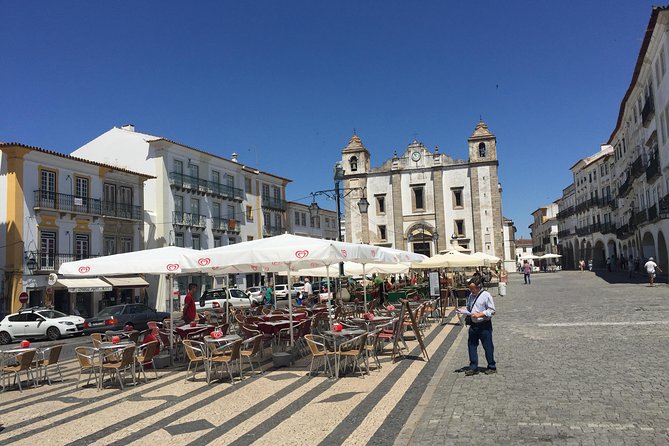
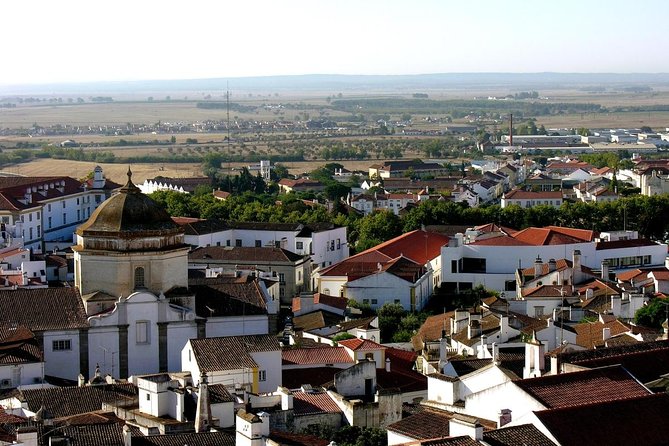
Évora sits on a gently sloping hill rising out of the huge Alentejo plain, and you can feel that geography right away. The city’s historic center is protected by an outer wall, and that fortification vibe helps you understand why Évora became so important. UNESCO recognition here isn’t just paperwork—it’s the physical layout, the density of monuments, and the way different eras layered on top of each other.
You’ll walk into old streets with Moorish origins—narrow lanes that contrast with open squares where light hits hard and makes the stone glow. This is one of those places where the city plan itself is part of the story. Romans conquered Évora in 59 B.C. and called it Liberalitas Julia, which connects directly to the Roman monuments you’ll see later.
The advantage of starting with a general orientation is simple: once you get your bearings, the landmark stops feel less random. The downside of a packed day is that the orientation can’t be a long, slow wandering session. If you like to linger in café seats for an hour at a time, plan to keep expectations realistic.
Temple of Diana: a Roman landmark that changed jobs for centuries
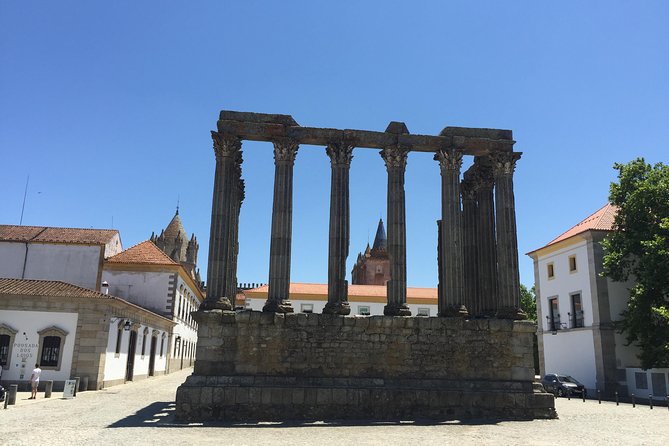
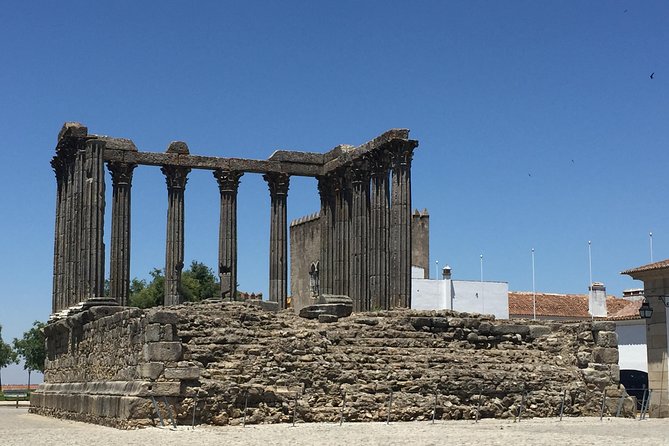
The Roman Temple of Évora, often called the Templo de Diana, is the ex-libris monument of the city. It’s over 2,000 years old and built in the first century, during the time of Caesar Augustus. Standing there, you get one of the best lessons a UNESCO site can teach: monuments survive, but their meanings often don’t.
The story is wild in a good way. The temple was practically destroyed in the 5th century during invasions and later served as a bank vault and even something like a butcher’s associated with the castle. Then, in the 19th century, archaeologists recovered more of the original Roman design. That arc—built for imperial worship, repurposed for practical life, then reinterpreted by modern archaeology—explains why the site feels both Roman and strangely lived-in.
You’ll have about 30 minutes at this stop, and for many people that’s enough. It’s a compact monument area, so you can see it, take photos, and soak in the context without feeling like you need an archaeology degree. Just wear good shoes. Évora’s streets and stone edges can be slippery or uneven, especially if weather changes.
São Francisco Church: Gothic-Manueline style tied to Portugal’s seafaring era
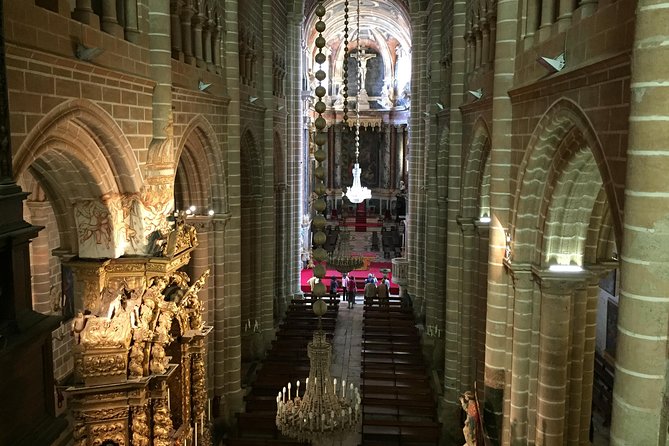
Next up is Igreja de São Francisco, one of the grandest churches in Portugal, built between 1480 and 1510. It’s a Gothic-Manueline space, and the decoration wasn’t random: it’s linked to royal painters Francisco Henriques, Jorge Afonso, and Garcia Fernandes.
What I like about this stop is how the church connects architecture to Portugal’s wider history. The nave symbolism includes the cross of the Order of Christ and the emblems associated with founding kings—King John II and King Manuel I. So you’re not just looking at pretty vaulted ceilings. You’re reading an era that helped drive maritime expansion.
You’ll have about 30 minutes here. That time is useful, but it’s also tight if you want a slow, detail-by-detail look at every carved emblem. If you’re the type who enjoys spotting symbols and checking how different motifs repeat, this is a stop you’ll wish for more time. Still, in a day pairing Évora with Arraiolos, it’s a strong balance.
Évora Cathedral and Rua 5 de Outubro: medieval scale plus handy craft streets
The Cathedral of Évora is the city’s big medieval anchor. Construction began in 1186 and it was consecrated in 1204, with completion taking longer. It’s described as the largest medieval cathedral in Portugal, and it dominates the skyline and urban landscape.
The practical detail you’ll appreciate: the route goes up Rua 5 de Outubro, highlighted as one of the best streets to buy Alentejo handicrafts. So this stop can double as a low-key shopping walk if you want to pick up something small and local.
Your time here is about 45 minutes, and admission is not included in the tour. That’s not a deal-breaker, but it’s the one thing to plan for financially. Also, because this is a major church, you’ll want to arrive ready to move thoughtfully—quiet, respectful, and prepared to share space.
If you’re trying to prioritize photos: the cathedral area tends to deliver strong silhouettes and stone textures. If you’re visiting during bright light, the contrast between sunlit squares and shaded church interiors can be dramatic in a good way.
You can also read our reviews of more tours and experiences in Lisbon






Chapel of Bones: the memento mori you won’t forget
The Chapel of Bones is one of Évora’s best-known monuments, located at Praça 1º de Maio and part of the Church of San Francisco complex. It was built in the 17th century under the initiative of three Franciscan friars, and the point is explicit: transience and fragility of human life.
Here’s the practical takeaway: don’t treat it like a quick photo stop. Give it enough time to land emotionally. Even if you’re not into morbid art, the chapel’s design is meant to make visitors slow down and reflect. You’ll have about 30 minutes, and that seems about right—enough to see, read what you can, and exit with your thoughts intact.
Admission is also not included here. If you’re trying to manage costs, it helps to know which stops are free versus paid ahead of time. And if the theme feels too intense for you, it’s still worth knowing where it is, so you can decide with your own comfort level.
Arraiolos Rug Center: the craft and the story behind the name
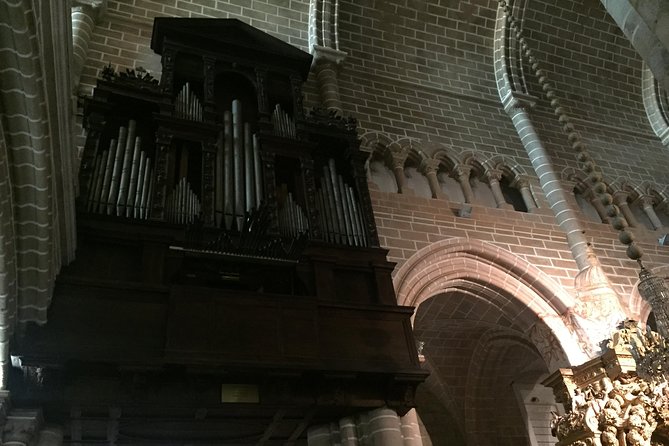
After the Évora monuments, the day shifts into Arraiolos, and that change of pace is a big part of the value. First stop is Tapetes de Arraiolos at the Centro Interpretativo, focused on the Arraiolos rug tradition.
This is where the day becomes more than sightseeing. The rug is linked to the village that gave it its name, with manufacturing noted as important prior to the 15th century. There’s also a historical paper trail in the text: the oldest reference mentioned dates to the late 16th century, with a document from 1598 referencing a new carpet revaluated in two millers.
There were also archaeological excavations referenced in Praça do Meguesio in the early 21st century under archaeologist Ana Gonçalves—again, connecting craft tradition to physical evidence and local memory. Even if you don’t buy anything, this is a good stop for understanding how a craft becomes a cultural brand.
Time is about 30 minutes, and admission is not included. If you’re a collector or you’re curious about how rugs are made and how patterns carry meaning, you’ll likely enjoy this more than a generic “museum-style” stop. It also breaks the day’s intensity with a calmer, more grounded theme.
Arraiolos Castle: circular architecture and 360-degree plain views
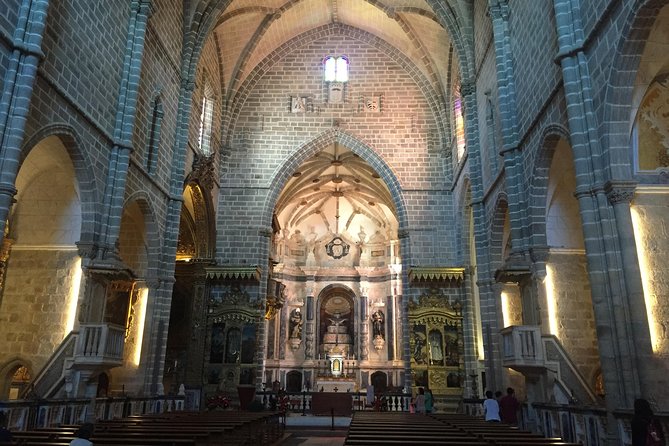
Arraiolos Castle is built in 1305 and is one of the few castles in the world described as having circular architecture. What you’ll notice on the hilltop is the shape of the walls and the way the interior lawn area opens up.
The interior building is noted as a bit degraded by time, but the ellipsoidal walls and vast lawn are in excellent condition. The real payoff is the viewpoint: the castle sits on top of São Pedro hill and offers 360-degree views over the Alentejo plain. This is one of those moments where you stop “tour mode” and just look. It also helps you understand why castles were built here—visibility and control.
You’ll have about 30 minutes at this stop, and admission is included as free. It’s a great cost-to-time option: strong views without ticket fees and without requiring long museum time.
Igreja da Misericordia in Arraiolos: baroque mood and XVIII-century tile panels
To round out the Arraiolos portion, the tour includes Igreja da Misericórdia. It belongs to the Brotherhood of the Holy House of Mercy of Arraiolos, established in 1524, and it’s described as exemplary of Baroque style. The foundation is noted for the end of the 16th century, with construction era in the 16th century.
The detail that makes this stop feel specific is inside: there’s an interesting set of tile panels of the 18th century lining the walls. If you’ve been to Portugal before, you know azulejos can turn a church visit into a visual treasure hunt. This is a shorter stop—about 30 minutes and free entry—so it works well as a calm close rather than a second long-ticket attraction.
By the time you get here, the day’s emotional texture has shifted: you started with Roman ruins and Gothic grandeur, then moved to craft history and a wide-open castle view. The church stop balances the day with something quieter and more intimate.
Value, pacing, and who this private tour really suits
At $500.33 per group (up to 3), the price is clearly aimed at small parties. Here’s how I think about the value: you’re paying for transportation from Lisbon, a private guide/escort, and an air-conditioned vehicle, plus structured time at major sites that would take planning on your own. If you’re traveling as two or three people, the math usually works better because you’re splitting the private costs.
One nuance: the experience notes a maximum of 8 people per booking, but the listed price is per group up to 3. If you’re traveling with four to eight people, check how the operator structures pricing for larger groups. Don’t assume it scales the same way.
Pacing-wise, this is a “see the hits” day, not a slow country ramble. You’ll be on the move, and the time at each stop is enough to enjoy the core experience, but not enough to fully master every detail. Still, the private format helps. You can ask questions and spend a few extra minutes where you care most.
This tour is a strong fit if:
- you want UNESCO Évora without self-driving
- you like Roman ruins plus Portuguese church art
- you care about local craft traditions like the Arraiolos rug
- you prefer private guidance over a crowded group
It’s less ideal if:
- you want mostly downtime and long unstructured wandering
- you hate paying separate entry fees for major sites (since the Cathedral and Chapel of Bones are not included)
Also, if you enjoy quirky historic extras, one shared day highlight points to an added stop around Guadalupe and the Almendres cromlechs (a megalith area) being included on at least one version of the schedule. That’s not guaranteed from the base structure, but it’s a good example of the kind of flexible value a private day can offer—when time allows.
Should you book this tour?
Book it if you want a confident, guided day that hits the key landmarks of Évora and then meaningfully connects to Arraiolos through the rug tradition and castle views. The best parts here are the pairing: Roman + medieval + craft + big landscape, all in one go, with the comfort of hotel pickup.
Hold off or adjust your expectations if you’re trying to travel “light” in terms of entry fees, or if you hate tight time windows at church monuments. Also consider your tolerance for emotionally intense art at the Chapel of Bones.
If you’re unsure, this is the kind of private tour that’s easiest to enjoy when you communicate what you care about most—temples, cathedral architecture, rug history, or castle views—so your guide can help you spend your time where it matters to you.
FAQ
How long is the full-day private tour?
The duration is listed as about 8 hours.
What is the meeting time?
The tour start time is 9:00 am.
Is hotel pickup and drop-off included?
Yes. Pickup and drop-off from your Lisbon hotel are included.
Is transportation included?
Yes. You travel by air-conditioned vehicle with a private transport arrangement.
Is this a private tour?
Yes, it’s a private tour, meaning only your group participates.
Are tickets included for all stops?
Some admissions are free, while others are not included (for example, the Évora Cathedral and the Chapel of Bones are listed as not included).
Is lunch included?
No. Food and drinks are not included, and lunch isn’t included.
How many people are allowed per booking?
The operator notes a maximum of 8 people per booking. The published price is per group up to 3.
Does the tour run in bad weather?
Yes, it operates in all weather conditions, so dress appropriately.
What’s the cancellation policy?
Free cancellation is available up to 24 hours in advance for a full refund. If you cancel within 24 hours, the amount paid is not refunded.