REVIEW · CITY TOURS
Lisbon City Center Tour – The Unmissable Lisbon
Book on Viator →Operated by Take Lisboa · Bookable on Viator
Lisbon reveals itself on foot. This city-center route mixes squares, secret side streets, and landmarks into one smooth 2.5-hour orientation walk, with the best twist being pay-what-you-think pricing. I especially like how it goes where cars can’t, so you get alleyway Lisbon instead of only the postcard fronts. I also like the takeaway tips mindset—your guide doesn’t just point, they help you decide what to do next.
One thing to consider: it’s a steady walking tour over uneven streets, and on a rainy or foggy day you may get fewer photo-perfect moments (plus the pace can feel fact-heavy if you prefer lighter talk).
In This Review
- Key highlights to know before you go
- Pay-what-you-think pricing and why this tour feels like good value
- Praça dos Restauradores to Rossio Square: independence, faith, and Lisbon’s “main stage”
- Chiado, Bairro Alto edges, and the Santa Justa elevator free area
- Largo do Carmo to Igreja de São Roque: revolutions and Jesuit art
- A Brasileira, São Carlos Theatre, Rua Augusta, and the Tagus finale
- How the guides shape your experience (and what to ask them)
- Tips for uneven streets, rainy days, and getting the most out of each stop
- Should you book the Lisbon City Center Tour?
- FAQ
- How long is the Lisbon City Center Tour?
- Where does the tour start and end?
- What language is the tour offered in?
- Do I need to buy tickets for the stops?
- Is there a mobile ticket?
- How much does it cost?
- What group size should I expect?
- What if the weather is bad?
- What’s the cancellation policy?
Key highlights to know before you go
- Pay-what-you-think model: you’re not locked into a fixed fare for the guide’s effort
- City-center focus without the car-traffic stuff: the route favors alleys and quieter lanes
- Small group size (max 25): easier conversation and better Q&A
- A lineup of landmark types: independence square, churches, memorials, viewpoints, and major downtown streets
- Plenty of short stops: most sights are about 5–15 minutes each, so you keep moving
- Weather matters: it requires good weather, so plan for flexibility
Pay-what-you-think pricing and why this tour feels like good value
At this price point, you’re mostly buying orientation, stories, and local “how to spend your time” guidance. The tour is listed at about $3.62 per person, but the bigger idea is that you choose the value at the end—so if the guide clicks with you, you can reflect that. If your expectations are different, you won’t feel stuck paying for something that didn’t land.
For first-timers, this model can be a win. You’re not paying extra for a long ticket line or museum admission. Instead, you’re getting a walking thread through central Lisbon: major squares, older streets, and viewpoints that connect neighborhoods. That’s the kind of spending that helps you plan the rest of your trip—where you should go next, and what to notice when you’re there.
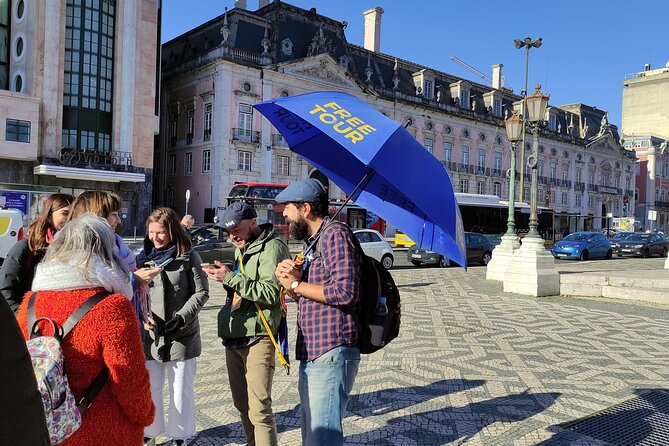
The tour runs around 2 hours 30 minutes and is offered in English. The group is capped at 25, which matters more than you might think in Lisbon. Central streets can get busy, and smaller groups keep the walk from turning into a shuffle. You’ll also notice how different guides work—some emphasize humor and conversation, some pack in more context—so this small size makes a difference.
You can also read our reviews of more city tours in Lisbon


Praça dos Restauradores to Rossio Square: independence, faith, and Lisbon’s “main stage”
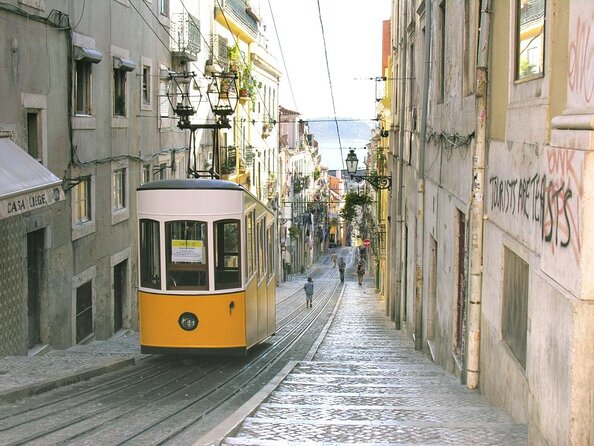
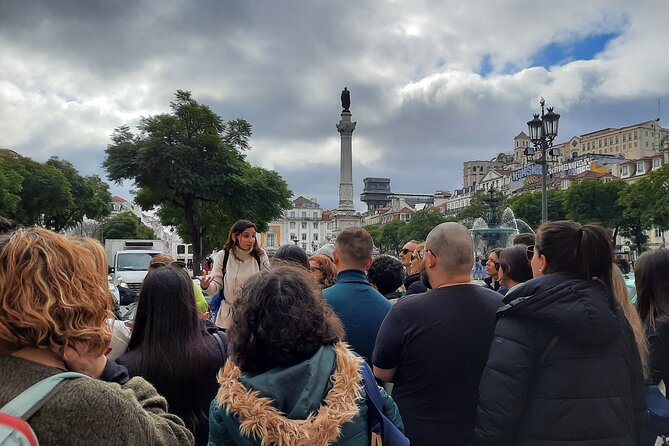
The tour starts in Praça dos Restauradores, at the Monumento dos Restauradores. This is a great opening because it’s right where Avenida da Liberdade reaches its energy—an instant sense of scale before you step into tighter lanes.
Stop 1: Praça dos Restauradores (near the start)
You’ll spend a short moment here to set the theme: this square is tied to Portugal’s independence. It’s not just a pretty starting line. It helps you understand Lisbon as a city that constantly references its own past—politics, identity, and pride—through monuments and street names.
Stop 2: Igreja de São Domingos
Next comes a church stop that flips expectations. It’s described as one of the least adorned, yet it’s called one of the richest in a spiritual and symbolic sense. That contrast is very Lisbon: simple outside, meaningful inside. It’s also a good pause to catch your breath, especially if you’re still waking up after travel.
Stop 3: Memorial as Vítimas do Massacre Judaico de 1506
This is a heavier stop, and it’s one of the most memorable in the middle of a city-walk itinerary. The memorial is a tribute to victims of intolerance and religious fanaticism stemming from the Jewish massacre of 1506. If you like Lisbon history that isn’t only royal palaces and sunny tiles, you’ll appreciate this moment. It also sets up the tour’s tone: Lisbon isn’t just scenery—it’s memory.
Stop 4: Praca Dom Pedro IV / Rossio Square
Rossio Square is older and has hosted major events for centuries, and it’s the kind of place where you can feel Lisbon functioning like a capital. A quick stop here helps you place neighborhoods on a map. When you leave, you’ll be able to look around and understand why so many things radiate from this kind of central hub.
Stop 5: Estação do Rossio
Then you get one of those “how did they build this here?” surprises: Estação do Rossio is described as imposing, and the construction date is meant to surprise you. Even if you don’t care about railway history, stations tell you how a city moves. Lisbon’s center is all about movement—tram lines, walking routes, and shortcuts between hills.
Practical note: these early parts are where you learn the walking rhythm. The streets aren’t uniform—some are slick, some narrow, some slightly steep. If you’re prone to rushing on Day 1, slow down. You’ll enjoy the tour more and you’ll keep your energy for the viewpoints later.
Chiado, Bairro Alto edges, and the Santa Justa elevator free area
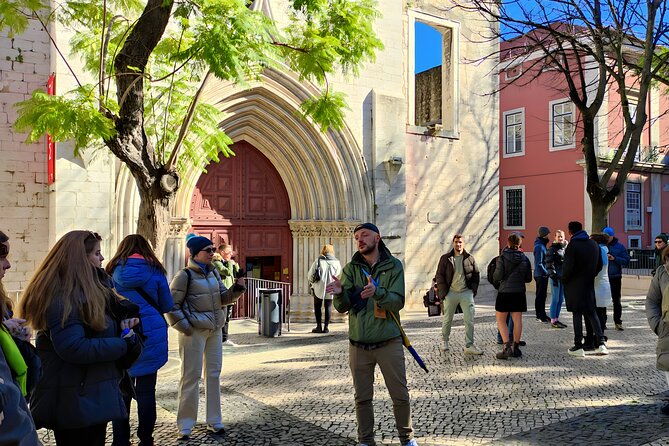
After Rossio, the route shifts into neighborhoods. This is where you stop feeling like you’re only walking “through Lisbon” and start feeling like you’re moving between Lisbon types: business and shopping streets, then artsy corners, then nightlife edges.
Stop 6: Chiado (entrance to Lisbon’s cosmopolitan neighborhood)
Chiado is presented as the entry point to one of the city’s most cosmopolitan areas. Think of it as Lisbon’s arts and ideas zone—less about grand monuments, more about the feel of people living and creating around the streets.
Stop 7: Elevador de Santa Justa (free area access)
One of the most photogenic parts is the Santa Justa elevator area. The tour includes access to the free area of the elevator, and it’s described as a public transport “monument.” Even if you don’t ride it, the setting makes sense: Lisbon is built on levels, and this is one of the ways the city solves height with style.
If you’re planning your own photos later, here’s the trick: try to notice angles while you’re there. You’ll remember where streets compress, where terraces open up, and how roofs stack. On clear days you’ll feel the charm instantly; on wet days, you’ll still get the structure, just with less sparkle.
Stops 10–11: Bairro Alto and Largo do Chiado transition
Bairro Alto is framed as the nightlife district with over 500 years of history. Largo do Chiado works as a hinge between Chiado and Bairro Alto, a small square that marks the shift in mood. You’ll leave with a clearer mental map: which streets feel like cafés and culture, and which feel like after-dark energy.
Largo do Carmo to Igreja de São Roque: revolutions and Jesuit art
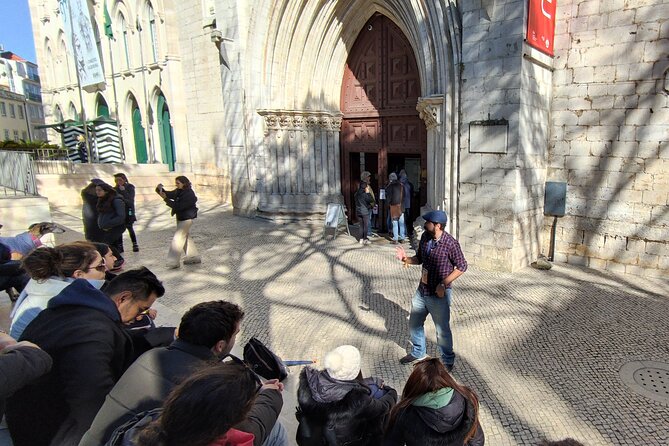
This section gets interesting because it blends big ideas—politics and religion—with street-level reality. You’re not touring a museum room. You’re standing in neighborhoods where history actually happened and people still walk by today.
Stop 8: Largo do Carmo
This is described as a stage for passionate revolutions. Even with a short stop, it’s the kind of place that makes you rethink Lisbon as political as well as beautiful. If your guide tells you how the square fits into the story, the stop becomes more than a photo break.
Stop 9: Igreja de São Roque
The São Roque church is from the 16th century and is described as the earliest Jesuit church in Portugal. It served as the home church in Portugal for over 200 years, before the Jesuits were expelled. Inside is also noted as housing one of the world’s most valuable chapels.
Here’s what matters for your visit: this is a stop that rewards attention. If you rush through the doorway, you’ll miss why it’s included. If you take the full time and look slowly, it gives you a stronger sense of Lisbon’s religious art history without feeling like homework.
A Brasileira, São Carlos Theatre, Rua Augusta, and the Tagus finale
The tour’s later part leans into downtown Lisbon: cafés, performing arts, and the wide main drag where most visitors end up eventually—except you’ll reach it with better context.
Stop 12: A Brasileira
This stop is tied to coffee and modernist creativity. It’s highlighted as where coffee was launched and where Fernando Pessoa and other intellectuals created the modernist magazine Orpheu. If Pessoa matters to you, this is a satisfying moment. If Pessoa doesn’t yet, it’s still a helpful reminder that Lisbon’s literature culture is not abstract—it’s connected to real places you can point at.
Stop 13: Teatro Nacional de São Carlos
This is the São Carlos National Theatre, described as the only Portuguese theatre geared toward producing and presenting opera and choral and symphonic music. So if you’re the type who likes a city’s musical personality, you’ll enjoy seeing the cultural focus without needing to score tickets right away.
Triumphal arch and Rua Augusta
You’ll then hit the triumphal arch that appears in many Lisbon travel photos—followed by Rua Augusta, described as the most agitated and charming downtown street. This is the energetic corridor where the city shows off. Expect more foot traffic and more “main character” energy from the street itself.
Stop 15: Praça do Comércio
Finally, the tour ends at Praça do Comércio, one of Europe’s most beautiful squares, where the city ends and the Tagus begins. It’s a perfect finish because it gives you a big open space after tighter streets. You’ll also be close to the arch and an equestrian statue of D. José I, which the meeting point/end point description calls out—so you’ll know exactly where the tour wraps.



How the guides shape your experience (and what to ask them)
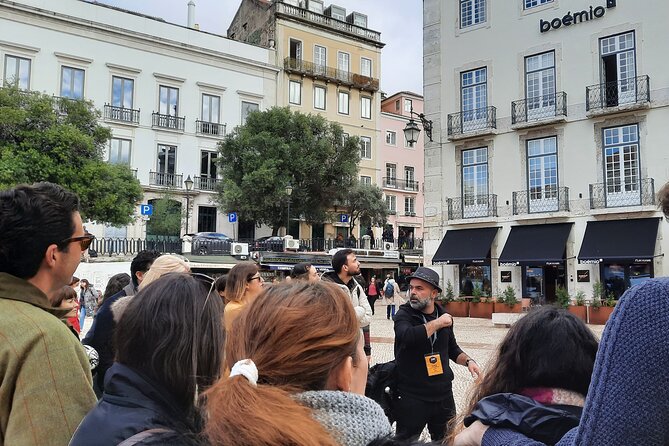
What really stands out across the tour experience is guide energy. Different names show up frequently—Miriam, Cecília, Claudia, Hugo, Sandra, Marian, and others—and their styles vary in a way that you’ll feel during the walk.
Some guides lean into humor and storytelling and keep it light while still packing in context. One guide style described includes regular mini stops every so often to point out what to notice. Another guide is noted for handling rain and fog without letting the walk lose its rhythm, including directing people toward good photo spots even when weather isn’t cooperating.
A different style is where you should calibrate expectations. One negative note complains about long lecture-like segments—too many facts, too little direct attention to the specific sites right in front of you. You can prevent that from ruining your tour by doing two simple things:
- Ask a question early about what you should prioritize for your remaining days.
- If the talk gets too dense, bring your attention back to the street scene and ask what you’re looking at.
Also, use the tour as a planning tool, not just a sightseeing loop. Several guides are described as sending follow-up guidance with food and cultural suggestions—one example mentions a WhatsApp document with local tips. If your guide offers something similar, save it. Lisbon is a city where good eating and good timing turn an average day into a great one.
Tips for uneven streets, rainy days, and getting the most out of each stop
If you want the tour to feel smooth, treat it like a walking day, not a sit-and-stare day.
Wear shoes that handle uneven pavement. Lisbon’s center is walkable, but the surface can be a bit rough underfoot. Bring a light layer. Even when the day is warm, you’ll be near open squares and exposed areas.
For weather: the experience requires good weather. If it’s canceled due to poor weather, you’re offered another date or a full refund. If you do go on a rainy day, accept that photos may be less crisp and fog may soften views. Use that situation for a different kind of enjoyment: focus on architecture, signs, and street life rather than chasing sunlit shots.
Finally, pack a small attention plan for the itinerary:
- Start by listening to the “why” behind squares and memorials.
- During church stops, look slowly at what’s inside rather than only taking the exterior photo.
- Near the end (Rua Augusta and Praça do Comércio), switch to orientation mode: where your next walks should go and how the city opens up toward the water.
Should you book the Lisbon City Center Tour?
I’d book this if you want a fast, walkable orientation to central Lisbon and you like your history served as street-level stories. It’s especially strong for first-time visitors who need bearings and want neighborhood context without planning a complicated route. The small group size helps, and the pay-what-you-think model makes it easier to feel like you’re buying value instead of paying for a generic checklist.
I’d think twice if you hate steady walking or you prefer very short explanations at each stop. Also, if you know you’ll be irritated by a lot of facts in a row, prepare yourself by asking early how the guide will pace the talking—or be ready to focus your attention more on what you can see.
If you want one early activity that helps the rest of your Lisbon days make more sense, this is the kind of tour that can do that.
FAQ
How long is the Lisbon City Center Tour?
It runs about 2 hours 30 minutes.
Where does the tour start and end?
It starts at Monumento dos Restauradores, Praça dos Restauradores, and ends at Praça do Comércio MB, between the arch and the equestrian statue of D. José I.
What language is the tour offered in?
The tour is offered in English.
Do I need to buy tickets for the stops?
The itinerary lists admission tickets as free for the stops included on the route.
Is there a mobile ticket?
Yes, the tour uses a mobile ticket.
How much does it cost?
It’s listed at about $3.62 per person, and the tour highlights a pay-what-you-think model.
What group size should I expect?
The tour has a maximum of 25 travelers.
What if the weather is bad?
The experience requires good weather. If it’s canceled due to poor weather, you’ll be offered a different date or a full refund.
What’s the cancellation policy?
You can cancel up to 24 hours in advance for a full refund; cancellations within 24 hours don’t receive a refund.