REVIEW · LISBON WALKING TOURS
Lisbon Highlights for Newcomers Private Tour
Book on Viator →Operated by Local CoolTour · Bookable on Viator
Lisbon in two hours, smart and simple. This private English tour strings together major sights in central neighborhoods, so you get your bearings fast and learn what you’re looking at while you walk between stops. Santa Justa gives you the view, and the Carmo Archaeological Museum stop adds real weight to the route.
I especially like the mix of big, famous landmarks with smaller, story-rich moments. Jesuit baroque at Igreja de São Roque is a great example, and so is the chapel linked to Italian merchants at the Church of Our Lady of Loreto.
One possible drawback: the tour is only about 2 hours, so each stop is brief. If you want long museum time or a slow café break at every square, you’ll probably want to come back later.
In This Review
- Key highlights at a glance
- Getting oriented in central Lisbon: Chiado to Baixa in one loop
- Chiado’s first stop: Praça Luís de Camões
- Loreto chapel: the Italian merchants story in plain view
- Igreja de São Roque: baroque drama in a Jesuit church
- Trindade and tile-and-arch Lisbon: monasteries become restaurants
- Santa Justa lift: the 1902 engineering moment and the big view
- Largo do Carmo: a shaded pause that changes the pace
- Carmo Archaeological Museum: ruins, earthquake history, and skip-the-line ease
- Rossio station and Neo-Manueline style: Estacao do Rossio
- Rua Augusta and Praça do Comércio: the arch and the river reveal
- Igreja de S Domingos and Casa do Alentejo: national monument to dining atmosphere
- The ginjinha stop and ordering like a local
- Price and value: what you get for about $82.21
- Who this Lisbon tour suits best (and who might want something else)
- Should you book Lisbon Highlights for Newcomers?
- FAQ
- How long is the Lisbon Highlights for Newcomers private tour?
- What does the tour cost?
- Is this a shared group tour?
- What language is the tour offered in?
- Are tickets included for the sites on the route?
- Where does the tour start and end?
- Do I get a ticket on my phone?
- What is the cancellation policy?
Key highlights at a glance
- Chiado orientation fast: start in the historic heart of Lisbon and begin with the city’s atmosphere.
- Two standout churches: Loreto chapel and Igreja de São Roque, with the baroque details explained.
- Santa Justa lift viewpoint: use the engineering and the panoramas to connect Lisbon’s geography.
- Carmo Museum with skip-the-line: see ruins from the 1755 earthquake era with time planned for you.
- Iconic Baixa walk: Rossio station, Rua Augusta, and Praça do Comércio all in one loop.
- A taste stop for ginjinha: learn what to order and why it matters locally.
Getting oriented in central Lisbon: Chiado to Baixa in one loop
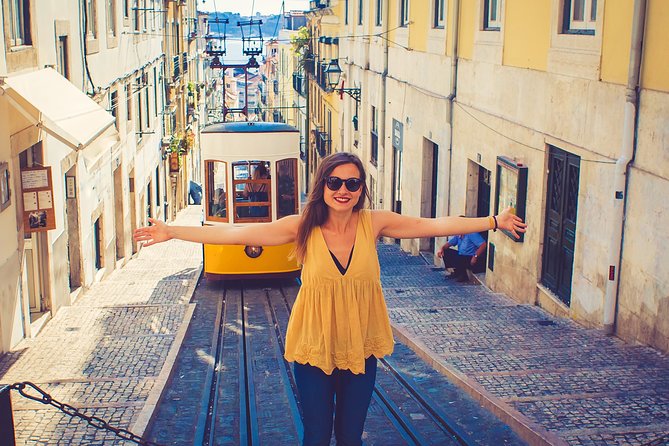
If you’re new to Lisbon, the city can feel like a puzzle with hills. This tour helps you solve it quickly. You begin in Largo do Chiado, then work your way toward Baixa Pombalina and end at Praça do Comércio near the river. The value here is momentum: you’re not just checking boxes, you’re learning the logic of the city as you move through it.
It’s designed for newcomers. You get short, focused stops that give context without forcing you to read wall plaques for an hour. And since it’s private, your guide can adjust the pace to your questions. That matters in Lisbon, where a lot of the magic is in the details—especially in churches and older squares.
At around 2 hours, the schedule is tight but not rushed in a stressful way. It’s more like a guided highlights walk that shows you what to zoom in on later.
You can also read our reviews of more private tours in Lisbon


Chiado’s first stop: Praça Luís de Camões
The tour kicks off at Praca Luis de Camoes, in Chiado, one of Lisbon’s liveliest and historic areas. This is a smart start because Chiado sits at a crossroads of Lisbon identity: it’s old, it’s walkable, and it’s full of places where you’ll want to stop after the tour.
You’ll take a walk through the square and get your first feel for the city’s layout. Squares like this are more than pretty spaces. They’re meeting points and visual anchors. A guide’s job is to point out what to notice: the way streets funnel traffic, how the area connects to nearby neighborhoods, and why this part of town stayed culturally important over time.
Why this works for beginners: before you start climbing your way through Lisbon’s viewpoints and churches, you want a mental map. This stop helps you build it.
Loreto chapel: the Italian merchants story in plain view
Next is the Church of Our Lady of the Loreto of the Italians. The key detail here is the origin story: in the sixteenth century, Italian merchants dedicated a chapel to Our Lady of Loreto. That one line changes how you read the building. It stops being just another small church and becomes a clue about who lived, traded, and prayed here.
This is a short stop, so you’re not meant to linger for an hour of religious study. Instead, you get the essentials: what the chapel represents and why it’s tied to Lisbon’s historic trading life. The payoff is that you learn how Lisbon’s international connections shaped local culture.
If you like places with a clear human backstory, this is one of those stops you’ll remember when you pass similar churches later.
Igreja de São Roque: baroque drama in a Jesuit church
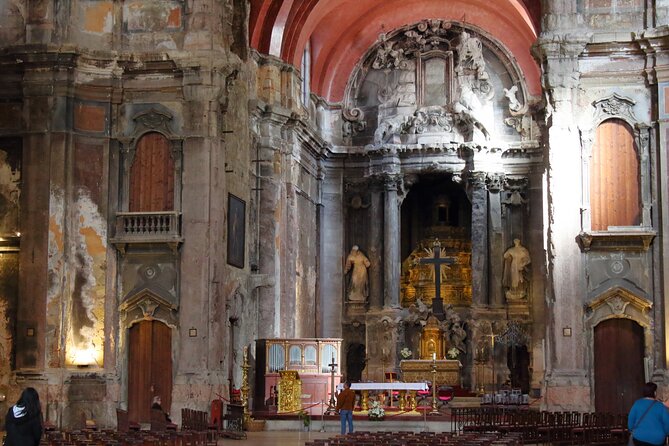
Then comes Igreja de São Roque, a big one. It’s described as the first Jesuit church in the Portuguese empire, and the highlight is the baroque treasure you’ll see from the seventeenth century.
Baroque can be overwhelming if you don’t know what you’re looking at. A good guide makes it manageable by pointing out the visual themes: ornament, power, and the way religious art tried to communicate feeling quickly. Expect the focus to be on the building’s identity as a Jesuit project, not just on fancy decorations.
Practical note: this stop is only about 10 minutes. That’s enough for the main ideas and a look around, but it’s not enough for a slow, deep photo session. Use it as a taste. If you end up wanting more, you’ll know what kind of details to revisit.
Trindade and tile-and-arch Lisbon: monasteries become restaurants
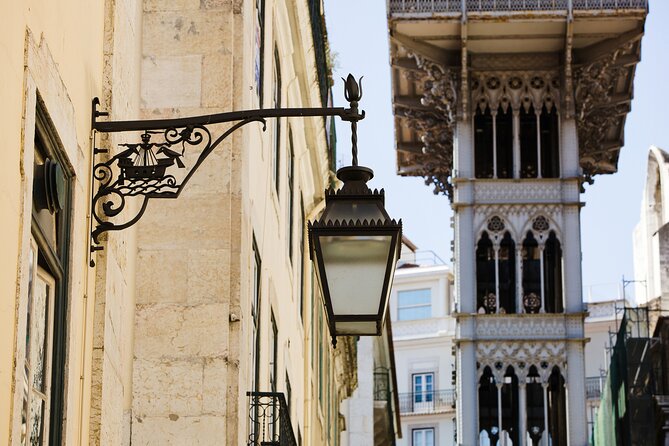
At Trindade, you’ll see a restaurant space famous for its tiles, frescoes, and arches—rebuilt from an old monastery. The interesting thing isn’t just the aesthetics. It’s reuse.
Lisbon has a habit of turning old religious spaces into new civic life. Here, the physical structure tells a story of how the city repurposes what time and history leave behind. A guide’s explanation helps you see the layers: the monastery roots, the later transformation, and how the atmosphere still feels tied to the past.
Since the stop is brief, treat it as a visual reset. You’ve been inside churches. Now you’re seeing how historic art and architecture survive in daily life.




Santa Justa lift: the 1902 engineering moment and the big view
Next is the Elevador de Santa Justa, and yes, it’s worth it. It’s an engineering work from 1902, and the best part is the payoff above. You get a panoramic point over Baixa Pombalina, the Alfama hill area, and São Jorge Castle in the distance.
This is where Lisbon makes sense. From the ground, Lisbon looks like hills and stairs. From a viewpoint, you start understanding why buildings appear in the places they do. You can connect the neighborhood names to the physical terrain, and suddenly future walks feel easier.
How to get more out of this stop: spend your time looking outward, not only at the immediate structure. The guide can help you connect what you see to what you’ll explore next on your own.
The tour includes enough time for the viewpoint, but again, it’s not a half-day. If you’re the type who wants sunrise views or a long sunset linger, you’ll likely add a return visit later.
Largo do Carmo: a shaded pause that changes the pace
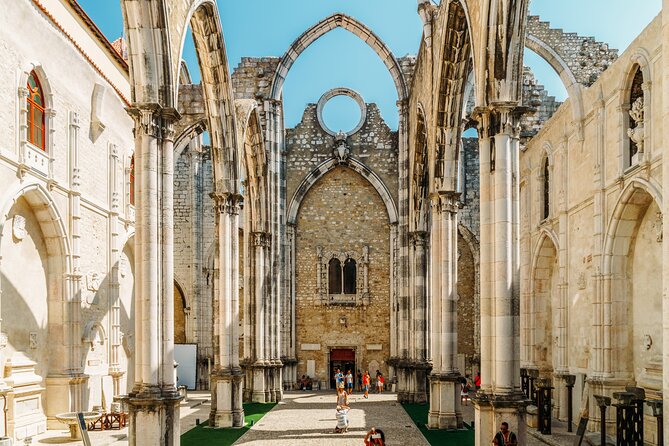
At Largo do Carmo, you take a minute to relax under the trees. This square is charming, and the value of the stop isn’t only the scenery. It’s pacing.
In two hours, you’ll have several interior moments (churches and the museum) and multiple quick exterior stops. A shade break helps you reset your attention. It also helps with practical sightseeing energy—especially if you’re walking in warm weather.
Even though it’s only about 10 minutes, think of it as your mental breather before the heavier historical stop.
Carmo Archaeological Museum: ruins, earthquake history, and skip-the-line ease
This is the stop with the most emotional weight: the Carmo Archaeological Museum. You’ll see the ruins of a gothic temple destroyed in the earthquake that hit Lisbon in 1755. A skip-the-line ticket is included, which matters because waiting inside can steal your time on a tour like this.
The reason this stop hits hard is that it doesn’t ask you to imagine the past. You stand near physical evidence of disaster and rebuilding eras. And because it’s a guided highlight version, you’re not left alone with ruins and silence. You get the essential context: what happened, why it changed Lisbon, and what the site represents today.
Time is around 15 minutes, so don’t expect a full museum experience. Do expect a strong foundation. After you’ve seen the ruins and understood their place in Lisbon’s history, you’ll notice earthquake references and rebuilding themes in other areas later.
If you want a quick but meaningful Lisbon history lesson that still feels hands-on, this museum stop delivers.
Rossio station and Neo-Manueline style: Estacao do Rossio
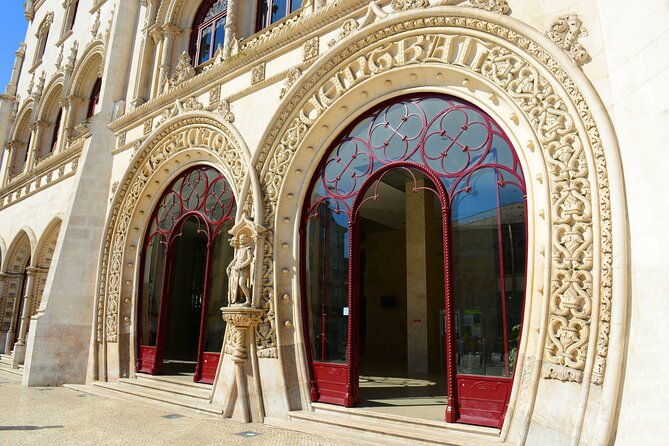
Then you move to Estacao do Rossio, and you’ll see a station in Neo-Manueline style. This is a great contrast to the churches and ruins. It’s Lisbon’s decorative spirit applied to transportation and civic architecture.
Stations are often treated as transit zones, but Lisbon’s style turns them into landmarks. A guide’s explanation helps you spot why the design matters: it’s not just old-world romance. It’s a national look expressed through modern public spaces.
It’s a short stop at about 5 minutes, so focus on two things: the façade and any distinctive details your guide calls out. Then keep moving. This stop works best as a visual cue that Lisbon’s identity shows up everywhere, not only in churches.
Rua Augusta and Praça do Comércio: the arch and the river reveal
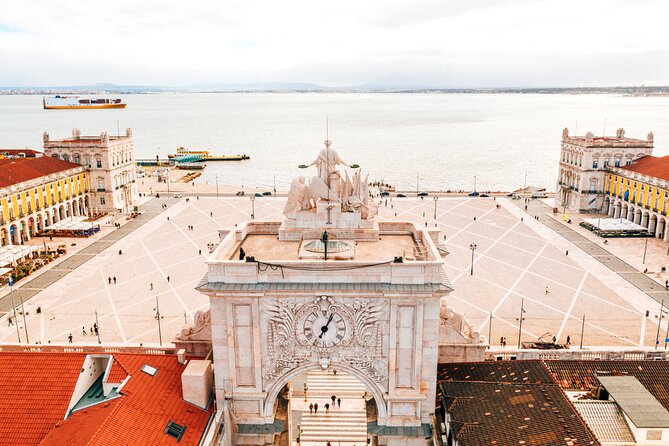
From Rossio, the route brings you onto Rua Augusta, an elegant main street. You’ll see the imposing monumental arch that leads toward Comércio Square.
This is the classic Lisbon photo corridor, but the value on a guided route is timing and meaning. The arch isn’t just an object to frame for Instagram. It’s part of how Lisbon reasserts itself as a city with renewed public space.
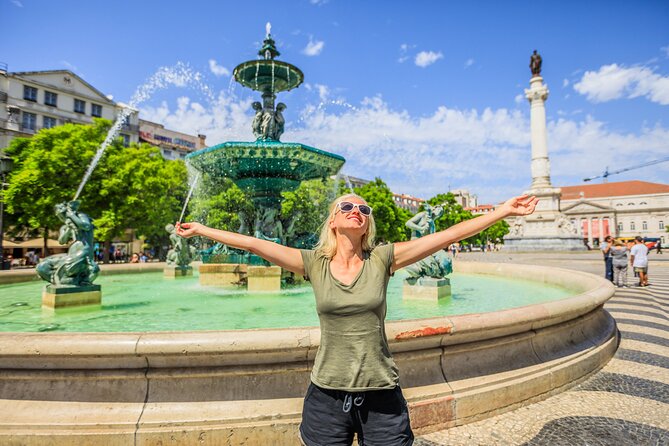
Finally, you reach Praça do Comércio, with its view over the Tejo (Tagus) River and the Cais das Colunas, described as an old footbridge for kings and presidents. That line alone gives you a sense of how this spot functioned as a stage for power and arrival.
You also hear about Masonic symbolism associated with the square entrance. That’s the kind of detail that makes a sight feel real. It turns what could be just a pretty waterfront into a place tied to civic identity.
If you want a simple way to understand Lisbon’s priorities, start here in the square. Everything else you see later clicks into place more easily.
Igreja de S Domingos and Casa do Alentejo: national monument to dining atmosphere
The route also includes Igreja De S Domingos, now a National Monument. You’ll learn about the church’s history and about the square where tragic events occurred in the city. This stop adds depth because it links architecture to national memory.
It’s another quick visit, so you’re not doing a full church tour. But you’re getting what you need to make sense of why the site matters beyond its exterior appearance.
After that, you’ll pass Casa do Alentejo, a historic neo-Moorish and Art Nouveau palace built in the last quarter of the seventeenth century. Today, it’s a distinctive restaurant in Lisbon. Even if you’re not ordering a meal during the tour, you get a sense of the building’s style and why it’s famous locally.
I like these moments because they show Lisbon isn’t only about monuments. It’s also about spaces that still earn their keep in daily life.
The ginjinha stop and ordering like a local
One of the most practical Lisbon moments is tasting ginjinha, described as the most typical Portuguese liquor. You’ll stop at R. das Portas de Santo Antão 6 for this.
This isn’t random. A guide can tell you what ginjinha is and how it fits into Portuguese drinking culture. And it’s a great way to keep your energy up during a sightseeing loop without spending a long time in a sit-down restaurant.
Quick tip for enjoying it: treat it like a tasting, not a full night plan. The tour is short, and you’ll still have viewpoints and walking ahead.
Price and value: what you get for about $82.21
At $82.21 per person for about 2 hours, the price can look either fair or steep, depending on what you compare it to. Here’s the value logic I see:
- You’re paying for organization: the sights are connected into one efficient route across central Lisbon.
- You get guided interpretation, especially for churches and ruins where a little context changes everything.
- The tour includes a museum ticket with skip-the-line for the Carmo Archaeological Museum. That’s a clear, tangible value add.
- It’s private, so it’s not a crowded group pacing experience. Only your group participates.
If you’re the type who likes to understand what you’re seeing before moving on, this kind of tour is cost-effective. If you’d rather roam independently with no guidance and spend extra time in just one place, you might prefer a self-guided day. But for newcomers, this private highlights format is a strong start.
Who this Lisbon tour suits best (and who might want something else)
This tour fits you best if:
- you’re in Lisbon for a short visit and want major highlights without spending your day planning
- you enjoy churches and architecture but want help spotting what matters
- you want history tied to specific buildings, not just general facts
- you prefer a private experience in English
It may feel less ideal if:
- you love long museum time
- you plan to spend hours taking photos at one viewpoint
- you’re looking for deep, step-by-step neighborhood exploration beyond the core landmarks
For most newcomers, it lands in a sweet spot: orientation plus meaning, in a compact timeframe.
Should you book Lisbon Highlights for Newcomers?
I’d book it if you want a first day that feels organized and rewarding. The route ties together Chiado, Santa Justa, Carmo ruins, and the Baixa riverfront into a plan that helps you understand Lisbon’s geography and history fast. The skip-the-line museum stop is a practical win, and the overall pacing suits people who don’t want to waste time.
One more reason to lean yes: the guide style seems to matter here. Feedback includes praise for André, described as enthusiastic about Lisbon and strong at sharing Portuguese history in a friendly, anecdote-driven way. That kind of storytelling is exactly what turns a highlights tour into a memorable orientation.
If you’re ready for a well-timed sampler that sets up what you’ll explore next on your own, this is a solid choice.
FAQ
How long is the Lisbon Highlights for Newcomers private tour?
It’s listed as approximately 2 hours.
What does the tour cost?
The price is $82.21 per person.
Is this a shared group tour?
No. It’s private, so only your group participates.
What language is the tour offered in?
It’s offered in English.
Are tickets included for the sites on the route?
Many stops have free admission. The Carmo Archaeological Museum admission is included, and you’ll use a skip-the-line ticket.
Where does the tour start and end?
It starts at Largo do Chiado, 1200-273 Lisboa, Portugal and ends at Praça do Comércio, 1100-148 Portugal.
Do I get a ticket on my phone?
Yes. The tour includes a mobile ticket.
What is the cancellation policy?
You can cancel for free up to 24 hours in advance of the experience start time for a full refund. Changes made less than 24 hours before the start time aren’t accepted.