REVIEW · AUDIO TOURS
Electric Car with GPS Audio Guide Full Day Tour in Lisbon
Book on Viator →Operated by Lisbon Eco Tours · Bookable on Viator
Lisbon can feel like a maze, but this day tour keeps you moving with a Twizy and GPS audio guide. I love that you get a built-in route to big icons and smaller streets, plus the freedom to pause, reroute, and linger at viewpoints. The main thing to consider is that several of the major sights have admission not included, so your “free time” may turn into ticket lines.
What makes this setup work is that it’s not a stuffy group schedule. You drive, you decide how long you stay, and the audio handles the story while you handle the turns. It’s a fun, practical way to see a lot of Lisbon without needing to memorize every bus and tram stop first.
In This Review
- Key highlights at a glance
- Twizy + GPS Audio: why this format works in Lisbon
- Price and value: what $79.01 covers (and what it doesn’t)
- Before you go: driving license, Twizy logistics, and parking reality
- R. da Madalena start: how the day kicks off
- Mosteiro dos Jerónimos: Manueline architecture and Vasco da Gama’s story
- Torre de Belém: defense, then lighthouse and customs house
- Praça do Rossio and Baixa: Lisbon’s nerve center on foot
- Alfama and the National Pantheon area: old streets and Portuguese identity
- Castelo de São Jorge: a fortress on Lisbon’s highest hill
- Lisbon Cathedral (Santa Maria Maior): Romanesque and earthquake survival
- Terreiro do Paço (Praca do Comercio): the river-facing main square
- 25 de Abril Bridge plus São Vicente de Fora: modern engineering and a patron saint
- Miradouro da Senhora do Monte: the high viewpoint that earns its time
- Bairro Alto: São Roque Church and the remains of Europe’s big earthquake moment
- How to pace your day: keep it fun, not frantic
- Should you book this Lisbon Eco Tours GPS Twizy day ride?
- FAQ
- How long is the Electric Car with GPS Audio Guide full day tour in Lisbon?
- Where does the tour start and end?
- Is this tour guided by a person or by GPS audio?
- What language is the GPS audio guide in?
- Do I need to pay for admission at the main attractions?
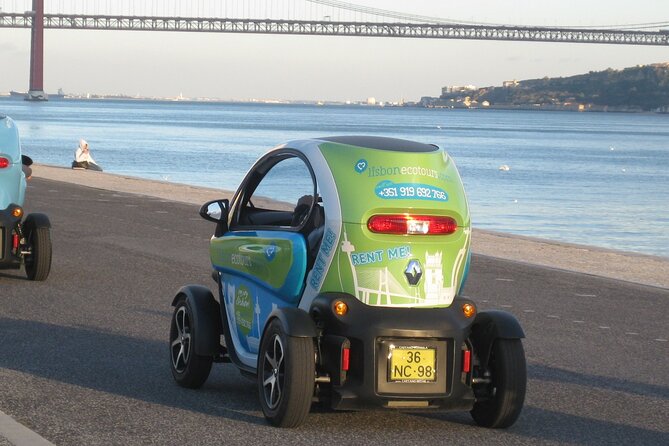
- What car do I drive?
- Do I need a driving license?
- Is there a security deposit?
- What’s included in the price?
- Are food and drinks included?
Key highlights at a glance
- GPS audio that drives the day so you can focus on the streets, not the map
- Private Twizy time with just your group, plus parking and insurance included
- UNESCO hits in a single loop including Jerónimos and Torre de Belém
- Castelo de São Jorge + multiple miradouros for serious views without extra planning
- Built-in orientation of Baixa, Alfama, and Bairro Alto so you understand the city’s layout
Twizy + GPS Audio: why this format works in Lisbon
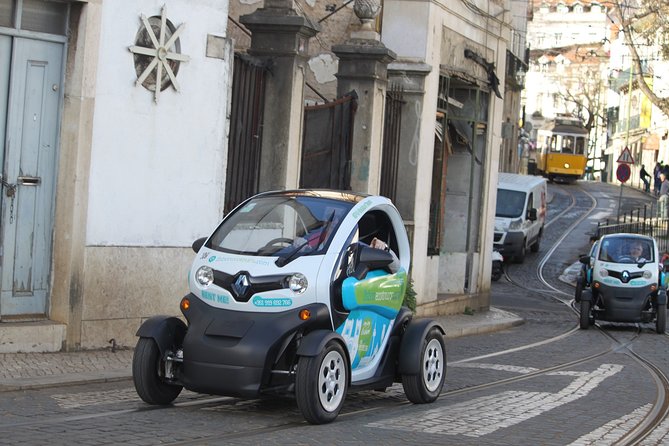
Lisbon runs on hills, viewpoints, and neighborhood vibes. The beauty of this tour format is that you don’t need to “design a route” first. A GPS audio guide handles the navigation and tells you what you’re seeing as you go, so you can treat the day like a self-guided tour with training wheels.
The Twizy setup also changes the feel of the city. Instead of cramming onto a bus or fighting for rides between far-flung spots, you zip between areas and park close enough to walk. It’s especially helpful in Lisbon because a scenic viewpoint can be only a few turns away, but a public-transport journey might take much longer.
And since it’s designed for independent exploration, you’re not stuck doing the same pace as a big crowd. If you want more time at a viewpoint, you can. If a church doesn’t grab you that day, you can skim and move on.
You can also read our reviews of more guided tours in Lisbon



Price and value: what $79.01 covers (and what it doesn’t)
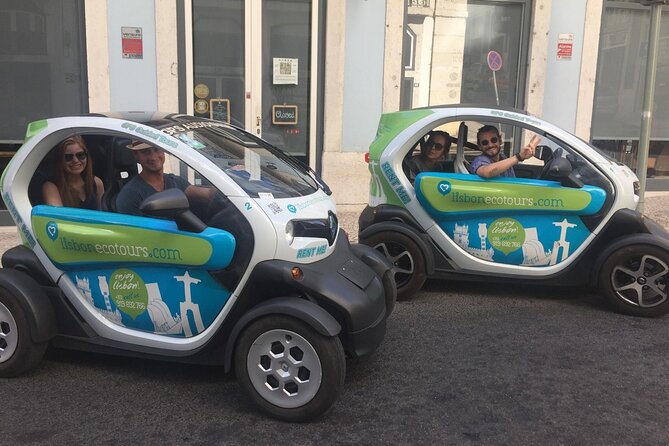
At about $79.01 per person for roughly 6 hours, the value is in the mix: a private eco car experience plus GPS audio, free parking, and car insurance. For many people, the cost makes sense because you’re not paying separately for transportation, and you’re not boxed into a fixed guided narrative all day.
What’s not included is also important:
- Food and drinks (you’ll need to plan your own breaks)
- Several big-ticket entrances (Jerónimos Monastery, Torre de Belém, São Jorge Castle, Lisbon Cathedral, and other stops marked as not included)
So I’d think of this as a “transport + stories + stops” day, not a “everything’s included” sightseeing pass. If you plan to go inside every church and castle, budget more. If you’re happy soaking up exteriors and viewpoints, you can keep costs tighter.
One more cost consideration: there’s a 150€ security deposit in cash held until the Twizy is returned. Bring that with you, or at least make sure you can access it.
Before you go: driving license, Twizy logistics, and parking reality
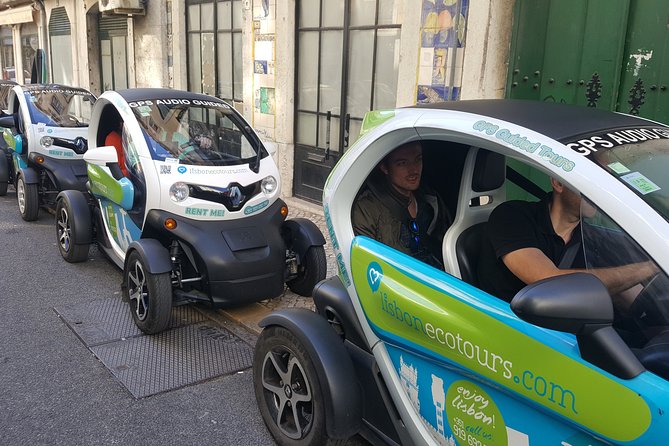
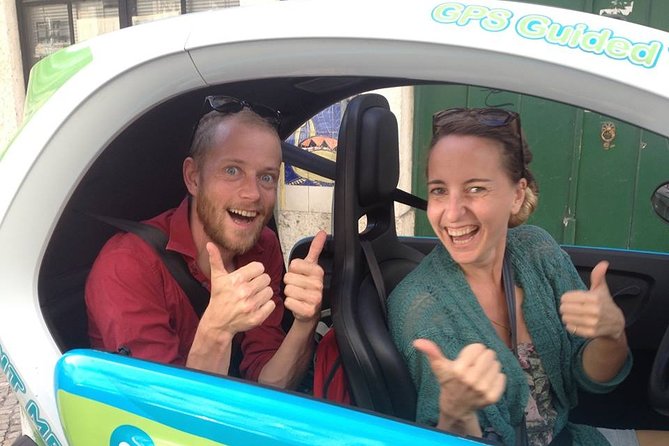
This tour is designed around driving a two-seater Twizy. A driving license is required, and children under 18 must be accompanied by an adult. If you’re the type who hates narrow streets or steep corners, take that seriously—this is a driving experience, not a passenger-only ride.
On the good side, the tour includes free parking and car insurance, and the meeting point is near public transportation. You’re also using a mobile ticket, which keeps the start process straightforward.
Practical tip: because you’ll be moving between neighborhoods, you’ll want to wear shoes you can walk in, even if your car does most of the work. Lisbon’s charm is built for strolling, not standing still.
R. da Madalena start: how the day kicks off
The tour meets at R. da Madalena 67, 1100-318 Lisboa and ends back at the same place. Expect a short check-in style start, then you’re off.
This matters because Lisbon’s best sightseeing tends to be scattered—downtown, then up toward Alfama and the castle hill, then back toward the river and viewpoints. Starting in central Lisbon makes the loop feel efficient instead of like you’re backtracking all day.
Also, because it’s private, you’ll have less pressure to “keep up” or wait for a long walking line. Your group can usually set a comfortable pace from the first hour onward.
Mosteiro dos Jerónimos: Manueline architecture and Vasco da Gama’s story
Your first major landmark is Mosteiro dos Jerónimos (Jerónimos Monastery), a UNESCO World Heritage Site since 1983. This is one of Lisbon’s big names, and the audio context helps you notice details you might otherwise miss.
A few specifics worth listening for:
- It was designed by Portuguese architect Diogo de Boitaca
- It commemorates the return of Vasco da Gama
- Construction began 6 January 1501 and wasn’t finished until the 17th century
- The style is mainly Manueline (Portuguese late Gothic)
One cool historical link you’ll hear is that the monastery sits on the site of the earlier Ermida do Restelo, a chapel where Vasco da Gama and sailors prayed before leaving for India.
You get about 1 hour here, and admission is not included. That means your choice is simple: either plan to enter and pay, or stay focused on the exterior and the surrounding area. If you’re trying to keep the day moving, the audio still pays off even if you don’t go deep inside.
You can also read our reviews of more tours and experiences in Lisbon






Torre de Belém: defense, then lighthouse and customs house
Next is Torre de Belém (Belém Tower), also UNESCO-protected since 1983. You’re looking at a Manuelino masterpiece built between 1514 and 1520, created by Francisco de Arruda.
The tower’s job changes over time, and that’s part of what makes it interesting:
- Built on the northern bank of the Tagus River
- Used for defense
- Later transformed into a lighthouse and customs house
You’ll have about 45 minutes, with admission not included. If you decide not to pay for interior access, you can still get a lot from the way the tower sits at the waterline, plus the river views the area offers.
Practical note: this is a popular stop. Don’t assume you’ll rush through. Even if you’re only doing exterior viewing, give yourself enough time to breathe and take photos without feeling rushed.
Praça do Rossio and Baixa: Lisbon’s nerve center on foot

From the Jerónimos/Belém side of the day, you swing toward the city’s core with Praça do Rossio (officially Praça de D. Pedro IV). This is described as Lisbon’s nerve center, in the Baixa neighborhood near Rua Augusta and close to Restauradores Square.
What makes Rossio a great stop on a day like this:
- It’s lively and easy to read: people, shops, restaurants, street energy
- It works as a quick orientation moment after you’ve been seeing grand monuments
- You can take breaks here without committing to a museum time schedule
The audio + GPS help you understand where you are in Lisbon’s layout. And because it’s a public square, there’s no “ticket decision.” You can simply walk around, look for a place to stop, and keep the pace you want.
Alfama and the National Pantheon area: old streets and Portuguese identity
You then move into Alfama, one of Lisbon’s most genuine neighborhoods. The focus here is on the look and feel: old buildings, colorful streets, and a sense of tranquility that’s different from the central squares.
Right around this area, you’ll also get context tied to the National Pantheon: it’s described as a symbol of Portuguese identity that honors the country’s great men and women. It’s the kind of detail that turns a stop from just scenery into a clearer picture of what Lisbon values and remembers.
No matter what you choose to do inside (admission details aren’t provided here), this part of the tour is about changing gear. In practical terms, it’s where you feel Lisbon shift from “monument day” to “neighborhood day.” Give yourself a slower walk and let the hills guide you.
Castelo de São Jorge: a fortress on Lisbon’s highest hill
Then comes Castelo de São Jorge (São Jorge Castle). This is one of Lisbon’s emblematic landmarks, sitting on São Jorge hill, the highest point in Lisbon. The silhouette is dramatic by day and by night, and the audio context makes it easier to see why it matters.
The castle’s history is layered:
- A small fortress was built by the Visigoths in the 5th century
- The Moors modified and enlarged it in the mid-11th century
- During Afonso I of Portugal (1109–1185) it was altered and later became a Royal Palace
- It was completely restored in 1938
You get about 1 hour here, and admission is not included. This is one of the stops where I think you should decide early what kind of visit you want:
- If you love history and walls and can handle an entrance fee, go inside and take your time.
- If your priority is views and photos, you might spend more time outside and treat the castle as a viewpoint stop.
Either way, this is the part of the day where your earlier navigation pays off. You’re not just seeing Lisbon; you’re understanding where the neighborhoods sit around the hill.
Lisbon Cathedral (Santa Maria Maior): Romanesque and earthquake survival
Next is Lisbon Cathedral, officially Santa Maria Maior. Construction dates from the 12th century, and the style is predominantly Romanesque.
A key story you’ll hear is how it survived major disasters, including the 1755 earthquake, which left part of the religious edifice in ruins. Over the centuries, renovations and rebuilds shaped what you see today.
You’ll have about 45 minutes, and admission is not included. If you’re on your feet from castle hill already, this is a solid “finish with meaning” stop. You get a focused, historical interior option without turning the day into an all-museum marathon.
Terreiro do Paço (Praca do Comercio): the river-facing main square
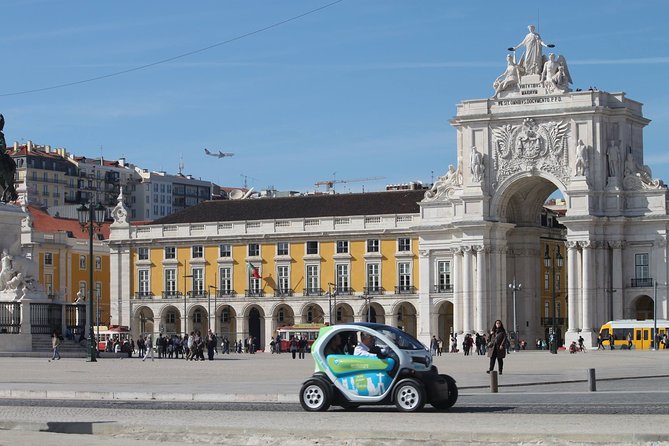
You’ll head to Praça do Comércio, also called Terreiro do Paço (Commerce Square). It’s Lisbon’s main square and built on the site where an old Royal Palace stood before the 1755 earthquake destroyed it.
What you’ll notice quickly:
- The southern side opens to the Tagus River
- The other three sides have yellow-colored buildings with arcades along the façade
- It used to function like the “door” to Lisbon for commercial ships unloading goods directly onto the square
You’ll also be near Cais de Sodré ferry terminal, where ferries depart down the Tagus.
You get about 45 minutes, and admission is not included because this is a square. This stop is a good reset. After hours of hills and monumental buildings, you can stand, breathe, and watch the river traffic.
25 de Abril Bridge plus São Vicente de Fora: modern engineering and a patron saint
Lisbon closes this loop with two very different tones.
First, you’ll pass the 25th April Bridge (Ponte 25 de Abril), described as the longest suspension bridge in Europe. It has two levels: cars on top, and trains on the lower level (added in 1999). It opened on 6 August 1966 and was initially named Salazar Bridge, after António de Oliveira Salazar. After the Carnation Revolution in 1974, it was renamed for April 25.
Then the tour continues to Igreja de São Vicente de Fora and its monastery. This is a historic building tied to Lisbon’s patron saint São Vicente, honored in the city since 1173. The origins go back earlier, but the present building was built between 1582 and 1629.
You’ll have about 30 minutes, with admission not included. This is a great balance after the bridge. You go from engineering and scale to faith, tradition, and the kind of quiet that appears when you step away from the main roads.
Miradouro da Senhora do Monte: the high viewpoint that earns its time
Lisbon is called a city of seven hills for a reason, and this tour puts you at one of the top viewpoints: Miradouro da Senhora do Monte in the Graça neighborhood. You’ll get about 25 minutes here.
The description is clear: this viewpoint offers a unique panoramic view and is highlighted as one of Lisbon’s most beautiful, especially because it sits on one of the city’s highest points.
If you like photos, plan to spend a few minutes just watching light shift. If you’re not a photo person, treat it as a “data moment” for your brain: you’ll connect the neighborhoods you visited to the layout you’re looking down at.
Bairro Alto: São Roque Church and the remains of Europe’s big earthquake moment
The last stretch heads to Bairro Alto, with a connection to Chiado as part of the same bohemian area vibe. You’ll find restaurants, bars, shops, and theaters here, plus an interesting past that shows up in the architecture and stories.
The audio guides you to the São Roque Church, encourages you to enjoy a stunning viewpoint, and points out the remains of the greatest earthquake in modern Europe.
You’ll have about 45 minutes, and admission is not included. This is a nice way to end the day because it ties Lisbon’s “big monument” theme back to something human—damage, repair, and the layers that survived.
After this stop, you return to the meeting point, finishing back where you started.
How to pace your day: keep it fun, not frantic
A GPS tour can turn into a checklist if you don’t actively manage time. I’d use a simple approach:
- Pick one “must-enter” sight (Jerónimos, São Jorge, or the Cathedral), and treat the rest as “see from the outside” unless you’re still fresh.
- Build in short breaks in public squares like Praça do Rossio and Terreiro do Paço so you’re not only walking between entrances.
- Plan your food around convenience because food and drinks aren’t included. Keep snacks or a simple meal option in mind so you’re not making rushed decisions later.
Also, because you’re driving, your energy matters. Lisbon’s hills are part of the charm, but they can be tiring. Don’t try to win the day by racing from stop to stop. Use the audio time to learn, then let your feet set the pace.
Should you book this Lisbon Eco Tours GPS Twizy day ride?
I think you should book it if you want a practical, low-stress way to hit major Lisbon landmarks while still feeling free. The combination of private Twizy time, GPS audio guidance, and a route built around recognizable sights makes it easy to understand the city fast—without the rigidity of a traditional guided tour.
Skip it (or at least think twice) if you don’t want to drive, you lack a driving license, or you’re hoping for an “all entrances included” sightseeing day. The 150€ cash deposit and the fact that several attractions have admission not included can change the real total cost.
If your goal is orientation plus memorable sights—Jerónimos, Belém, castle views, cathedral stops, and viewpoints—this is a strong value way to do it.
FAQ
How long is the Electric Car with GPS Audio Guide full day tour in Lisbon?
It lasts about 6 hours (approx.).
Where does the tour start and end?
It starts at R. da Madalena 67, 1100-318 Lisboa, Portugal and ends back at the same meeting point.
Is this tour guided by a person or by GPS audio?
It includes a GPS audio guide and you follow the route independently using that guidance.
What language is the GPS audio guide in?
The tour is offered with English audio.
Do I need to pay for admission at the main attractions?
Some stops include admission and some do not. The tour lists admission ticket included at the starting point, while places like Mosteiro dos Jerónimos, Torre de Belém, Castelo de São Jorge, and Lisbon Cathedral are marked as admission ticket not included.
What car do I drive?
The tour uses a Twizy, which is a two-seater car.
Do I need a driving license?
Yes, a driving license is required.
Is there a security deposit?
Yes. A 150€ security deposit in cash is held until the Twizy is returned.
What’s included in the price?
Included are the GPS audio guide, time to stop at the points of interest, free parking, and car insurance.
Are food and drinks included?
No. Food and drinks are not included.