REVIEW · CRUISES & BOAT TOURS
Sailing tour to the sunset in Lisbon
Book on Viator →Operated by Bloo Boat Charter · Bookable on Viator
A Lisbon sunset sail turns the river into a moving viewpoint. This one pairs a classic sailboat feel with guided stops you’d normally drive between, from Belém monuments to Cristo Rei. I especially liked the friendly crew and the calm pace that leaves time to take photos and ask questions, and I also liked the onboard context that ties what you see to Lisbon’s maritime story. The main thing to consider is that this experience depends on good weather, so plan for wind and occasional chill.
You’re paying about $45.66 for roughly 2 hours, and the value is in what’s included: fuel, welcome drink, light snacks, and the full set of fees and taxes. It’s also kept to a small group (max 12), which means the boat doesn’t feel like a human shuffle line. One drawback: you’re not getting a full meal, so bring a plan for dinner afterward.
In This Review
- Key Highlights You’ll Actually Notice
- Why a Lisbon Sunset Sail Changes the Way You See the City
- Getting On Board: Bloo Boat Charter Practical Setup
- Sunset Sail Value: What $45.66 Really Buys You
- National Monument to River Views: Infante Dom Henrique’s Story in Stone
- The Artillery Ship Idea: Lisbon’s Departures for the Indies
- Central Tejo to MAAT: Industrial Lisbon at Golden Hour
- Jerónimos Monastery From the River: Manual I’s Monumental Late-1500s Feel
- The 25 de Abril Bridge: A Huge Structure With Political Meaning
- Praça do Comércio and Baixa: Lisbon’s Grand Arrival Steps
- Lisbon Cathedral to Sé: The Mix of Styles You Can Spot Even From Far Away
- Alfama at Dusk: Fado, Tiny Streets, and the Arabic Meaning
- Cristo Rei: The Sacred Heart Sanctuary’s Giant Scale
- The Boat Experience: Relaxed, Not Crowded, With Room to See
- What to Bring (So the Sunset Feels Easy)
- Who This Lisbon Sunset Sail Is Best For
- Should You Book This Lisbon Sunset Sail?
- FAQ
- How long is the Lisbon sunset sailing tour?
- What is the meeting point for the tour?
- Are meals included?
- What does the tour include?
- Is there a mobile ticket?
- How many people are on the boat?
- What happens if the weather is poor?
Key Highlights You’ll Actually Notice
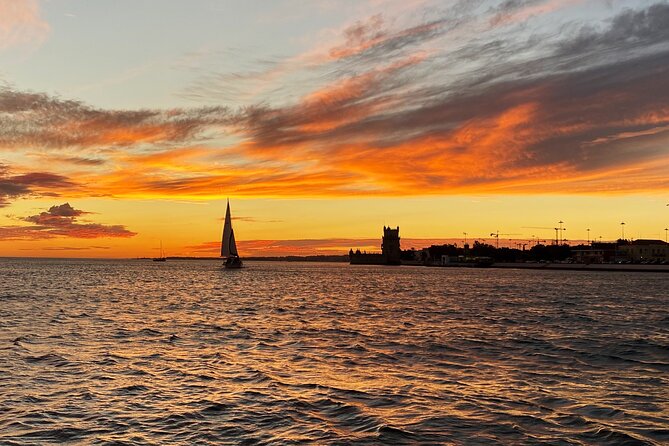
- Small group size (max 12) makes it easy to move around for the best sunset angles
- Multilingual crew (Portuguese, English, French, Spanish) keeps explanations clear
- Belém-to–Baixa sights from the Tagus means you skip the long travel shuffle
- Industrial architecture stop with MAAT (Central Tejo + New Building) adds variety beyond churches
- Sunset pacing is designed for relaxing, not rushing through landmarks
Why a Lisbon Sunset Sail Changes the Way You See the City
Lisbon has a talent for looking best when the light softens. On land, the city can feel like it’s asking you to choose between hills, streets, and crowds. On the Tagus at sunset, that pressure fades. The river gives you a wider frame, and suddenly even familiar neighborhoods feel new—because you’re seeing them the way the city’s ships and bridges have always interacted with it.
This is the kind of tour where you can sit back, but you don’t stay clueless. The crew shares information as you go, so the monuments aren’t just pretty silhouettes. You also get a relaxed flow: a couple of landmark “moments,” snack breaks, and time to watch the sky change color without a packed schedule.
If you’re the type who enjoys details—designers, construction eras, what something replaced, why it was built—you’ll get more out of this than a simple sightseeing cruise. And if you just want a calm evening with good views? You’ll still be happy.
You can also read our reviews of more boat tours in Lisbon



Getting On Board: Bloo Boat Charter Practical Setup

This sail runs out of Bloo Boat Charter at Doca do Bom Sucesso, gate 3 (1400-038 Lisboa). The good news is that it’s near public transportation, so you’re not locked into a taxi-only plan. You also get a mobile ticket, which makes check-in less of a hassle.
The total time is about 2 hours. That’s long enough to feel like you did something special and short enough that it won’t crush your evening plans. It’s also booked relatively far in advance on average, so if sunset timing matters to you, I’d book early rather than playing chicken with the calendar.
Inside the experience, the included items are straightforward and useful:
- Welcome drink
- Light snacks like peanuts, cashews, and fried corn
- Crew + fuel + all fees and taxes
- No meals
The crew speaks Portuguese, English, French, and Spanish, so you’re not stuck on a translation workaround if your preferred language isn’t the default.
Sunset Sail Value: What $45.66 Really Buys You
At about $45.66 per person, you’re paying for more than movement on water. You’re buying a package that removes a lot of “extra costs” that tend to creep in when you plan your own route: transport between major riverside landmarks, paid entry tickets (not included here), and the time you’d spend syncing schedules.
The inclusion list also makes the experience feel complete for its length. The welcome drink and snack assortment are exactly what you want on a cool-to-chilly evening when you don’t want to commit to a full sit-down meal yet. And because the group is capped at 12, the vibe stays more personal and less crowded.
Here’s the trade-off: you should treat this as a scenic, guided river experience, not a dinner cruise. If you tend to get hungry, plan a real meal afterward.
National Monument to River Views: Infante Dom Henrique’s Story in Stone
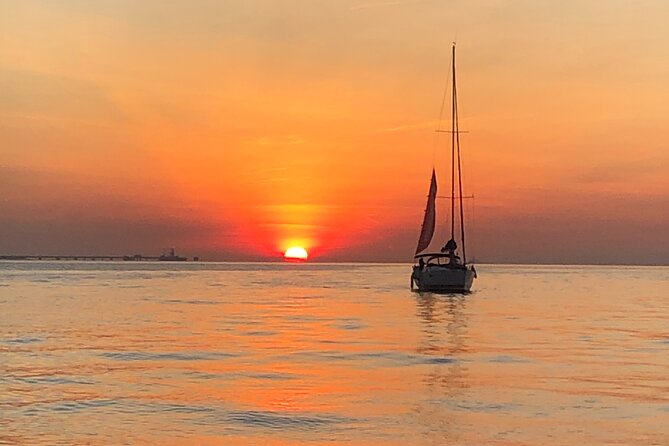
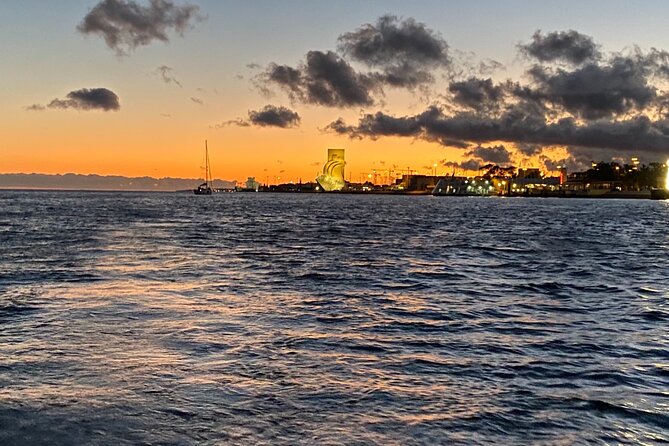
One of the early sights is the National Monument dedicated to Infante Dom Henrique, also known as the Navigator. This matters because it frames what you’re about to see: Lisbon built much of its global reach on navigation, and this monument is designed to make that point visible.
You’ll learn two useful architectural details right away:
- The architectural design is by Cottinelli Telmo
- The sculptures are by Leopoldo de Almeida
The monument also features a central statue of Infante Dom Henrique holding a model of a caravel. On top of that, the ramps include 32 figures connected to the history of the discoveries. From the river, this kind of scale can be hard to appreciate if you’re viewing from one angle. Seeing it from the Tagus helps you understand how the city “faces” the sea.
A practical note: monuments like this can look different depending on angle and cloud cover. Sunset light can exaggerate or soften details, so if photos are a priority, stay positioned and don’t be shy about adjusting your spot when the crew gives you a good viewing moment.
The Artillery Ship Idea: Lisbon’s Departures for the Indies
Another stop brings you to a structure intended to replace an old artillery ship anchored along that stretch of water. The location is described as a rocky outcrop in the river, opposite the old beach of Belém.
The key story here is not just the object itself, but what it represents: this was meant to support the way Lisbon’s fleets departed for the Indies. It’s a reminder that maritime power isn’t only about trade routes; it’s about defense, logistics, and engineering.
The works were carried out by Diogo Boitaca, who also directed advanced works of the neighboring Jerónimos Monastery. That connection is one of the reasons I like this segment: it links the “religious landmark” side of Belém with the practical, ship-and-stone side of Portuguese expansion.
If you’re the kind of person who likes seeing how different eras connect, this stop does that. If you’re expecting a hands-on museum explanation, you might find it more like a guided viewpoint—short, focused, and designed to keep the sail moving.
You can also read our reviews of more evening experiences in Lisbon




Central Tejo to MAAT: Industrial Lisbon at Golden Hour
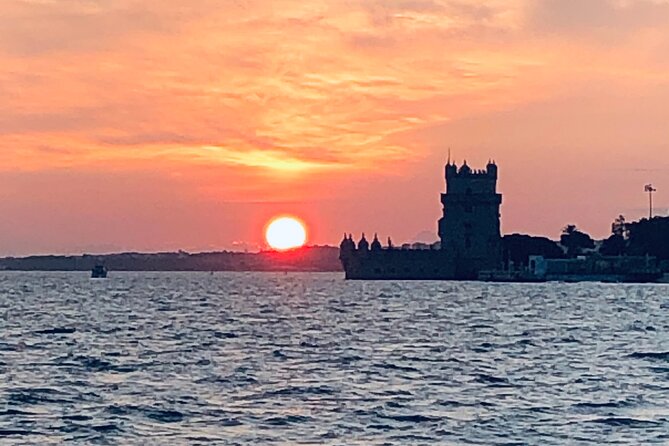
Next up is an area where Lisbon does something unusual: it lets an industrial building share space with contemporary culture.
You’ll see Central Tejo, also called Central Tejo / Central Tagus, built between 1908 and 1951. It represents an old thermoelectric power station that supplied electricity to Lisbon and its region. The structure is described as a unique piece of Lisbon’s architectural panorama and one of Portugal’s best examples of industrial architecture from the first half of the 20th century.
Right alongside that is MAAT, the contemporary art museum. MAAT is made up of two poles: the old Central Tagus and the New Building. Even if you don’t go inside, the fact that it’s integrated into a former power station gives you a stronger sense of how Lisbon repurposes space rather than simply replacing it.
This is also where the river angle pays off. Industrial buildings can feel flat from streets. On the water, they gain height and geometry, and you can appreciate why they’re considered architectural standouts.
One practical thought: if you’re visiting MAAT later on another day, this sailing viewpoint can help you decide what to prioritize. On the sail, you’re getting context; on foot, you can get the detail.
Jerónimos Monastery From the River: Manual I’s Monumental Late-1500s Feel

Belém’s Jerónimos Monastery is the big name, and it shows. It was built at the end of the 15th century by King Manuel I. The monastery is classed as a National Monument since 1907 and was designated UNESCO World Heritage in 1983, together with the Tower of Belém.
There’s also a popular recognition point: on July 7, 2007, it was elected one of the seven wonders of Portugal.
From a boat, you don’t get the up-close stone work the way you would inside the complex, but you do get something important: scale. You’re viewing it as part of a riverside corridor where ships, pilgrims, and rulers once all moved through the same direction. The river ties the monastery to the city’s maritime identity.
If you’re hoping for a long stop to walk around, adjust your expectations. This is primarily a sailing and viewing experience with onboard commentary. Think of it as the best possible warm-up for a fuller Belém visit later.
The 25 de Abril Bridge: A Huge Structure With Political Meaning
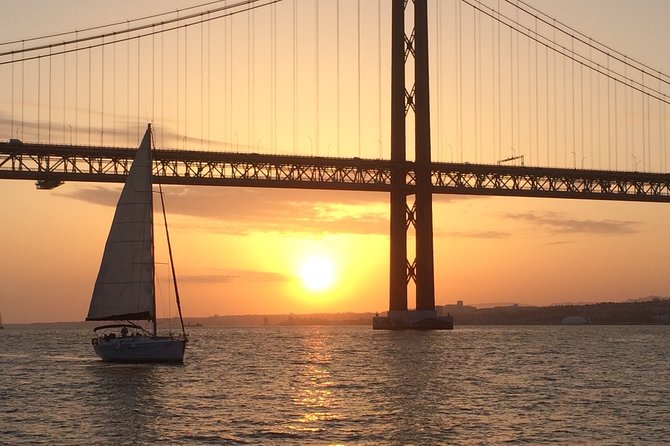
Then the sail brings you to the 25 de Abril Bridge, a suspension road-rail bridge over the Tagus that connects Lisbon (north bank) to Almada (south bank).
Here’s why it’s more than just a cool shape:
- Until 1974, it was called Ponte Salazar
- The name 25 de Abril refers to the revolution of April 25, 1974
- Construction began November 5, 1962
- It was inaugurated August 6, 1966
Seeing it at sunset is satisfying because the bridge becomes a silhouette and then a glowing framework as the light fades. It’s also a great landmark for orientation. Even if you haven’t memorized Lisbon’s layout, the bridge gives your mind an anchor point for where you are on the river.
Praça do Comércio and Baixa: Lisbon’s Grand Arrival Steps
As the sail moves toward downtown, you’ll pass Praça do Comércio (also known historically as Terreiro do Paço). This is Lisbon’s big, formal greeting.
The square was home to the Portuguese kings’ palace for about two centuries, and now it’s partially occupied by government departments. The square is described as one of the biggest in Europe, and it used to be the noblest entrance to the city.
From the water, look for the idea of arrival: prominent figures disembarked on the marble steps of Cais das Colunas. The placement matters. It tells you why this area was meant to impress power and ceremony as much as it was meant for everyday movement.
Two landmarks to keep an eye out for:
- In the center: an equestrian statue of D. José, erected in 1775 by Joaquim Machado de Castro
- On the north side: the Triumphal Arch of Rua Augusta, which is the entrance to Baixa
This is a stop that clicks if you like architecture and civic design. It can feel a bit formal if you’re more into cozy street life, but sunset softens the grandeur and makes it feel human again.
Lisbon Cathedral to Sé: The Mix of Styles You Can Spot Even From Far Away
Next is the Cathedral of Lisbon, also called Church of Santa Maria Maior and known as the Parish of Sé. It’s the seat of the Patriarchate of Lisbon and a major church for the city.
Construction began in the second half of the 12th century, after Lisbon was conquered from the Moors by D. Afonso Henriques. Today it presents a mix of architectural styles, and it’s been a National Monument since 1910.
From a boat, you won’t get a close view of ornamentation, but you can still appreciate the silhouette and the way parts of the structure look layered across centuries. This is the kind of architectural mixing that makes Lisbon feel like a living timeline instead of a single period postcard.
Alfama at Dusk: Fado, Tiny Streets, and the Arabic Meaning
When the sail heads into the region of Alfama, you’re no longer looking at just buildings. You’re looking at a neighborhood identity.
Alfama is Lisbon’s oldest and one of its most typical neighborhoods. The name is said to come from Arabic al-hamma, meaning fountain of warm waters or good waters. It’s also described as the smallest neighborhood in all of Lisbon.
Alfama is known for restaurants and fado houses, and it has big festive traditions tied to Santos Populares, especially the night of Santo António (June 12 to 13).
From the water, you’ll catch the neighborhood as texture: roofs, slopes, and the tight geometry that suggests why it’s such a strong fado zone. If you want, you can use this as your “memory map” for later walking. When you’re on foot the next day (if you are), Alfama will make sense faster because you already saw it from this vantage.
Cristo Rei: The Sacred Heart Sanctuary’s Giant Scale
The final highlight leans dramatic—Cristo Rei, the National Sanctuary dedicated to the Sacred Heart of Jesus.
It’s located at 133 meters above the level of the Tagus. The structure includes:
- A 75-meter high portico designed by António Lino
- A statue of the Holy Redeemer with open arms facing Lisbon, 28 meters high, designed by Francisco Franco de Sousa
At sunset, this kind of scale feels almost theatrical. It’s visible in a way that smaller monuments just can’t match. And because it’s explicitly facing Lisbon, it gives you a clear directionality to the city’s story: Lisbon facing outward, then back again toward itself.
If your ideal evening includes a wow moment—something you’ll remember even after you’ve left the river—Cristo Rei is that moment.
The Boat Experience: Relaxed, Not Crowded, With Room to See
A big part of why this sail works is the feeling onboard. The max group size of 12 travelers keeps it from turning into a packed experience where you’re stuck behind strangers for the best sunset angles. I like tours where you can actually move and find a view rather than “hope” the person in front of you moves first.
The crew’s attitude is another major plus. You’ll get clear guidance and friendly handling, and the pace stays calm. On at least one sail, the crew even adjusted timing to watch dolphins when they appeared. That’s a good sign: it means the crew isn’t just reading a script. They’re paying attention to what’s happening on the water.
What to Bring (So the Sunset Feels Easy)
Because the tour is weather-dependent and runs on a river, plan like it’s a late-day sail:
- Bring a layer for wind and chill
- Consider sunglasses (sun can bounce off the water)
- If you’re camera-focused, keep your lens or phone accessible so you can react to changing light
You’ll have snacks and a welcome drink, so you don’t need to pack a full picnic. But you should still plan to eat dinner afterward since no meals are included.
Who This Lisbon Sunset Sail Is Best For
This tour is a smart choice if:
- You want Lisbon highlights in one evening without the stress of hopping across town
- You like guided context, not just scenery
- You enjoy architectural details and how they connect to Lisbon’s maritime story
- You’d rather end the day on the water than go back out for more walking
It’s also a great “first day” option or “last evening” option. First day, it helps you understand where things sit along the Tagus. Last evening, it’s the calm send-off.
If you prefer a deep, museum-style visit where you spend an hour inside one place, you might find this too light. This is sightseeing from the river with commentary, designed for relaxation over long stops.
Should You Book This Lisbon Sunset Sail?
I’d book it if you want a calm, guided Tagus sunset with a small-group feel and a route that hits the kinds of landmarks that are harder to string together efficiently by yourself. The value is strong for a short evening: welcome drink, light snacks, fuel and fees handled, and a crew that speaks multiple languages.
Skip it (or at least reconsider) only if you’re not comfortable with weather-dependent outdoor plans, or if you’re expecting a full meal and long on-land walking time at each landmark. Otherwise, this is the kind of Lisbon experience that makes the city feel big in the best way—because the river brings it all together.
FAQ
How long is the Lisbon sunset sailing tour?
The tour lasts about 2 hours.
What is the meeting point for the tour?
The start point is Bloo Boat Charter at Doca do Bom Sucesso, gate 3, 1400-038 Lisboa, Portugal. The tour ends back at the meeting point.
Are meals included?
No meals are included. Light snacks and a welcome drink are included.
What does the tour include?
Included items are safe, crew, fuel, a welcome drink, all fees and taxes, light snacks (peanuts, cashews, fried corn), and a crew that speaks Portuguese, English, French, and Spanish.
Is there a mobile ticket?
Yes, the tour uses a mobile ticket.
How many people are on the boat?
The maximum group size is 12 travelers.
What happens if the weather is poor?
This experience requires good weather. If it’s canceled due to poor weather, you’ll be offered a different date or a full refund.