
REVIEW · ALFAMA & OLD TOWN TOURS
Lisbon: Baixa Chiado Quarter Walking Tour
Book on Viator →Operated by Vox City International Ltd · Bookable on Viator
Lisbon’s best center-city walk is only two hours. This Baixa–Chiado tour strings together landmark sights and real neighborhoods, from Praça do Comércio to Rossio, with elevator views along the way. I like that it mixes famous buildings with streets you can actually picture yourself strolling, not just snapping photos. You’ll also get the Vox City app map so you can keep exploring on your own after the walk.
I really like the way the route spotlights Lisbon’s “up and down” city design. You’ll see the Santa Justa and Bica elevator area right where Lisbon’s hills force you to slow down, look up, and appreciate the engineering. And stops like Bertrand’s Bookstore and the Carmo Convent ruins add stories you can connect to what you’re seeing on the pavement.
One possible drawback: the walk is planned as a tight circuit. If your group slows down or asks lots of questions in one spot, timing can feel stretched and the tour may feel less relaxed than you expected—especially if you were hoping for extra time to linger at every ruin and viewpoint.
In This Review
- Key highlights you’ll care about
- Why Baixa and Chiado feel perfect for a first Lisbon walk
- Price and what you’re actually getting for $107
- Where you start (and how to plan your shoes)
- Praça do Comércio and Augusta Street Arch: Lisbon’s big entrance idea
- Lisbon City Hall and the Baixa Pombalina grid: why this downtown is built to recover
- Bertrand’s Bookstore (1732) and Chiado’s literary pull
- Luís de Camões Square and the poet statue pause
- Santa Justa and Bica elevator areas: Lisbon’s hill engineering in plain sight
- Bairro Alto streets: street art, workshops, and the tascas vibe
- Carmo Convent ruins and the 1755 earthquake impact
- Rossio Square and Queen Maria II National Theatre: public life across centuries
- Chiado’s theatres and the Jesuit church stop: culture and schooling power
- Viewpoints and the Sao Pedro Alcantara moment
- Extending the day with the Vox City app map
- Who this tour suits best (and who should skip it)
- Should you book Lisbon: Baixa Chiado Quarter Walking Tour?
- FAQ
- How long is the Lisbon Baixa–Chiado walking tour?
- How much does the tour cost?
- What’s included in the ticket price?
- What’s not included?
- Where does the tour start and end?
- What’s the cancellation policy?
Key highlights you’ll care about
- Praça do Comércio + Augusta Street Arch: grand square views and symbolic architecture
- Bertrand’s Bookstore (1732): an anchor stop for Chiado’s literary identity
- Elevator moments: Santa Justa and the Bica funicular areas that define Lisbon’s hills
- Rossio Square + Queen Maria II National Theatre: a stage for centuries of public life
- Carmo Convent ruins: roofless stone arches that still feel powerful after 1755
- Vox City app included: map + multiple self-guided walks to extend your day
Why Baixa and Chiado feel perfect for a first Lisbon walk
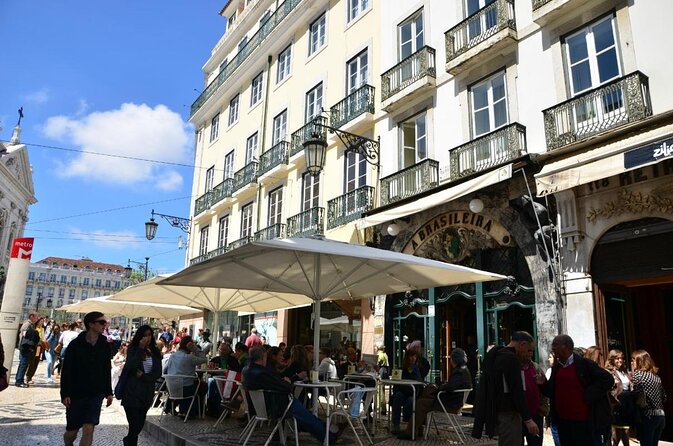
If you’re landing in Lisbon and want to understand how the city works, Baixa and Chiado are the fastest way in. Baixa is the rebuilt “downtown grid” by the riverfront—wide enough for crowds, structured enough to orient you. Chiado sits above it, with tighter streets, bookish corners, and theater energy. Even if you’ve only got half a day, this tour helps you stitch it together so the rest of your Lisbon days make sense.
The tour also leans into Lisbon’s signature geography: the city is famous for looking flat until you start walking. Then you feel the slope. Rather than pretending it’s easy, the route keeps steering you toward the places where Lisbon solves its own hill problem—especially around the elevators and funicular lines.
Finally, this walk is built around “see it, understand it, then keep going.” You move through squares and key streets, but you also learn what each spot represents: Portuguese civic power, Inquisition-era public life, rebuilding after the 1755 earthquake, and the long continuity of everyday culture like bookstores and cafés.
You can also read our reviews of more walking tours in Lisbon


Price and what you’re actually getting for $107
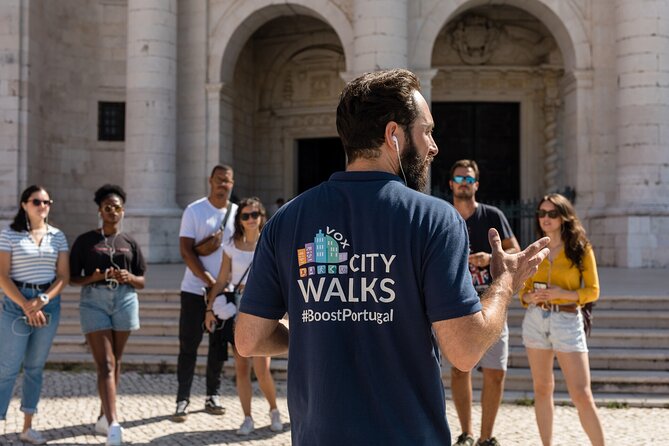
At $107 for about 2 hours, the value is mostly in three things:
1) a guided route through Lisbon’s core sights,
2) included Vox City app access for self-guided follow-ups, and
3) the fact that your walk covers a lot of “must-see” areas without requiring tickets or planning for transport.
What’s not included matters, because it affects your total day cost. Attraction entry tickets and food/drinks are not included. Public transportation tickets aren’t included either. So if you’re planning to go inside major landmarks, add those entry fees separately. If you’re happy doing the walk’s “outside viewing” (plus any optional elevator experiences you choose separately), your budget stays cleaner.
Also: group size is capped at 25 travelers, which is large enough to meet people but small enough that you usually won’t feel stuck behind a wall of bodies. That matters for a walking tour packed with squares and staircases.
Where you start (and how to plan your shoes)
You meet at R. dos Douradores 16, 1100-161 Lisboa, and the tour loops back to the same meeting point. That’s convenient: it means you don’t have to figure out a late-day transit plan just to get home with your feet still attached.
Because this is Lisbon’s center, you’ll be near public transportation, but you should still walk with a “less is more” mindset. Comfortable shoes beat stylish shoes here. Even on level-looking segments, Lisbon’s stone surfaces and sudden ramps can wear you down fast. If you’re visiting in warm weather, carry water. If you’re visiting in cooler months, you’ll likely be fine, but expect it to feel breezy near open squares.
Service animals are allowed, which is good to know for planning. And since you’ll be using a mobile ticket, double-check that your phone is charged and your ticket is accessible before you arrive.
Praça do Comércio and Augusta Street Arch: Lisbon’s big entrance idea

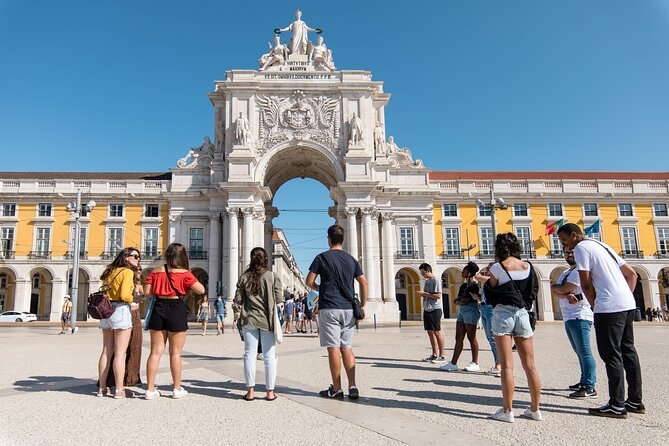
The tour kicks off in a part of Lisbon designed to impress. Praça do Comércio is one of those places where the scale changes how you see everything else. The open square puts you in the right frame of mind for what came before: Portugal’s seafaring importance and the power of the state.
From there, you’re set up for Augusta Street Arch, a monumental entryway with symbols meant to celebrate Portugal’s identity and history. The arch is easy to read from a distance, but it becomes more interesting when you realize it’s not just decoration. It’s the city telling you what it wants you to remember about the nation.
This stop is also practical. If you’re a first-timer, it gives you visual anchors. You’ll be able to recognize the square and arch later in photos, and that helps you navigate the rest of the day.
Lisbon City Hall and the Baixa Pombalina grid: why this downtown is built to recover

Near the civic center, you’ll pass Lisbon City Hall. It’s a Neoclassical building completed in 1880 after a 15-year construction. That timeline alone gives you a sense of how long it took to rebuild and stabilize Lisbon after massive disruption.
Then you move into the heart of Baixa Pombalina, the downtown shopping and banking district rebuilt after the 1755 earthquake. This is where Lisbon becomes a design lesson. You get a structured street pattern stretching from the riverfront to Avenida da Liberdade. If you’ve ever felt lost in older European cities, Baixa can feel like relief. Streets are more legible. You can orient faster.
For value, this is one of the best uses of a short guided tour. A self-guided wander in Baixa can be pretty, but a guide helps you notice what you’re walking through: reconstruction, civic life, and how the city’s layout influences your walking route.




Bertrand’s Bookstore (1732) and Chiado’s literary pull
One of the standout stops is Bertrand’s Bookstore, described as the oldest and longest operating bookstore in the world, founded in 1732 by French entrepreneur Pierre Bertrand. That’s not just a trivia nugget. In Chiado, where culture and ideas have a physical place, the bookstore feels like an anchor that ties today’s street life to centuries of daily browsing and reading.
Chiado’s energy is different from Baixa. Even if you’re just looking around, it feels more human-scaled—shops, cafés, and side streets that make the area feel lived-in. This is the kind of stop where your brain clicks into Lisbon as more than monuments. You start noticing the neighborhood vibe.
If you like your travel moments grounded in everyday institutions—places that survived wars, rebuilding, and changing fashions—this is a strong reason to choose the tour.
Luís de Camões Square and the poet statue pause
The walk includes Luís de Camões Square, with trees, stone benches, and traditional Portuguese paving. In the center is the Camões Monument, a bronze statue of the famed poet the plaza is named after.
This is a good “reset” stop. Open squares let you catch your breath and get your bearings before the next climb and corridor of streets. Also, it helps you connect Lisbon’s architecture to its cultural identity. A lot of cities have plazas. Not all have a named literary centerpiece with a monument that matches Chiado’s tone.
Look closely at the paving stones here and elsewhere on your walk. Lisbon uses ground-level details to shape how people move and gather—especially in pedestrian-heavy neighborhoods.
Santa Justa and Bica elevator areas: Lisbon’s hill engineering in plain sight
Lisbon’s elevators aren’t just attractions. They’re part of the city’s movement system, and this tour treats them that way.
You’ll see the Bica elevator, a funicular railway that climbs steep ridges. It’s described as having slopes that can reach around 12 degrees. Even if you don’t ride it, the setting tells you why Lisbon built these solutions. The streets don’t “naturally” connect—so the city manufactures connections.
The tour also highlights Santa Justa Elevator, opened in 1902 and heavily inspired by the model of the Eiffel Tower in Paris (including the idea of a metal landmark form). Early operations used a steam engine and later switched to an electrical motor. That history matters because it explains why the elevator looks like a piece of the industrial imagination rather than a simple lift.
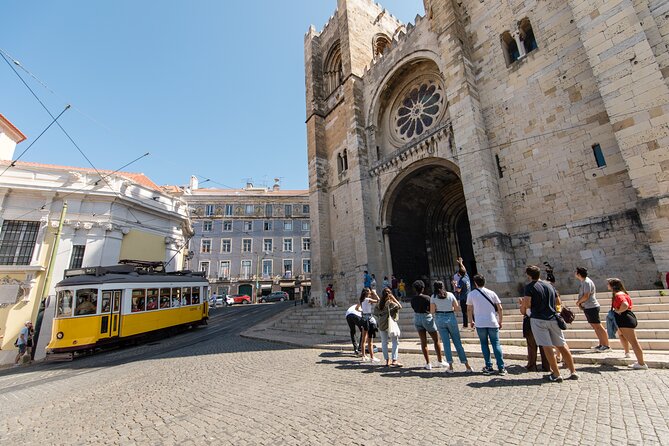
The overview also mentions the 28 yellow tram and the Gloria elevator area in the general experience. Even if you’re not riding, seeing these lines from street level makes Lisbon’s neighborhoods feel connected instead of random.
Tip: elevators and funiculars are easiest to appreciate when you watch people use them. On a walking tour, you get that context without spending the full day planning a ride.
Bairro Alto streets: street art, workshops, and the tascas vibe
The route takes you through Bairro Alto, where the streets shift in character. You’ll notice cultural activities, workshops, and boutiques, with street art mixing into historic architecture. It’s a part of Lisbon where you can feel the city’s creative layer without leaving the center.
If you’re visiting at night, the overview points to the tascas—family-owned taverns—as places you can pause. Even if you go during the day, keep an eye out for those narrower lanes where cafés and small eating spots are set into the street fabric.
This is also where Lisbon’s walk becomes more than sightseeing. You start imagining how your evenings might look: wandering, stopping for a drink, listening to ambient street noise, and taking the long way back to your base.
Carmo Convent ruins and the 1755 earthquake impact
Next comes one of the most emotionally direct stops: the Carmo Convent, devastated by the 1755 earthquake. What you see now is a roofless shell—stone arches and walls where the larger church was never fully rebuilt.
The important thing here is that the ruins don’t feel like an old photo. They’re still spatial. You can stand there and feel how missing ceilings and collapsed spaces change what a building can do for a city. It’s not just tragedy; it’s a physical reminder that Lisbon had to rebuild and then lived with the effects of that rebuilding.
If you’re the type of traveler who wants atmosphere with your facts, this stop can be a real highlight. If you prefer upbeat, photo-friendly pacing only, the tone can be heavier than some of the earlier square stops.
Rossio Square and Queen Maria II National Theatre: public life across centuries
The tour includes Rossio and the Queen Maria II National Theatre, tied to Rossio Square. You’ll learn that the theater is one of Portugal’s prestigious historical venues and that it dates back to 1450. The description also points out that it served as headquarters for the Portuguese Inquisition and as lodging for foreign noblemen visiting Lisbon.
Rossio itself is framed as a civic crossroads. The overview notes origins beyond the 1755 earthquake, reaching back to the 13th century. At different points, Rossio hosted bullfights, public shows, royal declarations, and even public executions tied to the Inquisition era.
That might sound grim, but it’s actually the kind of context that makes squares meaningful. Rossio isn’t just a place to photograph a façade. It’s where public life played out—celebration and control, theater and punishment, ceremony and spectacle.
Chiado’s theatres and the Jesuit church stop: culture and schooling power
As you keep moving into Chiado, the tour shifts toward performance and education themes. You’ll see the Trinity Theatre area referenced in the experience description as well as another stop described as one of the oldest theatres still open, built in the mid-19th century.
And there’s a separate church stop described as the earliest Catholic church established in Portugal and run by Jesuits, known for their contribution to education. Even without going into inside details, the point is clear: the Jesuits shaped how people learned and gathered, and you can still feel that influence in Lisbon’s central neighborhoods.
If you like travel that connects culture with institutions—who taught, who performed, who funded buildings—these Chiado stops give you that thread.
Viewpoints and the Sao Pedro Alcantara moment
The overview says you’ll include best viewpoints, including Sao Pedro Alcantara. Viewpoints are where a walking tour earns its keep. On flat days, you see a city as buildings. From a viewpoint, you see patterns: river vs. hills, the logic of neighborhoods, and why elevators and trams matter.
Even when you don’t get a long look, those moments help you remember Lisbon as a place with structure. Then when you go out on your own later, you’ll recognize what you’re seeing instead of guessing.
Extending the day with the Vox City app map
Here’s a practical plus: the price includes a free Vox City sightseeing app with a map of Lisbon and multiple self-guided walking tours. That means you’re not stuck with only what the guide covers.
After your two-hour loop, use the app to keep your momentum. You’ll be in the right part of town to choose an extra short walk—maybe another viewpoint, another square you noticed earlier, or a neighborhood lane you want to revisit without rushing.
If you tend to travel like this—guided morning, self-guided afternoon—this is a nice setup.
Who this tour suits best (and who should skip it)
This tour is a strong fit if you want:
- a first-time Lisbon overview centered on Baixa and Chiado
- iconic landmarks like Praça de Comércio, Rossio, and elevator areas such as Santa Justa
- neighborhood flavor plus context, not just a checklist
- a two-hour plan that doesn’t rely on transit tickets
It may be less ideal if you hate walking on uneven stone or you need long, unhurried time at every stop. Also, if you’re hoping for deep, museum-level history on every site, you might find the pace more “highlights with context” than “lecture with sources.”
Should you book Lisbon: Baixa Chiado Quarter Walking Tour?
I’d book it if your goal is to get oriented fast and see a tight group of core Lisbon sights with local storytelling. The price feels most reasonable when you factor in the Vox City app add-on and the fact that the route hits major areas in a short time.
I’d think twice if you need a very relaxed pace where you can linger for a long time at ruins and viewpoints. In that case, plan your day so you’re not rushing to an evening reservation right after.
If you’re arriving in Lisbon with only a day (or only half a day) to get the center right, this walk is a solid way to do it.
FAQ
How long is the Lisbon Baixa–Chiado walking tour?
It runs for about 2 hours (approx.).
How much does the tour cost?
The price is $107.
What’s included in the ticket price?
You get a Downtown Baixa–Chiado walking tour, the free Vox City sightseeing app with a Lisbon map and multiple self-guided walking tours, and an evening walking tour in high season.
What’s not included?
Not included are public transportation tickets, entry to attractions, and food and drinks.
Where does the tour start and end?
It starts at R. dos Douradores 16, 1100-161 Lisboa, Portugal and ends back at the same meeting point.
What’s the cancellation policy?
You can cancel for a full refund up to 24 hours in advance. If you cancel less than 24 hours before the start time, the amount paid won’t be refunded.