REVIEW · FATIMA, NAZARE & OBIDOS DAY TRIPS
Alcobaça & Óbidos: Self-guided tour
Book on Viator →Operated by Cityrama · Bookable on Viator
Medieval walls plus real-world guidance in one shot. This half-day, self-guided trip from Lisbon links Alcobaça and Óbidos with transport, a guide assistant, and an interactive phone-style guide so you can explore at your own pace.
I especially like two things: the smartphone guide helps you move through the sights without feeling stuck with a script, and Óbidos’ walled streets make the walking feel like a story you can actually control. It’s the kind of day where you can linger at a church door or speed up when you’ve got the view you came for.
One thing to plan for: there’s no hotel pickup, and the bus ride includes no bathroom. If you’re arriving from your hotel on your own, give yourself a little buffer to reach the meeting point and settle in.
In This Review
- Key things you’ll notice on this tour
- From Lisbon to Alcobaça and Óbidos: how the day flows
- Alcobaça’s Royal Monastery (UNESCO) and the drama behind the tombs
- Óbidos village: why this walled town feels like a time machine
- Rua Direita: the main street that pulls you toward Santa Maria
- Igreja de Santa Maria: Óbidos’ main church, and why it matters
- Castle of Óbidos: fortress walls, big views, and a separate ticket
- Church of Saint Peter and the 1755 earthquake rebuild
- Smartphone guide + included map: practical freedom in a small walled town
- Price and logistics: what your $50.88 really buys
- Who should book this Óbidos and Alcobaça day trip
- Quick decision guide: should you book?
- FAQ
- Where does the tour start in Lisbon?
- What time does the tour depart?
- How long is the tour?
- Is the tour fully self-guided once you reach Óbidos?
- Do I need to bring my own smartphone?
- Are entrance fees included for the churches and castle?
- Is transport included from Lisbon?
- Do they pick you up at your hotel?
- Is there a bathroom on the bus?
- How many people are in the group?
Key things you’ll notice on this tour

- Smartphone guide, 1 device per person: You don’t need to rely on your own phone signal. The tour gives you the tool to follow along.
- A UNESCO-class stop in Alcobaça: The Royal Monastery of Santa Maria de Alcobaça is a major Cistercian landmark, recognized by UNESCO in 1989.
- Óbidos is best on foot: The town’s layout rewards slow walking inside the medieval walls.
- You’ll hit three distinct churches: You get different eras and vibes, including the town’s main church.
- Castle time is separate from your included tickets: The Castelo de Óbidos isn’t included, so budget a bit extra if you want the fortress views.
- Small group feel: The tour caps at 20 travelers, which helps the day stay calm.
From Lisbon to Alcobaça and Óbidos: how the day flows
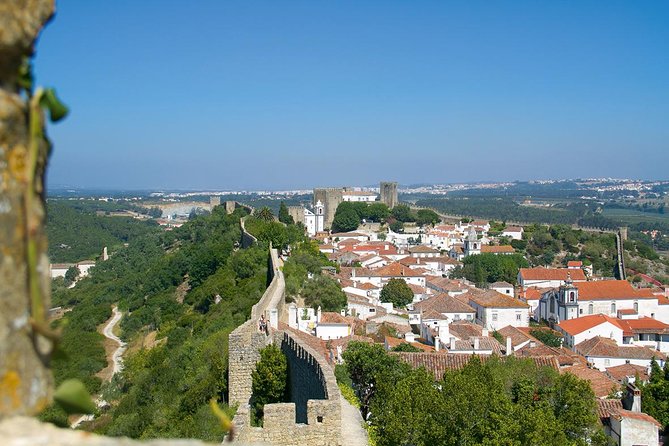
This is a classic Lisbon day trip format: you meet in the city, board a bus or minibus, and get shuttled out to the two towns. The day runs about 6 hours total, and it starts at 9:00 am from the Cityrama Gray Line Portugal meeting point on Alameda Edgar Cardoso.
Once you arrive in Óbidos, you’re not stuck marching in a group. You use an included interactive guide and follow prompts as you go, plus you receive a physical information folder and a map to help you plan your own mini-route. There’s still a guide assistant around for help and tips—so you get the best of both worlds: freedom with guardrails.
This setup is ideal if you don’t love the pressure of a packed guided tour, but you also don’t want to play guesswork with directions. The pacing is built for a moderate amount of walking, and the stops are short enough that you won’t feel trapped all day in buses.
You can also read our reviews of more guided tours in Lisbon



Alcobaça’s Royal Monastery (UNESCO) and the drama behind the tombs
Your first major stop is Alcobaça, home to the Monastery of Alcobaça, officially the Royal Monastery of Santa Maria de Alcobaça. Construction began in 1178, and the monks moved in by 1223. It’s also one of the largest and best-preserved complexes of the Cistercian Order, and it earned UNESCO World Heritage status in 1989.
What I like about this stop is how it gives you big, clear context fast. You’re not just seeing an old building—you’re seeing a power center of medieval Portugal. And then you get the human story: King D. Pedro chose the monastery church as the burial site for himself and Inês de Castro, whose impressive tombs you can visit.
Even if you’re not a history nerd, the scale of the complex helps you understand why this place mattered. It also sets the tone for Óbidos. You start the day with a serious stone monument, then you shift into the smaller, more playful medieval town streets.
Admission here is listed as free, and the stop is about 1 hour, so it’s enough time to get oriented and see the essentials without turning into a museum marathon.
Óbidos village: why this walled town feels like a time machine
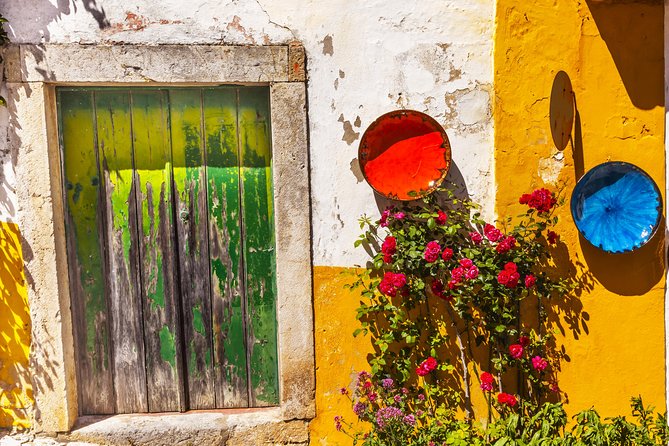
Óbidos is the star of the day, and the timing makes sense. You get around 2 hours in the village, which is just about right for a walled town where you’ll keep stopping for views, doors, and corners that look like they belong in a postcard.
The background you’ll encounter is layered: Óbidos may have been founded by the Celts in 308 BC, then connected to the ancient Roman city of Eburobrittium. Later came Moorish occupation, and then the first king of Portugal, Afonso Henriques, conquered the village from the Moors.
There’s also a royal twist that helps explain why the town kept its status. In the 18th century, Óbidos remained a noble summer place, and King John V stayed for eight years on medical advice—doctors recommended time at Caldas da Rainha to treat arthritis and obesity. That kind of specific detail makes the town feel more human than a list of dates.
When you arrive, you’ll be walking inside the medieval walls, and the interactive guide helps you steer your attention. This is the kind of place where the right approach is to take your time at the main streets, then peel off for side views when something catches your eye.
Rua Direita: the main street that pulls you toward Santa Maria
Óbidos is easiest to understand through its main spine: Rua Direita. This is the street that guides you toward the Church of Santa Maria, winding you through a maze of smaller lanes along the way.
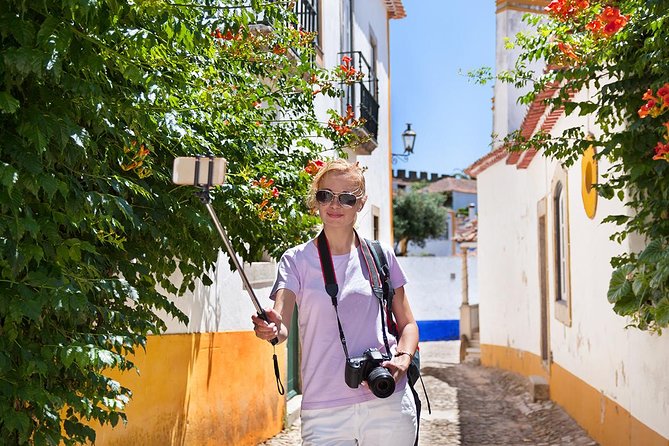
You’re given a shorter stop here—about 45 minutes—but it’s well chosen. This is where you’ll notice the town’s decorative style: Manueline porticos, flowered windows, and those tight little storefronts and openings that turn a walk into a visual scavenger hunt.
If you like wandering, Rua Direita is where you’ll feel that freedom most. You can follow the guide prompts, but you can also pause when the street does what it does best: it keeps rewarding you with details.
Admission for this segment is listed as free, so you’re not spending money just to get the “town feeling.” You’re paying in time, and that’s the best kind of investment in a place like this.
Igreja de Santa Maria: Óbidos’ main church, and why it matters
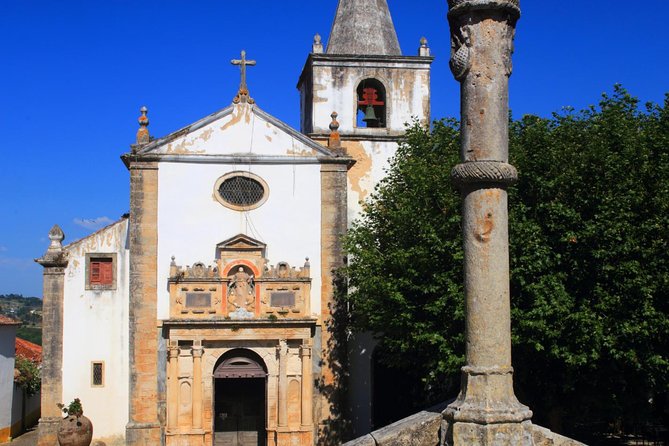
After Rua Direita, you’ll shift to Igreja de Santa Maria, also called Igreja Matriz de Óbidos. This is the town’s main church, founded between 1148 and 1185, which places it right in the long period of medieval rebuilding and shaping.
The value here isn’t just the building. It’s the role. In many Portuguese towns, the main church is where the community centers itself—socially, spiritually, and historically. You feel that immediately when you’re inside the walled town circuit.
The visit is another 45-minute window, and it’s listed with free admission. That means you can go in with zero pressure to “get your money’s worth.” If you love churches, you’ll get to enjoy it without treating it like a box to check.
Also, the way the day is structured—big Alcobaça monastery first, then Rua Direita, then Santa Maria—makes the religious architecture feel like part of one connected story rather than three separate stops.
You can also read our reviews of more tours and experiences in Lisbon





Castle of Óbidos: fortress walls, big views, and a separate ticket
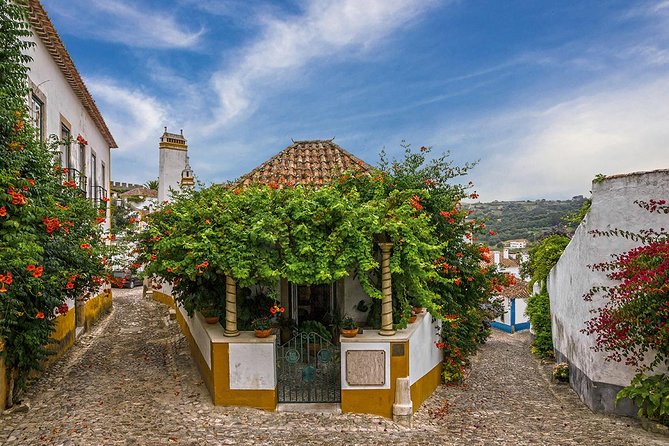
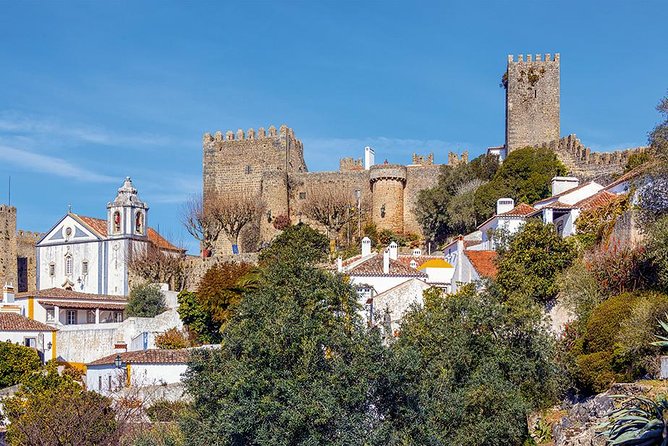
Now the day turns toward the payoff most people come for: Castelo de Óbidos. The castle’s origins are part of the town’s layered history. It was originally built by the Arabs in a place that had already seen Lusitanians, Romans, and Visigoths. Later, during the Christian reconquest era, Afonso Henriques took the castle around 1148.
Your castle stop is about 45 minutes, and this is where you need to plan your budget a bit. Castle admission is not included, so you’ll want to factor in an extra ticket if the fortress views are a priority for you. The day works either way—you can still enjoy the town—but skipping the castle entirely would mean losing one of the strongest “Óbidos identity” moments.
I like the castle segment because it gives perspective. From up there, you can see how the town sits inside its defensive shape. It’s one thing to read about walls. It’s another to look out and understand why the walls were worth the trouble.
Church of Saint Peter and the 1755 earthquake rebuild
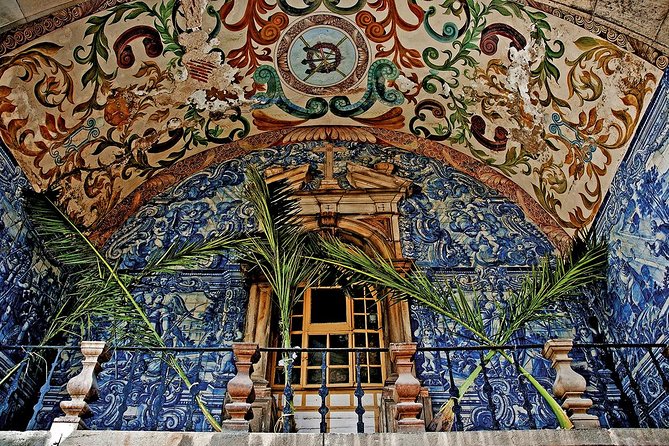
The last church stop is Church of Saint Peter. This one has a more complicated story, which is exactly why it’s a good addition to the route. It’s a medieval church, but founded in the seventeenth and nineteenth centuries and rebuilt after the 1755 earthquake.
You’ll spend about 45 minutes here, and admission is free. That combination matters: you can add a meaningful historical stop without spending time on paid entry lines or extra costs.
This church helps balance the day. Santa Maria gives you the medieval main-church anchor, while St. Peter’s brings in the earthquake-era rebuilding thread—proof that these places kept changing long after the medieval period ended. If you’re the type who likes seeing how a town survives, adapts, and rebuilds, St. Peter’s fits nicely.
Smartphone guide + included map: practical freedom in a small walled town
The heart of this experience is the self-guided interactive smartphone. You get one device per customer, and it’s designed to be intuitive—enough that you can focus on streets and buildings instead of fiddling with apps.
You also get a map and an information folder. That matters more than it sounds. In a walled historic center like Óbidos, it’s easy to lose time. The guide tool and paper support help you keep moving in the right direction without always looking at your phone screen.
There’s also human support: you’ll meet a guide assistant and get help and tips. In one common example, your arrival in Óbidos may include a suggestion for a local taste—like a quick shot of ginjinha—if that’s what the assistant thinks fits the moment. That’s the kind of small, local flavor that group tours often miss because everyone is stuck listening at once.
Bottom line: this tour feels like you’re doing Óbidos your way, but with enough structure that you don’t waste your limited time in the wrong lane.
Price and logistics: what your $50.88 really buys
At $50.88 per person, you’re paying for more than just transportation. You get round-trip transport from Lisbon to Alcobaça/Óbidos (no hotel pickup, but bus transfer is included), plus the guide assistant, the smartphone device, and the map/folder.
For value, it’s worth asking: what would it cost you to do this on your own? Likely more time and stress than money. You’d still need the logistics out of Lisbon, and you’d still be figuring out how to make a medieval town feel navigable in a short window.
One more note that matters on a practical level: there’s no bathroom on board the bus. That’s not a dealbreaker, but it should affect how you plan your day—especially if you’re tight on timing.
Also, smart casual is the dress code, and there’s a moderate walking load. If you’re bringing good walking shoes, you’ll enjoy this much more. Óbidos rewards comfortable feet.
Who should book this Óbidos and Alcobaça day trip
Book it if you want a half-day that balances big monuments and a picture-perfect walled town, and you like exploring without a constant group shuffle. The smartphone guide approach is a strong fit if you enjoy learning in small bursts while you walk.
It also works well for people who feel burned by “guided-only” tours. Here, the guide assistant can help, but once you’re moving, you control your pace.
Consider a different option if you dislike meeting points and prefer hotel pickup. Since there’s no hotel pickup and drop-off, you’ll need to get to the Alameda Edgar Cardoso meeting location and be there on time. If your plan is complicated or you hate transit surprises, this might not feel as smooth.
Quick decision guide: should you book?
I think this is a solid choice if you want medieval Portugal without turning your day into a full-day grind. You get UNESCO-class Alcobaça, a meaningful main-church stop, a separate castle experience, plus Óbidos street wandering inside medieval walls—with a tool that helps you steer.
If you do book, do two things: arrive a little early at the meeting point, and plan for the Castelo de Óbidos ticket cost since it’s not included. Also, if free cancellation matters to you, you can cancel up to 24 hours in advance for a full refund.
FAQ
Where does the tour start in Lisbon?
The tour starts at Cityrama Gray Line Portugal, Alameda Edgar Cardoso, 1070-051 Lisboa, Portugal.
What time does the tour depart?
The start time is 9:00 am.
How long is the tour?
The duration is approximately 6 hours.
Is the tour fully self-guided once you reach Óbidos?
You explore Óbidos independently using the included interactive smartphone guide. A guide assistant provides help and tips, and you also receive an information folder and map.
Do I need to bring my own smartphone?
No. The tour includes one smartphone per customer (including children).
Are entrance fees included for the churches and castle?
Admission for the Alcobaça monastery, the Óbidos town/castle-area churches, and St. Mary’s Church segment are listed as free. The Castelo de Óbidos entrance is not included.
Is transport included from Lisbon?
Yes. Transport by minibus or bus (depending on group size) is included, and you return to the meeting point in Lisbon.
Do they pick you up at your hotel?
No. Hotel pickup and drop-off are not included.
Is there a bathroom on the bus?
No bathroom is available on board the bus.
How many people are in the group?
The tour has a maximum of 20 travelers.