REVIEW · LISBON
Tour of Lisbon in a Private Tour
Book on Viator →Operated by Kitzel Tours Portugal · Bookable on Viator
Lisbon hits you fast: hills, river views, and church bells. This private 8-hour tour is a smart way to see the key sights with a dedicated guide, so you’re not stuck scanning maps or dodging crowds on your own. I really liked having a guide who can tailor what matters to you, and I also love that you get views at multiple levels (downtown, Alfama, and the high lookouts) without guessing the best route.
The big plus is the human pace. You can stop for photos, linger at viewpoints, and get practical tips for the rest of your time in Lisbon. The only real consideration is that Lisbon is hilly, and even with car time you’ll still do some walking on uneven streets and steps—so wear solid shoes and plan for a long day.
In This Review
- Key highlights to know before you go
- A private day that actually starts at your door
- Santa Justa Elevator: the downtown icon and one of the best city views
- Portas do Sol: an easy break with coffee, Tram 28, and top-tier Alfama views
- Alfama: medieval lanes, tiles, Fado energy, and the joy of getting lost
- Senhora do Monte: high views without forcing the sunset
- A church-and-cathedral circuit that explains Lisbon’s layers
- Baixa rebuilt after 1755: the streets you can read like a map
- Praça do Comércio: the royal palace site and Lisbon’s open door to the sea
- The Lisbon version of the Champs-Elysées: shop streets, theaters, and a spare viewpoint
- Cristo Rei in Almada: one of the biggest viewpoints you’ll ever see
- Monument to the Discoveries, Jerónimos church, and Torre de Belém: the Belém focus
- Price and value: is $118.56 per person worth it?
- Who should book this private Lisbon tour
- Should you book it?
- FAQ
- What time does the tour start?
- How long is the private Lisbon tour?
- Is this a private tour?
- Is hotel pickup included?
- Are any admission tickets included?
- What language is the tour offered in?
- Is WiFi available during the ride?
Key highlights to know before you go
- A private guide + private vehicle, with hotel/apartment/cruise port pickup and drop-off
- Santa Justa Elevator included (and it’s not just a ride, it’s a top-tier viewpoint)
- Multiple miradouros (Portas do Sol, Senhora do Monte, plus Cristo Rei across the river)
- Real Lisbon neighborhoods, especially Alfama, not only postcard streets
- Major Belém monuments focused on the parts you’ll actually want to see (like the Jerónimos church)
- Guides known for adapting on the fly, including rerouting if roads are closed
A private day that actually starts at your door
This tour is built around one simple idea: make your first day in Lisbon feel easier. Pickup and drop-off are included at your hotel, apartment, or even the cruise port, and you’re traveling in an air-conditioned private vehicle with WiFi onboard. That matters when you’re trying to cover a lot of ground in one day without burning time figuring out transit.
The other thing I like: it’s private, so you’re not negotiating for space in a big group. In the real world, that means less waiting, more flexibility, and better answers when you ask why a street curves, why a neighborhood survived the 1755 earthquake, or why certain buildings look the way they do.
From the guide side, the program has a strong track record. Names that show up repeatedly include João, Anastasia, Jorge, Anna, Ana, and John, and the consistent theme is that the guide doesn’t just recite facts. They explain how Lisbon grew, how it was rebuilt, and what to notice while you’re looking at stone, tiles, and viewpoints.
You can also read our reviews of more private tours in Lisbon



Santa Justa Elevator: the downtown icon and one of the best city views
You’ll begin with Elevador de Santa Justa, one of Lisbon’s most famous historical monuments. The structure is neo-Gothic, and it connects Rua do Ouro to Largo do Carmo—so it’s both a piece of engineering and a shortcut through the city’s vertical logic.
The ride itself is part of the show. The wooden cabins are decorated and feel like you’re ascending in a time machine. Then comes the payoff: from the top you can see Baixa, the Castle area, the Tagus River, and the impressive ruins of the Igreja do Convento do Carmo.
Why this stop works well on a tour day: you get an instant overview. From up there, you understand why Lisbon feels like layers instead of one grid. The guide can also help you place what you’ll see later—especially the downtown rebuild patterns.
One practical note: because this is a popular attraction, you’ll still want to move calmly and follow your guide’s timing. The good news is the ticket is included, so you avoid the usual hassle of figuring out entry details.
Portas do Sol: an easy break with coffee, Tram 28, and top-tier Alfama views
Next you’ll swing by Miradouro das Portas do Sol, one of those viewpoints that works like a neighborhood balcony. It’s a quick stop, but it hits hard: you get a strong view over the eastern front of Alfama plus the Tagus stretching through the street labyrinth below.
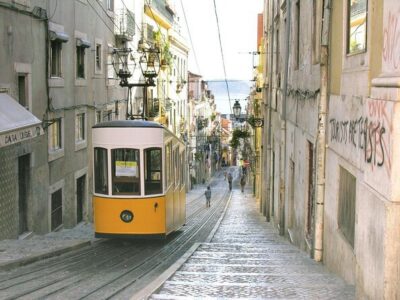
This is also a fun place to watch Lisbon in motion. The viewpoint’s kiosk is a simple win if you want an authentic Portuguese coffee without turning your day into a coffee hunt. And yes, Tram 28 passes by constantly, so if you want to see the famous tram in action without planning for it all day, this is an efficient spot.
The drawback here is basically the same for every famous Lisbon viewpoint: it can get crowded. The upside of going with a private guide is you can time it better and get the best photo angles without wasting time.
Alfama: medieval lanes, tiles, Fado energy, and the joy of getting lost
Then comes the real Lisbon soul: Alfama. This area is described as medieval and tied to earlier chapters of the city, including a history connected to a Jewish quarter and a fishing community. More importantly for your experience today, Alfama is Lisbon’s oldest neighborhood feeling—hillside alleys, small squares, and streets that survived when the 1755 earthquake reshaped so much of the rest of the city.
This is where you slow down and let your senses lead. You’ll pass balconies with clotheslines, tiles on walls, and corners where you might catch the smell of grilled fish. You’ll also hear the faint pull of Fado coming from restaurants tucked into the area—enough to make you want to stop, even if you don’t have time for a full show tonight.
The one “watch your step” moment is that Alfama can be physically demanding. Streets can be narrow, surfaces can be uneven, and stairs are part of the vibe. The benefit of a private guide is they can adjust pace and keep you from bouncing between viewpoints and getting tired too early.
Senhora do Monte: high views without forcing the sunset

After Alfama’s old-world maze, you’ll climb toward Miradouro da Senhora do Monte, a viewpoint that started as a bit more local and quiet before it became a couple-and-camera favorite. It’s high enough that it functions like a second, wider stage for the city.
There’s a small image of the Virgin Mary that gives the viewpoint its name, and behind it is an 18th-century chapel (often closed). There’s also a legend tied to a stone chair said to help with easier childbirth—whether or not you take legends seriously, the viewpoint name and story add color to the visit.
During the day you still get that “wow” factor, even if you’re not aiming for sunset. You may also see people spending long stretches in the shade of olive trees, cypresses, and stone pines, which is a nice way to cool down.
This is the kind of stop where I’d tell you to bring patience: it’s a view first, not a checklist. Let the guide point out monuments identified on the tile panel, and use the moment to orient yourself for the rest of the day.




A church-and-cathedral circuit that explains Lisbon’s layers
Two shorter stops help balance the viewpoint time with architecture and lived history: Church of St. Anthony and Lisbon Cathedral.
At the Church of Santo António, the big story is connection—it’s said to be on the site of Saint Anthony’s birthplace. It sits near old medieval Lisbon gates (near the old Porta do Mar) and has a small adjacent museum related to him. Even if you don’t go deep inside, the guide’s context helps you understand why this isn’t just another church stop.
Then you’ll move to Lisbon Cathedral, often called Sé. Construction began in the late 12th century after the Christian conquest of the city from the Moors. It’s a mix of styles, and it’s been a designated National Monument since 1910.
The practical value of this pair: it gives your day a “why” layer. Lisbon’s views are gorgeous, but the city’s meaning lives in the way its religious and civic buildings survived, changed, and got rebuilt.
Baixa rebuilt after 1755: the streets you can read like a map
Next you’ll enter Baixa, the downtown district rebuilt after the 1755 earthquake. This is where Lisbon becomes a city you can almost decode. Streets were designed with specific shapes and measurements, and they were named after trades and artisans—things like shoemakers and gilders.
In the 20th century, banks and offices moved in, pushing residents toward the Avenidas Novas. That shift left parts of the area underused for a stretch, and more recently Baixa has come back as a commercial and tourist hub. Many streets are pedestrianized and it links a chain of monumental squares.
If you want to understand Lisbon’s logic fast, Baixa is a great place to do it. Your guide can point out what feels “planned” compared to the older hillside districts.
Praça do Comércio: the royal palace site and Lisbon’s open door to the sea
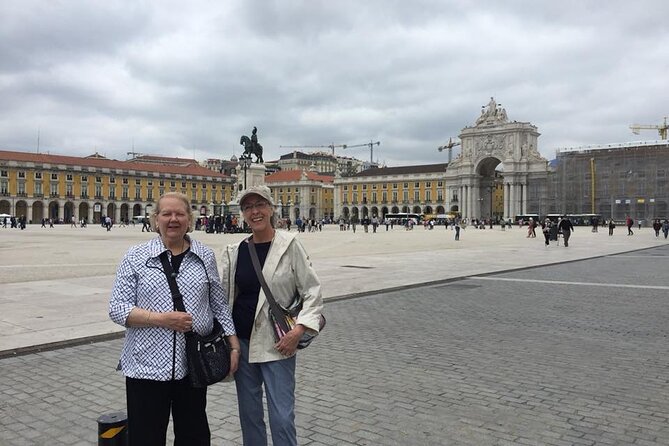
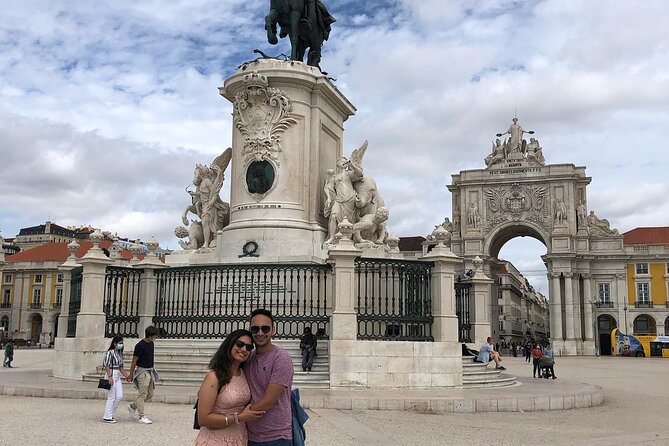
At Praca do Comércio (Commerce Square), you’ll see Lisbon’s classic river-facing postcard view—open space on the south end looking over the Tagus. The square was built on the site of the old Royal Palace, destroyed in the 1755 earthquake.
One side of the square opens to the water, while the other sides are lined with yellow buildings and long arcades. In the guide’s explanation, it becomes more than a photo stop: it was historically the “door” to Lisbon for commercial ships unloading goods directly onto the square.
This stop is also a good reset point after church and street wandering. Even if you don’t linger long, you’ll leave with a clear sense of where the river fits into the city’s story.
The Lisbon version of the Champs-Elysées: shop streets, theaters, and a spare viewpoint
You’ll also pass through the area often compared to the Parisian Champs-Elysées: a tree-lined avenue covered in Portuguese cobblestones between Restauradores and Marquês de Pombal. This is where you’ll find large luxury shops and some older theater buildings.
Not everything here is preserved, though. Many buildings were demolished during mid-20th-century redevelopment, but some stand out, including examples tied to the Valmor Prize. The tour route also takes you toward the hillside where you reach the older parish of Pena with the help of the Lavra Elevator, plus mention of the viewpoint Miradouro do Torel.
The value of this stretch is variety. It gives you a contrast: after climbing through old Alfama, you see the more elegant, urban shopping-and-architecture face of the city.
Cristo Rei in Almada: one of the biggest viewpoints you’ll ever see
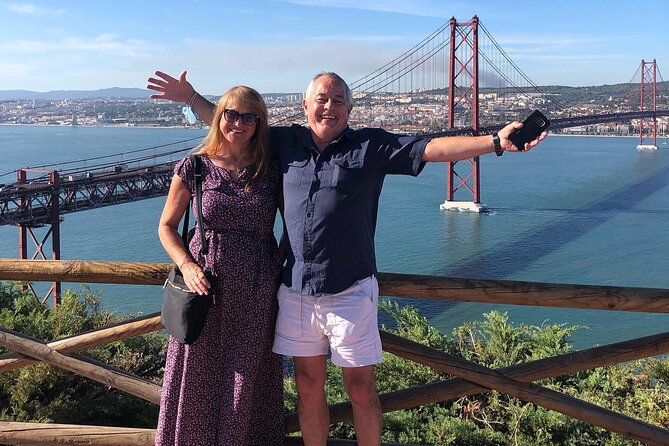
Then you’ll cross the river’s mood into Santuario Nacional de Cristo Rei in Almada. This is not a small viewpoint. It’s a massive monument at about 133 meters above the Tagus River, topped by a statue of Christ the King with open arms facing Lisbon.
The sanctuary includes a portico designed by António Lino and a towering statue by Francisco Franco de Sousa. From the top, you get an excellent, wide view over Lisbon plus the 25 de Abril Bridge.
This is the stop that often makes people feel like they actually “saw” the geography, not just the landmarks. Lisbon’s hills and the river make more sense once you view the city from this angle.
Timing-wise, you’ll have enough time to look, take photos, and catch your breath without feeling dragged.
Monument to the Discoveries, Jerónimos church, and Torre de Belém: the Belém focus
Your day finishes in the Belém area with three big touchpoints, designed to hit the themes of Portuguese overseas history.
First is Padrão dos Descobrimentos (Monument to the Discoveries), built to evoke the era of overseas exploration. The monument includes a stylized caravel, Prince Henry the Navigator at the prow, and a set of figures representing different roles tied to the age of discovery. The structure is also oriented in a specific north-south way with shields and castle emblems—so it’s history with design.
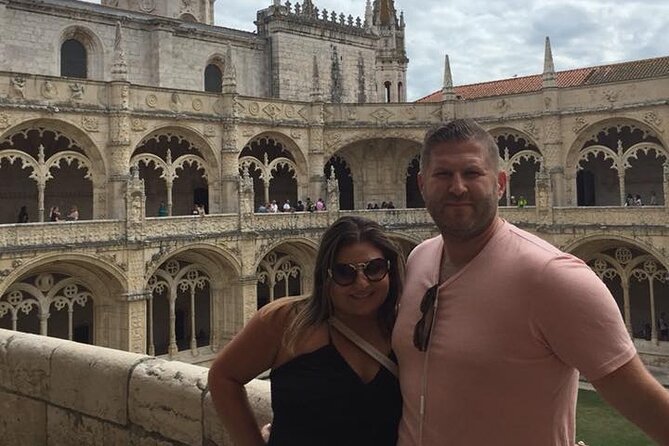
Then you’ll visit Jerónimos Monastery, but with an important detail: you’ll visit only the Monastery Church. The church is where Vasco da Gama is buried, and the stonework in the cloisters is linked to the meeting of the West and the East. Even if you don’t do a full monastery deep dive, the church stop is a strong payoff.
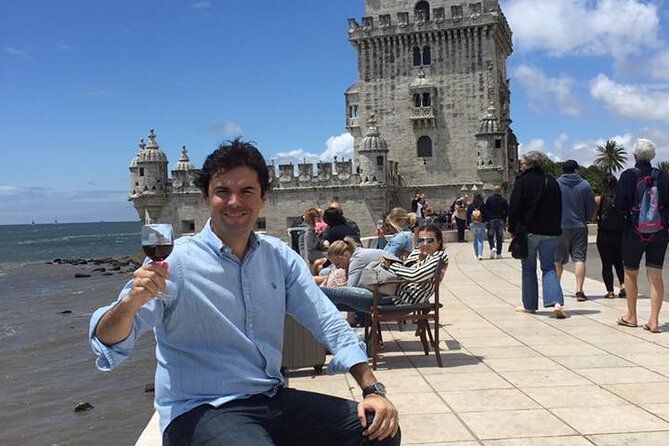
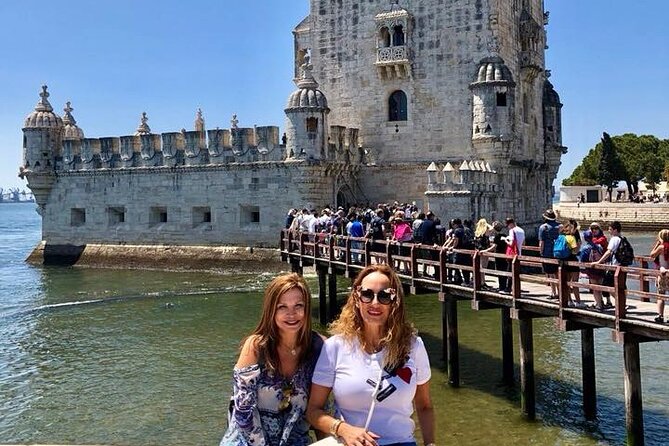
Finally, you’ll go to Torre de Belém (Belém Tower). This is described as a fairy-tale small castle from the Age of Discoveries, and it’s classified as a World Heritage Site. Expect a panoramic visit style here—enough time to appreciate what makes it Lisbon’s landmark tower look.
If you’re short on time in Lisbon, this trio is a practical ending. You’ll close the day with a strong theme and a set of iconic monuments that don’t require you to choose between them.
Price and value: is $118.56 per person worth it?
At $118.56 per person for about 8 hours, you’re paying for three things: a private guide, private transportation with hotel/cruise pickup, and multiple major sights where logistics can slow you down on your own.
Ticket math matters here. The tour explicitly includes the admission ticket for Elevador de Santa Justa. Many other stops on the day are listed as free (like Portas do Sol, the viewpoints, the cathedral, Praca do Comércio, and the Belém area sites), and lunch is not included.
Where the value really lands is the “time you buy back.” A private car helps you handle distance and hills. A guide helps you see what you’d otherwise skip, like viewpoint placement, neighborhood survival after the 1755 quake, and why each stop fits into the city’s story.
The reviews reflect that this feels like a worthwhile spend, not a budget gamble. Guides like João and Anastasia are praised for deep context, keeping the day moving without rushing, and handling changes when needed (like road closures).
The one cost consideration: if you’re the type who wants zero walking and zero standing, this won’t be that kind of day. You’ll be on your feet in older neighborhoods and at viewpoints. Still, a good guide can pace it.
Who should book this private Lisbon tour
This tour is a great fit if:
- You want a first-day overview with the right mix of viewpoints, neighborhoods, and monuments
- You prefer asking questions and getting tailored tips rather than following a group pace
- You want to avoid crowd stress by starting early and letting a local guide manage timing
It may be less ideal if:
- You want only “inside” museum time and no viewpoints
- You have strong mobility limits and would struggle with uneven streets and stairs in Alfama and hill areas
Based on guide behavior described in feedback, the guides tend to be thoughtful with different needs, including people who needed extra care for comfort.
Should you book it?
I’d book it if you’re trying to get Lisbon right quickly: you’ll get the skyline logic from Santa Justa, the neighborhood character from Alfama, the wide-angle city sense from Senhora do Monte and Cristo Rei, and then the Belém monuments that anchor Portugal’s overseas story.
If you do book, do yourself a favor: wear shoes you trust on cobblestones and steep lanes, bring water, and keep your camera ready for repeated viewpoint moments. And when your guide suggests where to spend the rest of your time, take that advice seriously. That’s often the best “extra” you get out of a private day.
FAQ
What time does the tour start?
The tour start time is 8:30 am.
How long is the private Lisbon tour?
It runs about 8 hours.
Is this a private tour?
Yes. It’s a private tour, so only your group participates.
Is hotel pickup included?
Yes. You’ll be picked up and dropped off at your hotel, apartment, or cruise port.
Are any admission tickets included?
Yes. Santa Justa Elevator includes an admission ticket. Other listed stops like Portas do Sol, viewpoints, Lisbon Cathedral, and the Belém sites are listed as free, and lunch is not included.
What language is the tour offered in?
The tour is offered in English.
Is WiFi available during the ride?
Yes. WiFi is on board in the vehicle.