REVIEW · CITY TOURS
City Tour, wonders of ancient Lisbon through the monuments
Book on Viator →Operated by Experience Tour · Bookable on Viator
Lisbon’s monuments land fast, with great views. This private tour strings together big sights and smart photo stops in about 1h45, with an English-speaking guide like Carlos guiding you through Portas do Sol-style outlooks and the older quarters. I love that it covers multiple must-sees without frying your legs on Lisbon’s hills, and I also love how the stops are timed so you actually get pictures and context at each one.
One thing to consider: many moments are brief, so if you prefer long museum stays or wandering at your own pace, you may feel a bit on the clock—especially in the viewpoints and squares.
In This Review
- Key highlights at a glance
- A private quick-hit route that actually makes Lisbon make sense
- Starting in Parque Eduardo VII’s royal tribute gardens
- Lisbon Cathedral: from mosque foundations to Romanesque-looking stone
- Santa Engrácia’s baroque side and its national status (1966)
- Alfama: where Fado gets its origin story and where ginjinha fits in
- Portas do Sol: the Tagus view balcony that Lisbon keeps showing on postcards
- Senhora do Monte: Lisbon’s highest viewpoint over the old city
- The royal palace area after the 1755 earthquake: reconstruction on full display
- The Marquis of Pombal monument and Lisbon’s post-earthquake mindset
- Rossio Square area and the Pedro IV / Pedro I statue
- Ending near a famed 19th-century station: travel history in iron and tile
- Price and value: what $36.05 buys you in a short, efficient route
- Who this tour is best for (and when it might not be your match)
- Final verdict: should you book this Lisbon monuments tour?
- FAQ
- How long is the tour?
- Is pickup included?
- Is the tour private?
- Is it offered in English?
- Are the admissions included and free?
- What is the cancellation window?
- Are service animals allowed?
Key highlights at a glance
- A private group with an English-speaking guide (often Carlos, and Andre is also mentioned in guide feedback)
- Comfort-first pickup in an air-conditioned vehicle with Wi‑Fi and water
- Free admission listed for several major stops, including the cathedral and the miradouros
- Tagus views from two different heights, from Portas do Sol to Senhora do Monte
- Big Lisbon landmarks packed into one route, ending near the famous 19th-century station area
A private quick-hit route that actually makes Lisbon make sense
Lisbon can feel like a puzzle: hills, winding streets, and neighborhoods that don’t line up neatly on a map. This tour is built to give you the framework fast—where everything sits, how the different eras show up in stone, and why the viewpoints matter. You’re not doing a long day of walking. You’re doing a focused run through the city’s most iconic “first impressions.”
The private format matters here. You’re not stuck with strangers who want to move on every 20 seconds, and your guide can adjust the pace. In guide feedback, people specifically mention flexibility with pickup and time spent at photo stops, which is exactly what you want when the light changes quickly in Lisbon.
You can also read our reviews of more city tours in Lisbon

Starting in Parque Eduardo VII’s royal tribute gardens
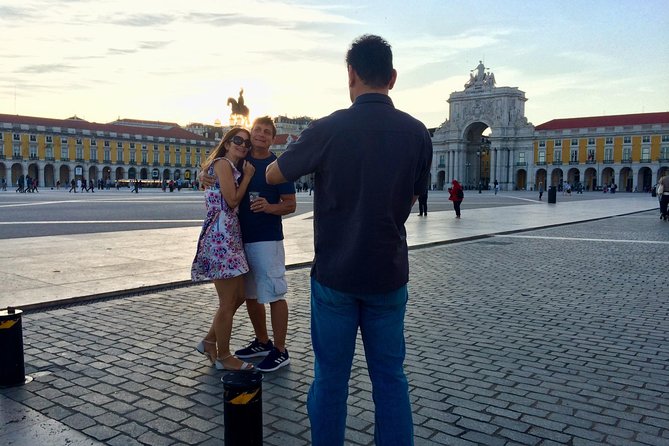
You begin at Parque Eduardo VII, a calm green pause with gardens built in honor of the King of England. It’s a great warm-up because it’s less frantic than the old city streets, yet it still sets up what you’re going to see later: Lisbon’s habit of mixing formal spaces with dramatic views.
This stop is short, but that’s the point. In about five minutes, you get your bearings, you stretch your eyes out toward the city, and you’re ready for the denser historic core.
Tip for your timing: if you’re chasing the best photos, arrive ready to take a few quick frames right away. Lisbon’s light can shift fast, and this tour moves on.
Lisbon Cathedral: from mosque foundations to Romanesque-looking stone
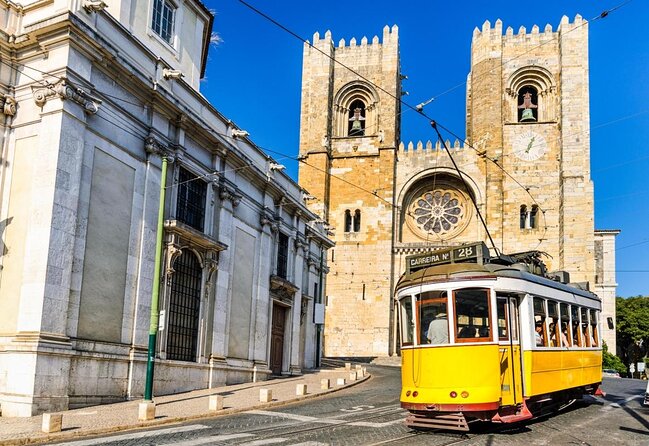
Next comes Lisbon Cathedral, with construction starting in 1147 on a site that previously held a Muslim mosque. That single detail is a big clue to why Lisbon’s architecture looks the way it does: multiple layers of faith and power, stacked over centuries.
The cathedral stop is about ten minutes. It’s enough time to notice the shift from “this is a building” to “this is a site with deep time.” And since the listed admission ticket is free, it’s a low-stress way to get your first real hit of medieval Lisbon.
If you’re the type who likes to understand what you’re standing in front of, this is a good match. The guide adds the story behind what you see, so you’re not just collecting photos.
Santa Engrácia’s baroque side and its national status (1966)
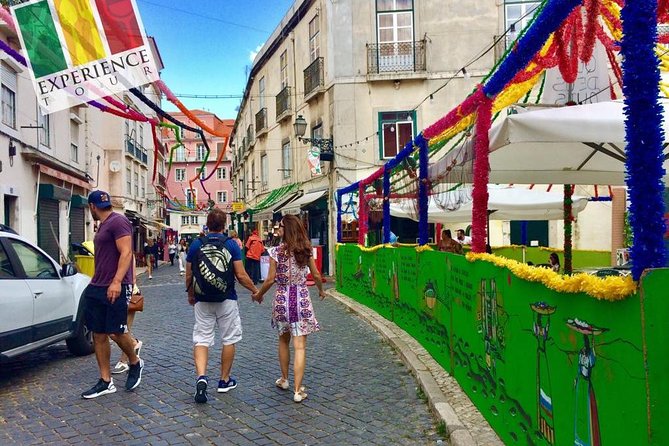
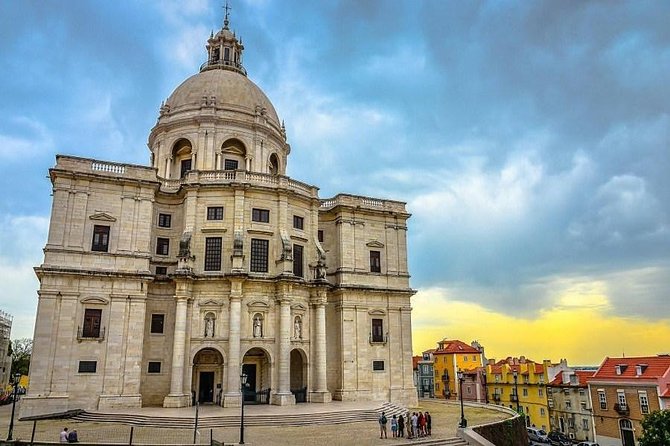
The route also connects you with Santa Engrácia, known for its baroque architecture and designated the Pateão Nacional in 1966. Even if you don’t consider yourself an architecture person, you can still appreciate how the building’s style reads like a statement—big, dramatic, and meant to hold attention.
This is one of those stops that can deepen the whole tour. Once you’ve seen earlier eras like the cathedral, Santa Engrácia helps show Lisbon’s later “we rebuild and we show it off” attitude.
Alfama: where Fado gets its origin story and where ginjinha fits in
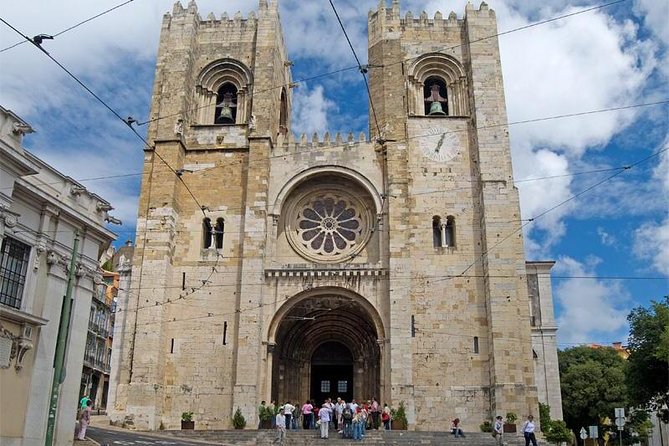
Then you roll into Alfama, Lisbon’s bohemian, picture-heavy neighborhood. The tour points out the area linked with the supposed birthplace of fado, and that matters because fado isn’t just music here—it’s part of the local identity you can feel in the street layout and the way people gather.
You’re given about fifteen minutes in Alfama, plus time for quick tastes and photos. The route even nudges you toward tasting ginjinha (the cherry liqueur). You don’t need a food crawl to get the vibe; a small sip is enough to connect the neighborhood with what it’s known for.
One practical note: Alfama streets are narrow and can be crowded near popular viewpoints. Keep your phone secure, watch your step on uneven pavement, and use the guide-led pace to get the shots without getting stuck in tangles.



Portas do Sol: the Tagus view balcony that Lisbon keeps showing on postcards
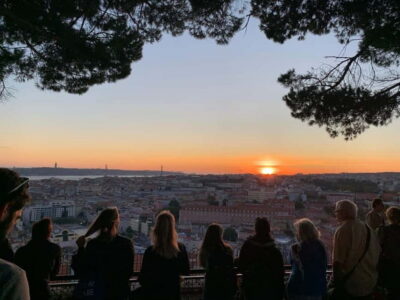
The tour’s viewpoint sequence is where you really start to understand Lisbon’s “why.” At Miradouro das Portas do Sol, you get a large balcony-style lookout with a privileged view of the Tagus. This stop is about ten minutes, but it’s the kind of ten minutes that changes your perspective.
From here, you can visually connect the city’s layers: rooftops, rooftops again, and then the river pulling everything into one scene. It’s the best kind of photo stop because you’re not photographing just a building—you’re photographing Lisbon’s whole arrangement.
How to do this well: set your phone camera to video or burst mode for the skyline, then slow down for a few wide shots. The best views aren’t only about crisp details. They’re about what your brain learns in a single glance.
Senhora do Monte: Lisbon’s highest viewpoint over the old city
Next is Miradouro da Senhora do Monte, described as the highest point in Lisbon on the shores of São Jorge Castle, overlooking the older city area. This is the second viewpoint for a reason: two heights teach you depth, and depth helps you navigate later on your own.
This stop is also about ten minutes. It’s enough time to take photos, compare it mentally to Portas do Sol, and then let the view sink in. After you’ve seen both, Lisbon stops looking random.
If you’re short on time and want the “I get it now” moment, these two miradouros are the heart of the experience.
The royal palace area after the 1755 earthquake: reconstruction on full display

From viewpoints, the tour moves to central historic ground. You’ll see the place where the Royal Palace was located before the 1755 earthquake, with today’s large square surrounded by 18th- and 19th-century buildings. This part of Lisbon is about consequences—how a catastrophe reshaped a city’s plan and its public spaces.
Places like this are more than background. Squares are where Lisbon shows its rebuilt identity. You can feel it in the layout and scale: it’s designed for visibility and movement, not hiding.
If you like historical cause-and-effect, this is where the tour gives you something useful. It links the city’s “look” to the major turning point that changed what came next.
The Marquis of Pombal monument and Lisbon’s post-earthquake mindset
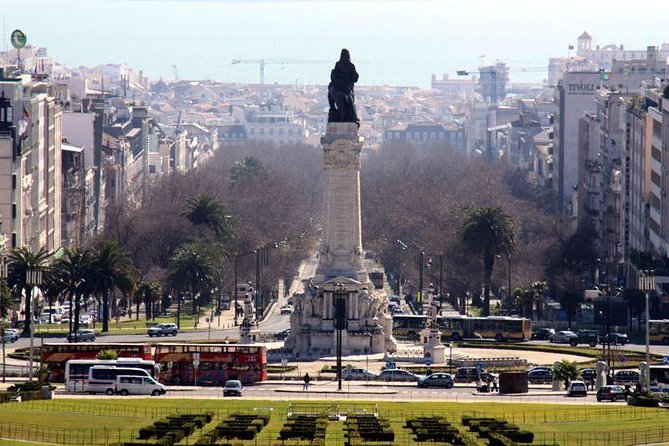
Nearby is the monument honoring the Marquis who mentored the reconstruction after the 1755 earthquake. This isn’t a random statue stop. It’s the symbolic bridge between the disaster and the rebuilding that follows.
In a tour that’s only around 1h45, it helps to have a guide who can explain why this figure matters. Otherwise, monuments can turn into background clutter. With a good guide, it becomes clear why Lisbon built the way it did.
This kind of stop is also a reminder: Lisbon’s modern identity isn’t just style—it’s decisions made after real damage.
Rossio Square area and the Pedro IV / Pedro I statue
The route then includes a beautiful central square featuring the statue of Pedro IV (or Pedro I in Brazil). This detail is a fun cross-connection because it ties Portuguese and Brazilian history into one shared reference point. It also gives you something to look for when you explore later—you’ll start seeing how Portugal’s royal story branches out beyond its borders.
Again, the stop is short, but it’s a solid way to anchor what you’ve learned into a recognizable landmark.
Ending near a famed 19th-century station: travel history in iron and tile
The tour finishes at one of Lisbon’s standout transport landmarks: a grand train station area inaugurated at the end of the 19th century, located on the outskirts of Rossio Square. Even if you never board a train that day, this is a satisfying ending point because it connects Lisbon’s history to modern movement.
From a practical standpoint, ending near a major hub helps you continue your day without awkward transitions. You get dropped in the right zone for getting food, shopping, or hopping on public transport.
Price and value: what $36.05 buys you in a short, efficient route
At about $36.05 per person for roughly 1 hour 45 minutes, this tour sits in the “serious value” category—if you want a guided overview without losing half a day. The big value is not just that it’s affordable. It’s that it’s efficient, and it’s structured around high-impact stops.
Several of the listed sights show free admission tickets, including Parque Eduardo VII, Lisbon Cathedral, Alfama, and the key viewpoint miradouros. That can make the tour feel lighter on your wallet compared with sightseeing days that stack entry fees.
Add in what you’re getting beyond photos: pickup in a comfort vehicle with air conditioning, Wi‑Fi, and water, plus an English-speaking guide. That’s a real benefit if you’re jet-lagged, traveling with parents, or simply don’t want to manage timing and logistics in steep neighborhoods.
Who this tour is best for (and when it might not be your match)
This works best for you if you want to:
- Get oriented quickly in Lisbon’s historic core
- See major sights without spending hours figuring routes
- Have a guide explain what you’re looking at at each stop
- Take photos without fighting steep streets for every transfer
It’s also a strong pick if you’re visiting as a small group or want a calmer experience than a big bus tour. Private tours are often where you get that personal pace—especially based on feedback mentioning flexible timing and extra time when asked.
The main mismatch is if you’re the type who hates brief stops. Since the tour moves quickly through multiple viewpoints and squares, it’s not built for long contemplation in museums or extended wandering with no agenda. If you want slow, deep exploration, you might treat this as the setup day—then come back later for the places you loved most.
Final verdict: should you book this Lisbon monuments tour?
If you’re trying to make the most of limited time, I’d book this. You’re paying for focus, smart pacing, and the kind of structure that helps Lisbon click fast. The combination of cathedral-to-views-to-reconstruction landmarks, plus a guide who keeps things moving and photo-friendly, makes the price feel fair.
I’d skip it only if you know you want hours in one spot. In that case, you’ll probably feel rushed. But for a first visit, jet-lag days, or anyone who wants Lisbon’s big monuments without exhausting transfers, this is a solid, practical choice.
FAQ
How long is the tour?
The duration is about 1 hour 45 minutes.
Is pickup included?
Yes, pickup is offered. You ride in a comfortable vehicle with air conditioning, Wi‑Fi, and water.
Is the tour private?
Yes. It’s a private tour/activity, so only your group participates.
Is it offered in English?
Yes, the tour is offered in English.
Are the admissions included and free?
For several key stops, the tour notes admission ticket as free, including Parque Eduardo VII, Lisbon Cathedral, Alfama, and the miradouros (Portas do Sol and Senhora do Monte).
What is the cancellation window?
Free cancellation is available up to 24 hours in advance for a full refund.
Are service animals allowed?
Yes, service animals are allowed.