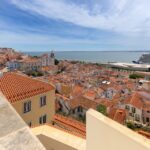
Lisbon clicks into focus on an e-bike ride. I love how the electric bike keeps the pace friendly without killing your legs, and I also like the stop-heavy route that mixes landmark time with clear local history. In a single morning, you get a “what am I looking at?” guide for central Lisbon, from Alfama’s oldest lanes to the big squares near the river.
The main thing to consider is comfort on a bicycle: you must be able to drive a bike, and the tour assumes moderate physical fitness. It also moves briskly between viewpoints, so if you want long, slow hangs at each spot, you may feel a little time-pressured.
In This Review
- Key highlights at a glance
- A smooth Lisbon orientation, starting in Alfama
- Price and what you really get for $28.83
- Your start and finish: Rua dos Caminhos de Ferro
- Stop 1: Alfama, Lisbon’s oldest neighborhood on an e-bike
- Stop 2: Campo das Cebolas and the Roman port ruins
- Stop 3: Praca do Comercio and the 1755 tsunami story
- Stop 4: Praca Dom Pedro IV (Rossio area) and classic city-center sights
- Stop 5: Praça dos Restauradores and Portugal’s independence monument
- Stop 6: Elevador de Santa Justa, Lisbon’s mechanical landmark
- Stop 7: Miradouro da Senhora do Monte, the high-point panorama
- Stop 8: Miradouro da Graça (Sophia de Mello Breyner Andresen) and Graça Church
- Stop 9: Feira da Ladra area (Campo de Santa Clara) and river views
- The ride itself: helmet, bike skills, and a manageable pace
- Where the tour helps your food plans (without turning into a food festival)
- Who this Lisbon e-bike loop is best for
- Should you book this Heart of Lisbon e-bike tour?
- FAQ
- How long is the Heart of Lisbon by Electric Bike tour?
- How much does the tour cost?
- What’s included in the tour price?
- Is the tour offered in English?
- Do I need to know how to ride a bike?
- What are the child age rules?
Key highlights at a glance
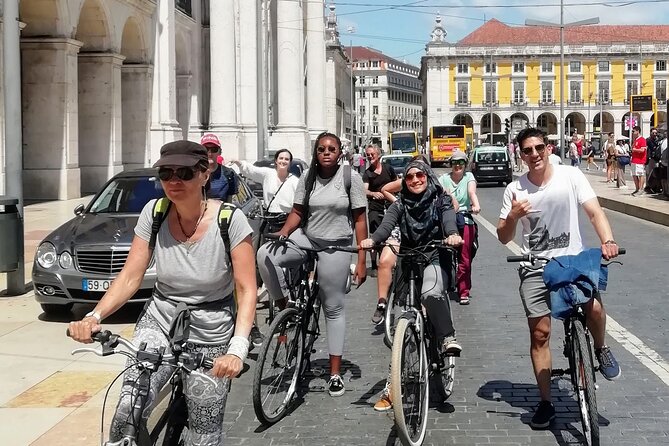
- Alfama starter streets: Old Lisbon first, then you gradually work toward the grand squares.
- Roman-port ruins at Campo das Cebolas: Short stop, big historical payoff.
- Riverfront storytelling at Praca do Comercio: Includes the 1755 tsunami and rebuilding consequences.
- Rossio to Praça dos Restauradores: Two major squares tied to Lisbon’s theater, rail history, and independence story.
- Miradouros with city-scale views: Senhora do Monte and Graça deliver high viewpoints in one loop.
- Small group rhythm: Max group size is 12, which helps the guide keep control and the flow.
A smooth Lisbon orientation, starting in Alfama
This e-bike tour is one of the smarter ways to start a short Lisbon trip. The route is designed to show you the city’s “layers” in order: first the oldest neighborhood (Alfama), then the downtown ceremonial spaces by the Tagus River, and finally the high viewpoints where Lisbon makes sense from above.
I also like that the tour is built for active sightseeing rather than museum-only time. You’re moving by bike most of the morning, and every stop is there to answer a real question: what is this place, why does it matter, and what should you notice next?
Practical tip: because the total time is about 3 hours, you’ll want to arrive with a clear goal. Come ready to take photos fast, listen closely at each stop, and save the long wandering for later neighborhoods.
You can also read our reviews of more cycling tours in Lisbon


Price and what you really get for $28.83
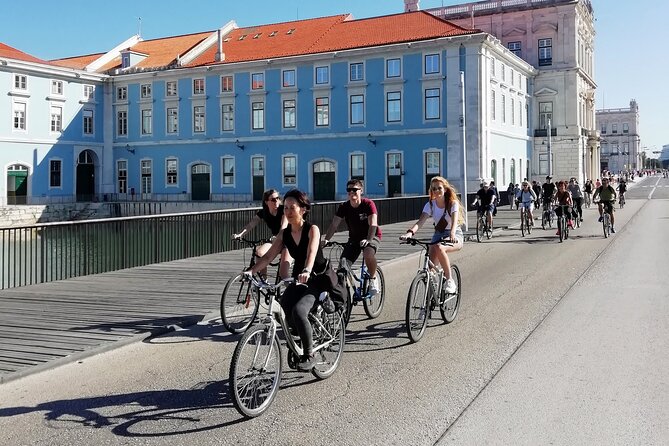
At $28.83 per person, the value comes from the combo of guided route + included gear + concentrated sightseeing. You get the electric bike and a helmet, and you also get a structured path through multiple Lisbon landmarks that would take a lot longer (and multiple transit rides) if you tried to stitch it together on your own.
Do note what isn’t included: tips, bottled water, and snacks. That doesn’t make the tour worse, but it does mean you should plan to carry a little cash or cards for a drink or bite during breaks—especially if you’re the type who likes to taste Lisbon as you go.
One more value angle: this tour is offered in English, uses a mobile ticket, and typically gets booked a bit ahead (about 19 days on average). That’s usually a sign it hits a useful sweet spot for visitors.
Your start and finish: Rua dos Caminhos de Ferro
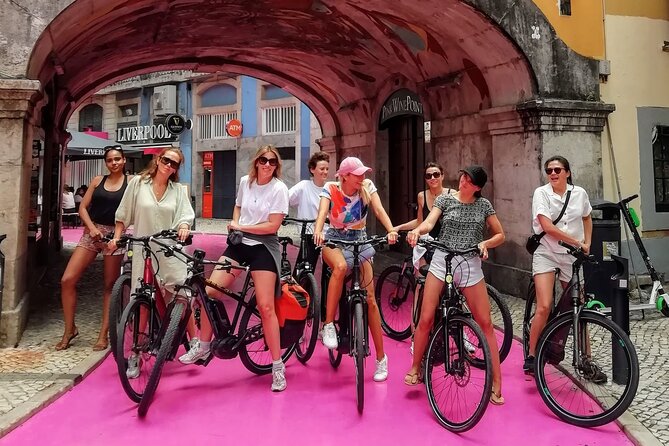
The tour starts and ends at Rua dos Caminhos de Ferro 62, 1100-108 Lisboa. Since it’s round-trip to the same meeting point, you’re not trying to “solve” the logistics of getting back to where you began—nice if you’re also juggling other day plans.
Start time is 10:00 am, and the route is planned for about 3 hours total. The tour also runs with near public transportation, which is helpful if you’re not staying in the exact center.
Expect the group to be small: the experience caps at 12 travelers. That matters. It means less waiting around at stops and a better chance that the guide can correct pacing or handle questions without losing the whole schedule.
Stop 1: Alfama, Lisbon’s oldest neighborhood on an e-bike
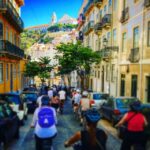
The tour kicks off in Alfama, Lisbon’s oldest and most traditional neighborhood. Starting here is smart because Alfama’s vibe sets the tone for everything else. You see where the city began, then you move toward the more formal squares and monuments later, so the changes feel like a real progression instead of random stops.
On an e-bike, you’re able to cover the distances without spending the entire morning either cramped in steep walking streets or stuck in slow transit. The downside is also tied to Alfama: it’s a place where you’ll want to look closer than you usually can in a short guided stop. You’ll get a taste, not a deep dive.
If you love architecture and old street character, this first stop is your best momentum-builder for the rest of the tour.
Stop 2: Campo das Cebolas and the Roman port ruins
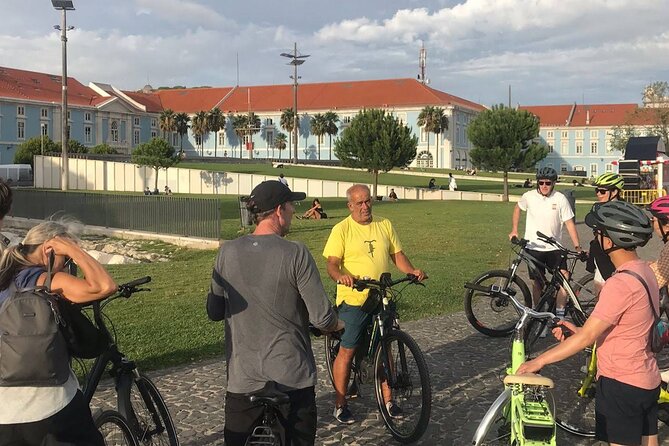
Next you head to Campo das Cebolas, where you can see ruins tied to an ancient Roman port. This is one of the stops that feels small on the map but big when the guide connects the dots. You learn how Roman influence shaped Lisbon long before modern Lisbon’s identity.
Time is short here, so don’t expect to read everything on-site. Instead, use this stop as a mental anchor: it helps explain Lisbon’s long relationship with the river and the importance of trade routes.
If you’re the kind of traveler who likes history, this is a great moment to sharpen your Lisbon “timeline brain” early in the day.
You can also read our reviews of more tours and experiences in Lisbon


Stop 3: Praca do Comercio and the 1755 tsunami story
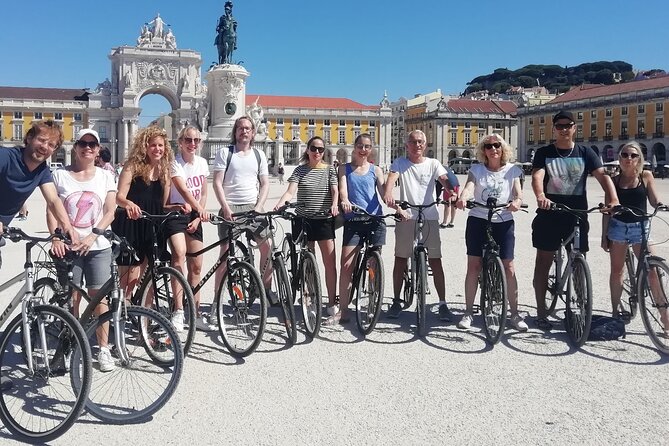
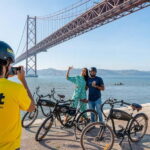
Then it’s out to Praca do Comercio, the monumental square facing the Tagus River. This is the city’s ancient gateway area, and that context is what makes the square more than just a pretty photo spot.
The guide also explains how the devastating tsunami of 1755 happened and what followed socially and architecturally. That’s a heavy topic, but it’s exactly the kind of story that turns a landmark into understanding.
Potential drawback: Praca do Comercio is a big open space, so you can feel exposed to wind or sun. If the morning weather is unpredictable, dress in layers and be ready to stand for short periods.
Stop 4: Praca Dom Pedro IV (Rossio area) and classic city-center sights
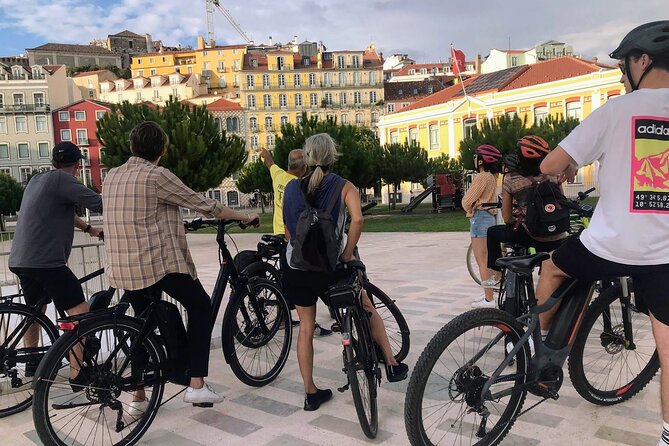
From Praca do Comercio, you ride for about 10 minutes through downtown streets until you reach Praca Dom Pedro IV, also closely associated with the Rossio area. Here you’re looking at another major square tied to Lisbon’s public life: you can spot the National Theater, Lisbon’s first major train station, and the enigmatic São Domingos Church.
This is a strong stop for people who like old storefront energy too. The route includes time to notice some of the oldest and most legendary stores nearby, which is a good way to spot where to return later for browsing.
Time is about 20 minutes, so treat it as a “scan and decide” moment. If you see a shop you like, make a note to circle back after the tour.
Stop 5: Praça dos Restauradores and Portugal’s independence monument
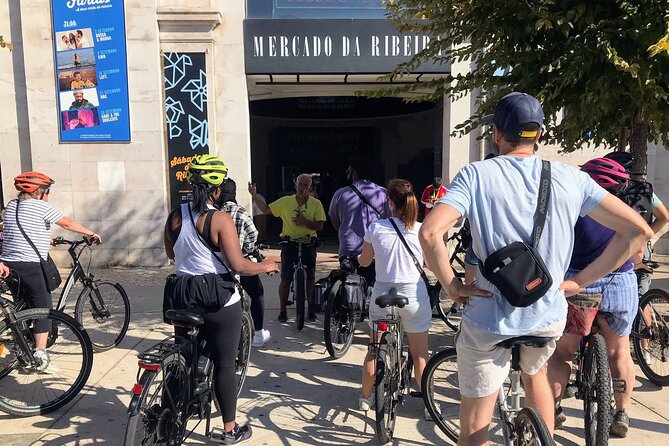
After a short ride, you reach Praça dos Restauradores. The centerpiece monument marks the restoration of Portugal’s independence in 1640, and the guide lays out why Portugal lost independence for 60 years.
This stop works well because it ties civic politics to a physical location. Instead of history feeling like dates only, you get a landmark that explains the story visually and emotionally.
You’ll also notice the square’s position at the start of Avenida da Liberdade, Lisbon’s most important avenue. That gives you a clean mental map for how to navigate the city after the tour.
Stop 6: Elevador de Santa Justa, Lisbon’s mechanical landmark
The tour includes a brief stop at the Santa Justa Elevator—a famous symbol built more than 100 years ago. Even if you don’t plan to ride it, the guide’s explanation gives you the context to understand why it became such a recognizable part of Lisbon’s identity.
This kind of stop is useful for first-time visitors because it prevents the elevator from being just a photo. You learn what problem it helped solve and why it mattered.
The practical catch: it’s a short stop, so if you want to do Santa Justa fully, you’ll need to plan separate time later.
Stop 7: Miradouro da Senhora do Monte, the high-point panorama
Next up is Miradouro da Senhora do Monte, described as the highest point in old Lisbon. This is where Lisbon turns into a citywide view, not just a neighborhood collection.
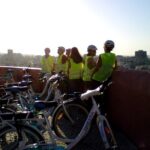
This stop lasts about 20 minutes, which is enough time to find a good angle, take photos, and absorb the scale. If you’re going to choose one “pause and stare” moment, this is a solid candidate.
Weather note: viewpoint stops depend on visibility. If the air is hazy or it’s rainy, your photos and views may be less dramatic. In that case, enjoy the city vibe anyway and let the guide’s stories fill the gaps.
Stop 8: Miradouro da Graça (Sophia de Mello Breyner Andresen) and Graça Church
Then you move to Miradouro da Graça, next to the Church and Convent of Graça. This viewpoint is famous for views over São Jorge Castle, and you also have time that can include a chance to visit the church.
This is a great mid-late tour stop because it shifts your perspective. Early Lisbon focuses on riverfront and squares; now you’re looking toward the castle area and the steep old-city structure around it.
If churches are your thing, take advantage of the time here. If you’re not, just treat the viewpoint as your payoff for climbing Lisbon’s visual layers.
Stop 9: Feira da Ladra area (Campo de Santa Clara) and river views
The tour ends with a stop at the Feira da Ladra area in Campo de Santa Clara. This is tied to Lisbon’s well-known street market on Tuesdays and Saturdays, and the viewpoint also offers a fantastic look toward the Tagus River.
The stop includes close views of the Monastery of São Vicente and the National Pantanal. Even without going into the buildings, seeing them from this angle helps you understand where they sit in the city’s larger layout.
One consideration: if you’re expecting a full market experience, you may be disappointed depending on the day and your timing. This tour is more about seeing and learning than spending hours shopping or browsing.
The ride itself: helmet, bike skills, and a manageable pace
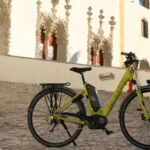
You get an electric bike and helmet, and the tour asks for moderate physical fitness. It also requires that all participants know how to drive a bicycle. That’s not a small detail. If you feel shaky on two wheels, this will be stressful instead of fun.
That said, the overall experience is set up to feel manageable for active travelers. The route favors city movement without making you do a full workout climb marathon, and you’re stopping frequently anyway.
Practical prep for you:
- Wear closed-toe shoes with decent grip.
- Bring sun protection and a light layer.
- Think of the ride as transportation with guided stops, not as a long-distance cycling outing.
Where the tour helps your food plans (without turning into a food festival)
Even though meals and snacks are not included, this tour is good for food strategy. The route naturally points you toward areas where you can grab something after, including Time Out Market and Praça dos Restauradores.
The best part is that the guide’s focus on local life often comes with extra restaurant and activity tips. In previous groups, guides like André, Rodrigo, and Rodriguez were specifically praised for being friendly, enthusiastic, and strong with English, plus for sharing practical ideas for what to eat next.
So use this tour as your morning research session. Pick one place you’ll try later, then go explore with confidence after the last viewpoint.
Who this Lisbon e-bike loop is best for
This is a strong fit if you:
- Want a first-day or short-trip orientation to central Lisbon
- Like history tied to real streets and landmarks
- Prefer active sightseeing over sitting on buses all morning
- Want guidance that helps you decide where to eat and what to do next
It may be less ideal if you:
- Have no bicycle comfort at all
- Want lots of unscheduled time at viewpoints or squares
- Are traveling with young kids who can’t ride on this tour’s age rules
Child note from the tour info: children 5 to 12 can’t participate, while 0 to 4 can participate with baby seats on the bike.
Should you book this Heart of Lisbon e-bike tour?
Book it if you’re trying to get your bearings fast and you like your Lisbon with a guiding brain turned on. For the money, the included electric bike + helmet and the concentrated landmark stops make it a practical way to see a lot without spending the whole day on logistics.
Skip or reconsider if you don’t feel comfortable riding a bicycle, or if you want a slower, longer look at each place. Also, if weather is poor and visibility matters to you, note that the tour depends on good weather, with an alternate date or a full refund offered if it’s canceled for poor conditions.
If you want Lisbon’s main characters—Alfama, the grand squares, the riverfront, and the big viewpoints—in one organized morning, this is a booking you can feel good about.
FAQ
How long is the Heart of Lisbon by Electric Bike tour?
It runs for about 3 hours.
How much does the tour cost?
The price is $28.83 per person.
What’s included in the tour price?
You get an electric bike and an included helmet.
Is the tour offered in English?
Yes, it is offered in English.
Do I need to know how to ride a bike?
Yes. The tour requires that all participants know how to drive a bicycle.
What are the child age rules?
Children 5 to 12 can’t participate, and children 0 to 4 can participate with baby seats on the bike.