REVIEW · CITY TOURS
Private 4-Hour Lisbon City Highlights Tour by Tuktuk
Book on Viator →Bookable on Viator
Lisbon’s hills feel a lot friendlier by tuktuk. This private 4-hour loop hits major sights like Alfama and the Belém area, then adds serious photo power at multiple miradouros. I especially like how the route stacks viewpoints close together, so you’re not constantly fighting uphill staircases.
You also get a smooth, no-stress start with hotel pickup (if your hotel is in the central area), and the tour is private, so it’s just your group. One thing to keep in mind: the schedule is tight, and a couple of negative reports point to occasional communication issues, so I recommend you double-check your start details the day before.
For your timing, you’ll have enough stops to feel the neighborhoods—not just drive past them. But you won’t get hours in any one place, so go in with a short list of what matters most to you.
In This Review
- Key highlights at a glance
- How a tuktuk makes Lisbon’s hills actually workable
- Price and value: what $180.27 buys you (and what it doesn’t)
- The route in human terms: Lisbon Cathedral to Alfama
- Lisbon Cathedral: a stone anchor for the whole city
- Portas do Sol: the classic Alfama photo angle
- Senhora do Monte: slightly calmer, still big views
- Alfama: narrow lanes, tiles, and Fado in the background
- Praça do Comércio (Terreiro do Paço): a wide-angle reset
- Chiado and Bairro Alto: city life, shopping streets, and Fado energy
- Chiado: elegant streets, bookstores, and café breaks
- Miradouro São Pedro de Alcântara: one last view before the climb
- Bairro Alto: lived-in streets with nightlife vibes
- Basilica da Estrela and Pink Street: two very different Lisbon moods
- Basilica da Estrela: neoclassical elegance and royal tombs
- Pink Street (Rua Nova do Carvalho): daytime color with nightlife history
- Time Out Market Lisboa: your best built-in food option
- Belém in one half-day: monuments, MAAT, and the riverfront mindset
- Jerónimos Monastery: the Manueline highlight
- Padrão dos Descobrimentos: a sculpted history lesson
- MAAT: modern art with a river view setting
- Torre de Belém: a quick Belém icon stop
- Getting the most from the time you have
- Comfort, safety, and the one real thing to watch for
- Who this tour is best for (and who might prefer something else)
- Should you book this Lisbon tuktuk highlights tour?
- FAQ
- How long is the Lisbon City Highlights tour?
- Where does the tour start and end?
- Does the tour include hotel pickup?
- Is the tour private?
- What language is the tour offered in?
- What’s included in the price?
- Are food and drinks included?
Key highlights at a glance
- Private tuktuk transport that’s built for Lisbon’s narrow, steep streets
- Multiple miradouros for skyline photos without long hikes
- A curated mix of Alfama, Baixa/Chiado, Bairro Alto, and Belém
- Time Out Market as a central anchor point for starting and ending
- Well-rounded guide storytelling shown in repeated guide feedback (Belal, Mohammed, Shaf, Sohel, Arif, Yar, and others)
- Free entry for many stops and no required museum tickets during the outdoor segments
How a tuktuk makes Lisbon’s hills actually workable
Lisbon’s beauty comes with stairs. A lot of them. A tuktuk tour is a practical way to cover ground fast, especially in older districts where streets twist and cars struggle. In this route, that matters because you’re moving between neighborhoods that each “feel” completely different—Alfama’s medieval lanes, Chiado’s central energy, Bairro Alto’s nightlife streets, then Belém’s riverfront monuments.
A private setup also changes the pace. Instead of blending into a crowd, you can shift timing within the group’s comfort level. That shows up in the feedback too: guides like Belal and Shaf are repeatedly described as patient and careful, including with older visitors, which is exactly what you want on a short half-day plan.
The tuktuk isn’t a magic carpet, though. Some reviews mention rougher road comfort, since Lisbon can be bumpy even when you’re not walking. If you’re sensitive to vibration or have mobility limits, it’s smart to ask before you go what kind of seating you’ll have and to plan your own stops accordingly.
You can also read our reviews of more city tours in Lisbon


Price and value: what $180.27 buys you (and what it doesn’t)
At about $180.27 per person for roughly 4 hours, this is not a budget sightseeing bus. You’re paying for three things at once: private transportation, a guide who can connect the dots, and an efficient route that covers a lot of “must-see” Lisbon without you manually building an itinerary.
What makes the value feel better is that many stops don’t require paid entry. The plan includes a mix of free-to-visit landmarks and outdoor viewpoints (Cathedral, major miradouros, squares like Praça do Comércio/ Terreiro do Paço, and multiple neighborhood viewpoints). So your money mostly goes toward getting from place to place and hearing the story behind it.
What’s not included is also clear: food and drinks are on you. If you want a proper sit-down meal, you’ll likely do it either before or after the tour. If you want snacks, plan for quick bites, and treat Time Out Market as your most likely “food moment.”
The route in human terms: Lisbon Cathedral to Alfama
You start at Time Out Market (Mercado da Ribeira, Av. 24 de Julho). That’s a good choice for a first-time plan because it’s a recognizable meeting anchor in central Lisbon, and it connects easily with other transit options. The tour ends back at the meeting point, which keeps the day simple.
Stop by stop, this is how the early part of the route “reads”:
Lisbon Cathedral: a stone anchor for the whole city
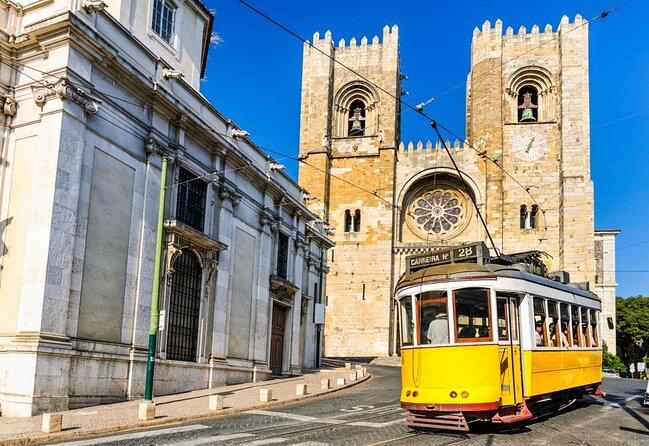
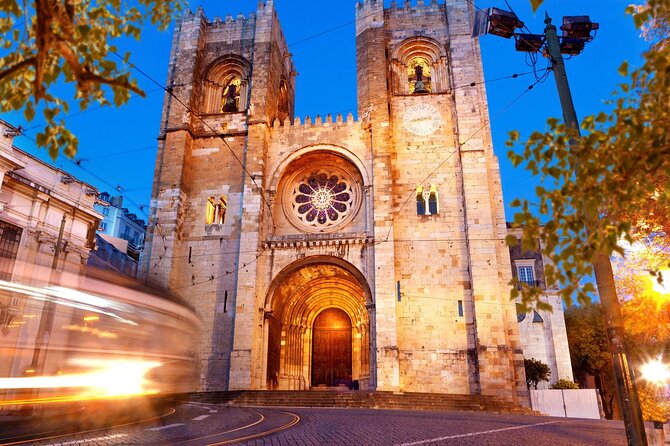
Lisbon Cathedral (12th-century roots) is the kind of stop that makes the rest of the tour easier to understand. You get a quick orientation on the city’s layered architecture—Romanesque, Gothic, and Baroque elements are all mentioned in the tour notes—plus a chance to appreciate the building as a historic landmark rather than just a photo backdrop. You’ll have about 15 minutes, which is short, but enough to see the exterior and get oriented.
If churches aren’t your thing, still treat this like a primer stop. The cathedral gives you a baseline before the viewpoint hopping starts.
Portas do Sol: the classic Alfama photo angle
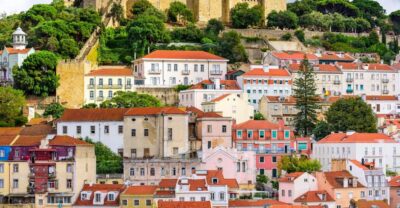
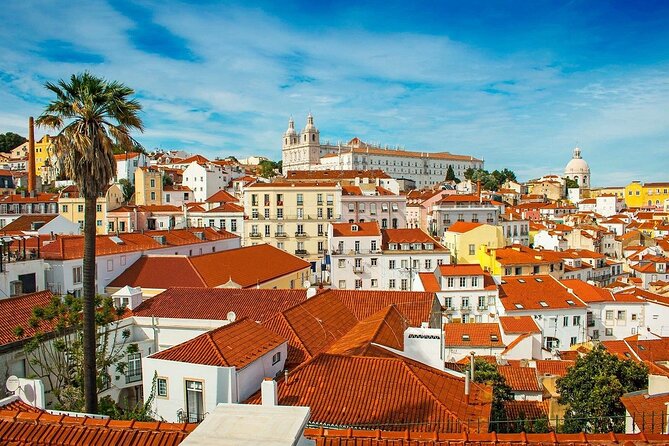
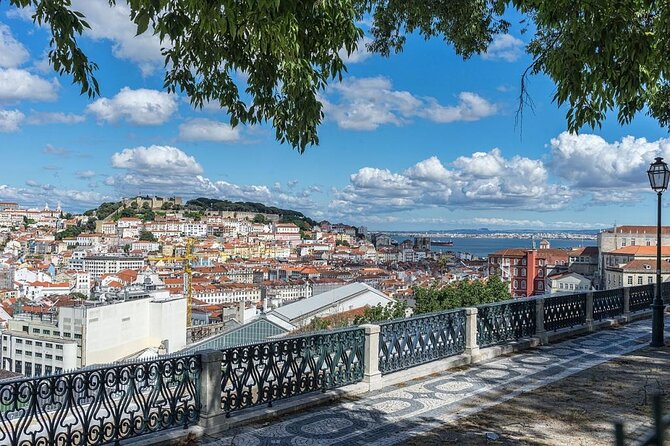
Next is Miradouro das Portas do Sol. This is where Lisbon does that postcard trick—red rooftops, the Tagus River in the frame, and São Jorge Castle as a recognizable silhouette behind it. You’ll have around 15 minutes, which is perfect for a couple of angles without exhausting your legs.
Sunsets are the big draw here, but even in daylight it’s a strong “orientation viewpoint.” It’s also the sort of place where you’ll see both tourists and locals congregating, which helps you understand why it’s a meeting point in its own right.
You can also read our reviews of more private tours in Lisbon






Senhora do Monte: slightly calmer, still big views
Miradouro da Senhora do Monte is another 15-minute viewpoint stop, and it’s a different mood from Portas do Sol. The tour notes describe an atmosphere tied to Fado spirit and romantic Lisbon vibes. In practical terms, it’s a great second viewpoint so you can compare light, angles, and how the city “folds” over its hills.
Alfama: narrow lanes, tiles, and Fado in the background
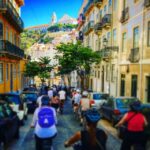
Then you enter Alfama, Lisbon’s oldest neighborhood. This is where the tuktuk earns its keep. You’re not just viewing a district—you’re passing through it, which gives you the feel of the medieval street pattern: winding lanes, whitewashed facades, and colorful tile details.
You’ll have about 15 minutes here. That’s brief, so aim for a couple of things only: a quick walk into one side street, one photo from a small square, and then back into the tuktuk when the clock says so.
Praça do Comércio (Terreiro do Paço): a wide-angle reset
After the tight streets, Praça do Comércio feels like a breath of fresh air. It stretches toward the Tagus River and is lined with yellow buildings and the famous Arco da Rua Augusta. The tour also points out the site’s deeper story: an earlier royal palace area that was destroyed by an earthquake in the 18th century.
You’ll get about 20 minutes. This is a good stop for a quick reset—look at the scale, check the river direction, and get your bearings before the central-city neighborhoods.
Chiado and Bairro Alto: city life, shopping streets, and Fado energy
Lisbon’s center has a different rhythm than Alfama. Chiado is more shopping-and-cafés. Bairro Alto shifts into nightlife territory.
Chiado: elegant streets, bookstores, and café breaks
Chiado gets a 15-minute slot. The tour description emphasizes boutique-style streets, charming bookstores, and trendy cafés. It’s a quick hit, but it gives you a sense of Lisbon as a modern European capital, not just an old-world maze.
If you want to do actual shopping, this timing might feel short. Use it for one street “sample,” not a full browsing plan.
Miradouro São Pedro de Alcântara: one last view before the climb
You’ll stop at São Pedro de Alcântara viewpoint (about 10 minutes). It sits in the Bairro Alto area and gives panoramic views over the historic center, castle, and the Tagus River. The garden nearby is also described as a calmer space with fountains and sculptures.
Ten minutes is barely enough for a photo and a breath of air—but it’s a smart slot because it caps the viewpoint run before you head into the neighborhood streets.
Bairro Alto: lived-in streets with nightlife vibes
Bairro Alto then gets about 30 minutes. It’s known for lively nightlife, historic lanes, eclectic bars, and Fado music. You’re not promised a full Fado experience on this schedule, but you can feel the “evening energy” in the street layout.
If you’re visiting during the day, this is still useful. You’ll see the district’s architecture and street life without needing to commit to a night plan.
Basilica da Estrela and Pink Street: two very different Lisbon moods
This part of the itinerary adds variety, which I like. You’re not only bouncing between famous viewpoints—you’re also getting a couple of distinctly different neighborhood flavors.
Basilica da Estrela: neoclassical elegance and royal tombs
Basilica da Estrela is a late-18th-century neoclassical church. The tour notes focus on marble work, domed ceilings, and magnificent altars, plus a major detail that makes it worth your time: it houses the tombs of Queen Maria I and King Pedro III.
Even if your church visit is quick, these are the kind of facts that make a stop feel meaningful instead of rushed.
Pink Street (Rua Nova do Carvalho): daytime color with nightlife history
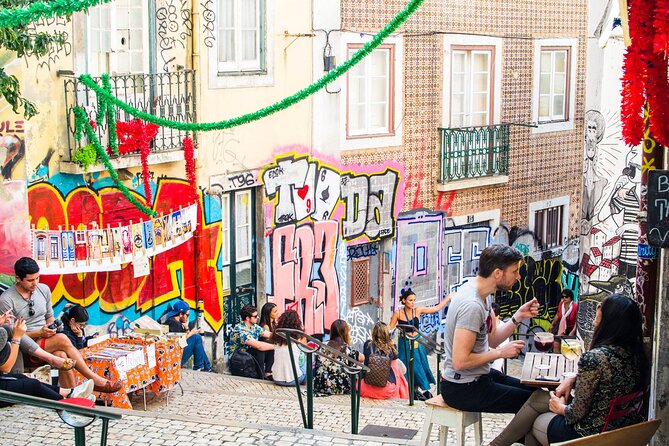
Calle Rosa de Lisboa, or Pink Street, is a fun and unusual contrast. The ground is literally painted pink, and the street’s name comes from that signature look. The tour notes also mention a bigger historical shift: it used to be a red-light district, but it’s now known for lively bars, clubs, and restaurants.
You’ll get about 20 minutes. It’s a great stop for photos and for understanding how neighborhoods change over time. Just don’t plan on a quiet walk here—this is a social street.
Time Out Market Lisboa: your best built-in food option
Time Out Market Lisboa is one of the most practical stops on the whole plan because it’s a real “do something” location. The tour notes explain it was revamped in 2014 after being known as Mercado da Ribeira.
Inside, it’s a food court-style market with many stalls linked to well-known Lisbon restaurants and a wide selection—traditional Portuguese dishes alongside international options. It’s also described as hosting activities like cooking workshops, live concerts, and art exhibitions.
This stop is listed at about 15 minutes. That’s enough time to grab a snack or a quick tasting, but not enough for a long meal if the lines are steady. My advice: decide before you arrive whether you’re doing a quick bite or a full choice dish, then commit quickly once you’re inside.
Belém in one half-day: monuments, MAAT, and the riverfront mindset
The itinerary’s second half moves toward Belém, which is smart. It clusters big-name Lisbon icons that sit near the Tagus. The pacing still stays “snack-size,” so think of this as seeing the sights enough to guide your next trip, not a full museum day.
Jerónimos Monastery: the Manueline highlight
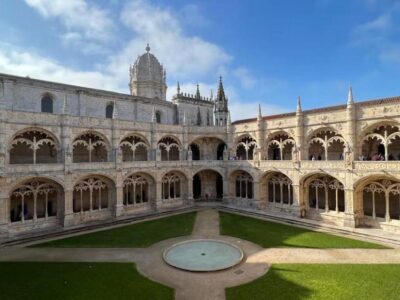
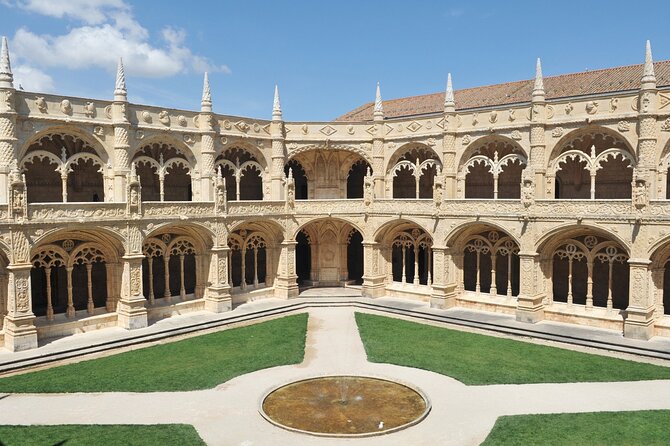
Jerónimos Monastery is described in detail: a Manueline-style masterpiece built in the early 16th century to commemorate voyages of discovery. The tour notes call out the intricate lace-like stonework and maritime motifs, and mention that it houses the tombs of Vasco da Gama and Luís de Camões.
This is one of those stops where even a short visit can change how the rest of the Portuguese history story lands. The trick is to keep your expectations realistic: with a 4-hour tour, you’ll likely focus on the most striking exterior features and key interior moments rather than trying to read every carved detail.
Padrão dos Descobrimentos: a sculpted history lesson
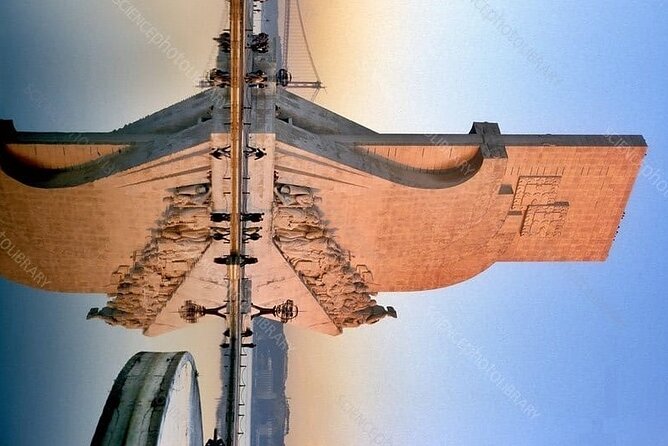
Next comes the Discovery Monument (Padrão dos Descobrimentos). The tour description highlights the towering structure and the sculptures of Henry the Navigator, Vasco da Gama, and Ferdinand Magellan. It also mentions that you can ascend for panoramic views and that there’s an exhibition inside.
Admission is listed as free for this stop. Even if you don’t go up, the exterior is a strong “Age of Discovery” visual statement, and it helps connect Lisbon to its seafaring identity.
MAAT: modern art with a river view setting
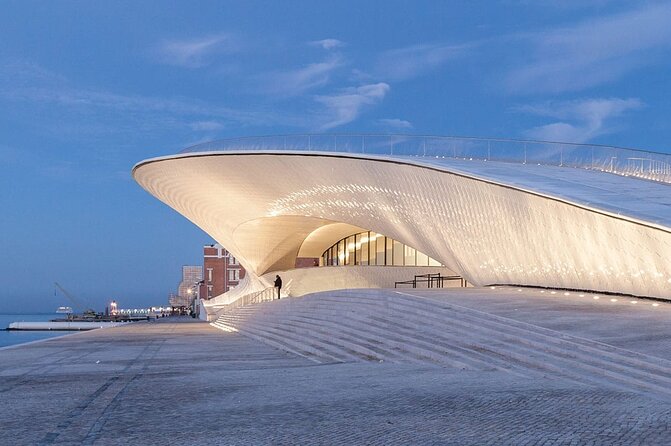
MAAT Lisbon is a contemporary museum focused on art, architecture, and technology. The tour notes describe a striking modern design and an undulating canopy, plus a riverfront promenade. If you usually skip modern art, I’d still give MAAT a chance here because its setting is part of the experience.
You’ll have about 25 minutes. That’s enough to walk the main areas, read a few exhibition prompts (if open), and get a feel for the building.
Torre de Belém: a quick Belém icon stop
The itinerary includes Torre de Belém with a 20-minute stop and notes that admission is not included. The data doesn’t give extra detail beyond the stop name here, so treat it as a photo-and-orientation stop rather than a deep visit unless you plan to add time elsewhere.
Getting the most from the time you have
This tour is built for a “see the city fast, then choose your next moves” style of travel. If you love photos, this itinerary is set up well: you get multiple viewpoint stops, plus neighborhood time that lets you frame Lisbon from street level.
If you want to make the day easier for yourself:
- Pick one or two “must photo” miradouros before you start, so you’re not overwhelmed at the viewpoints.
- Treat churches as orientation stops: see the outside and one key interior element instead of trying to tour everything.
- Bring a light plan for Time Out Market: quick snack or quick lunch, not both.
Comfort, safety, and the one real thing to watch for
Most feedback is very positive, and guide names like Belal, Mohammed, Sohel, Shaf, Arif, Yar, and others show up repeatedly in the ratings. People also praise careful driving in narrow old streets and a respectful, patient approach—exactly the behavior you hope for when you’re riding above cobblestones.
Still, there are a few sharp negative reports in the data: two mention an operator not showing up, and one mentions commentary that was hard to hear due to no headset. Another mentions vehicle comfort being rough.
So here’s the practical takeaway: keep your phone charged and your start details ready. If you’re relying on pickup, confirm the meeting point and time. And if commentary quality matters to you, ask what the audio setup is like for your group size.
Who this tour is best for (and who might prefer something else)
This is a smart choice if:
- You’re in Lisbon for a short time and want a high-impact overview.
- You don’t want to navigate uphill neighborhoods on foot for hours.
- You like guides who explain what you’re seeing and help connect Lisbon’s eras (medieval lanes to maritime monuments).
It’s less ideal if:
- You want long, slow museum time (this is a tight schedule).
- You’re very sensitive to bumpy rides and want a highly cushioned vehicle.
- You need a fully reliable pickup with no flexibility at all. With any private operator, it’s wise to be ready with the central meeting point address in case timing changes.
Should you book this Lisbon tuktuk highlights tour?
I think it’s a good booking for the right traveler. If you want a half-day sampler that combines neighborhoods, viewpoints, and Belém monuments—without spending your vacation doing logistics—this tour fits that goal.
The value comes from the mix: private transport, free-or-easy stops, and enough time at miradouros to get photos you’ll actually want to keep. The main decision point is risk management: because there are a couple of no-show complaints, don’t treat this as your only plan for the day. Build in a little slack.
If your priority is a guided, efficient orientation that makes your next Lisbon walk (or day trip) easier, this is very likely worth your money.
FAQ
How long is the Lisbon City Highlights tour?
It runs for about 4 hours.
Where does the tour start and end?
It starts at Time Out Market (Mercado da Ribeira, Av. 24 de Julho, 1200-479 Lisboa) and ends back at the same meeting point.
Does the tour include hotel pickup?
Hotel pick-up is offered.
Is the tour private?
Yes. Only your group participates.
What language is the tour offered in?
The tour is offered in English.
What’s included in the price?
Included are private tuktuk transport/transfer, insurance, and hotel pick-up (when applicable).
Are food and drinks included?
No. Food and drinks are not included.