REVIEW · TUK TUK TOURS
Tuk Tuk Lisbon: Exploring Urban Art
Book on Viator →Operated by TukGuide Portugal · Bookable on Viator
Street art in Lisbon is better at street level. This Tuk Tuk tour links major outdoor works into a tight route, so you can see names like Pichi&Avo, André Saraiva, and Vhils without spending hours on buses and stairs.
I love how it blends the art with the city walk-and-look rhythm. You get private transportation plus a guided explanation that helps the murals click, not just sit there looking cool. One consideration: it’s not recommended for reduced mobility (and kids under 7 can’t join), so check your comfort with the ride and the outdoor viewing spots.
In This Review
- Key highlights you’ll notice
- Why Lisbon urban art works best on a Tuk Tuk
- Sidewalk of Santa Apolónia: Pichi&Avo’s tag-to-statue feeling
- Santa Clara Field: André Saraiva’s 170 meters of tiles
- Travessa das Merceeiras: finding Vhils (Alexandre Farto) in Lisbon
- Graça and Senhora do Monte: literary faces that turn walls into characters
- Avenida Fontes Pereira de Melo: Os Gémeos, Blu, Eric Il Cane, and Sam3
- Lx Factory: Bordalo II’s garbage bee and the fun side of street art
- What 2 to 3 hours feels like in real Lisbon time
- Pickup, meeting points, and the easiest way to start
- Price and value: what you’re really paying for
- Who this Tuk Tuk art tour suits best
- Should you book Tuk Tuk Lisbon for urban art?
- FAQ
- How long is the Tuk Tuk Lisbon urban art tour?
- How much does the tour cost?
- Is the tour offered in English?
- Is pickup available?
- Where can I meet if I don’t want pickup?
- Is this a private tour?
- Do I need to buy monument tickets or museum tickets?
- Are food and drinks included?
- Are children allowed?
- Is the tour suitable for reduced mobility or pregnancy?
- Is free cancellation available?
Key highlights you’ll notice
- Photo-friendly stops that let you get close enough for real detail shots when traffic allows
- A mix of artists and styles, from sculptural street figures to huge tile mosaics
- Lisbon-by-literature moments in Graça, with faces of national writers in wall art
- International mural scale at Avenida Fontes Pereira de Melo across three vacant buildings
- Lx Factory creativity stop, including Bordalo II’s garbage-bee concept
- Private guide + small-group feel, offered in English with pickup options near central areas
Why Lisbon urban art works best on a Tuk Tuk
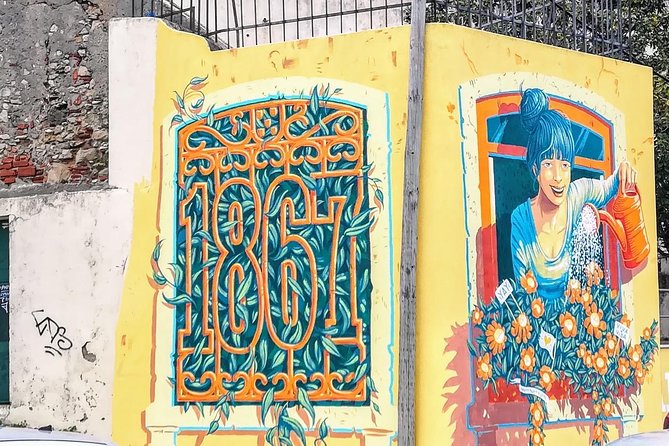
Lisbon is one of those cities where the best “museum” is outside. But street art is scattered, and the distance adds up fast when you’re hopping neighborhoods on foot. This is where the Tuk Tuk format earns its keep.
The whole idea is simple: you ride, you stop, you look, you learn. You’re not trapped in a long lecture, either. A good guide points out what to notice—faces, lettering styles, scale tricks, and the way different artists treat the same wall like a canvas with rules of their own.
Also, you’re not just getting a list of famous names. You’re getting context for why these works feel tied to Lisbon’s streets. That matters. A mural that reads like graffiti one minute can look like sculpture the next, depending on what you’re seeing and how the artist built the composition.
As for who you might ride with, the guides can vary. In past tours, Nuno has been praised for making the city feel alive with his art + history storytelling. Filipe and Pifas have also been singled out for street-art enthusiasm and for sharing plenty beyond just the paint on the walls.
You can also read our reviews of more tours and experiences in Lisbon.


Sidewalk of Santa Apolónia: Pichi&Avo’s tag-to-statue feeling
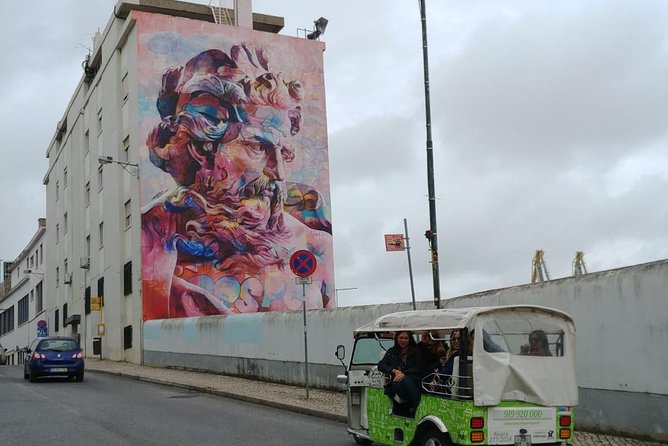
Your first key stop is the Sidewalk of Santa Apolónia, where you’ll encounter a major work by Pichi&Avo. The duo’s style is known for a mix: classic art forms paired with the rebellious energy of graffiti. Here, that translates into a big sculptural figure sitting over a mass of tags on the side of a building.
What I like about starting here is the visual “shock” of contrast. The figure has weight. The tags create noise. Put together, they tell you something about how street art can be both messy and deliberate at the same time.
Another smart detail is the link to its setting. This mural was made within an exhibition called Versus, at Underdogs Gallery. Even if you don’t go inside that kind of gallery world, the clue matters: these artists aren’t just painting walls for fun. They’re staging ideas.
Practical tip: bring your eyes for both layers—the main figure and the background writing. If you only focus on the face or outline, you miss how the lettering works like texture in the overall image.
Santa Clara Field: André Saraiva’s 170 meters of tiles
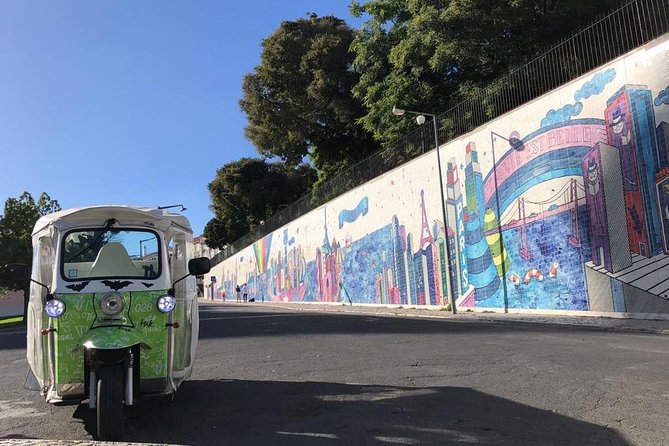
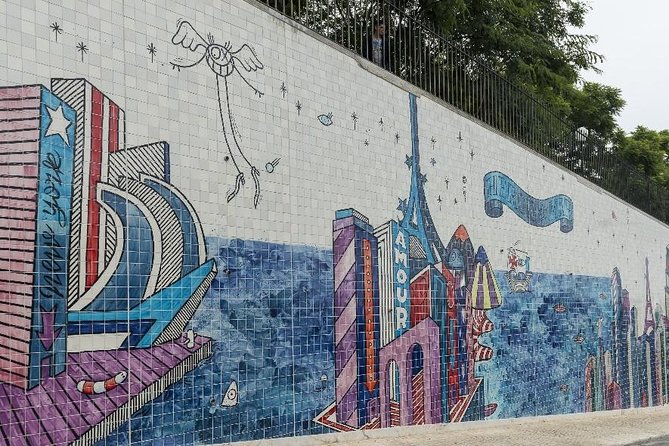
Next you head to Santa Clara Field, near the wall in the Jardim Botto Machado area (by Campo de Santa Clara and Feira da Ladra). This is where you’ll see André Saraiva’s tile mural, covering 170 meters and about 1,000 m², made from roughly 53,000 tiles.
Tile murals are slow art. They take time to craft, and they reward patience from the viewer. From a distance, you get the overall picture. Step closer and the tile grid turns into a pattern machine—light, color edges, and tiny variations that would be hard to recreate with paint alone.
This stop is also a lesson in scale. Street art often works as a surprise in your peripheral vision. Here, the scale is the main event. You’re not reading a small signature. You’re confronting a long wall that basically becomes its own neighborhood landmark.
If your schedule is tight, this is one of the stops where you should pause longer. You’ll learn more by standing still and letting your eyes adjust than by snapping one quick photo and moving on.
Travessa das Merceeiras: finding Vhils (Alexandre Farto) in Lisbon
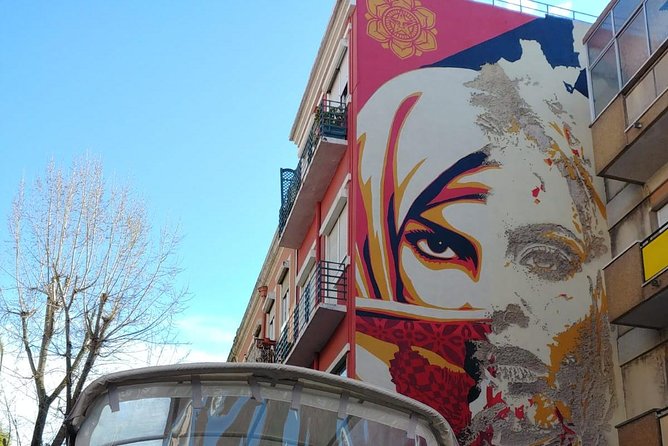
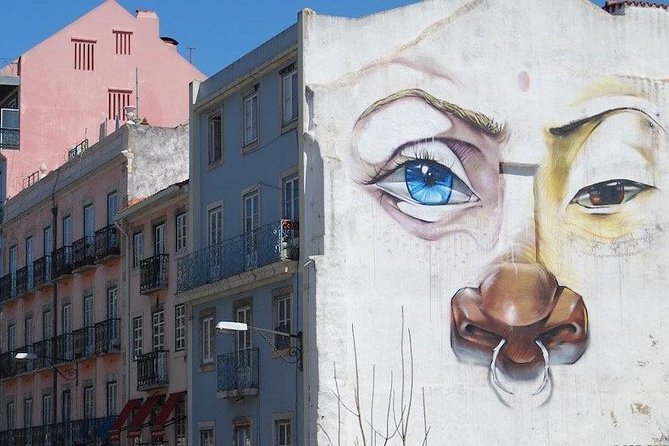
Then comes Vhils, real name Alexandre Farto, spotted in Travessa das Merceeiras. Vhils is known for making images by carving and removing material, which gives his work a built-in texture. It doesn’t sit on the surface like a decal. It feels cut into place.
This is a great stop for learning how urban art can change your idea of “where” a mural lives. Instead of thinking paint on flat walls, you start thinking about the wall as a physical object that can be sculpted.
It’s also one of those moments where placement matters. If you’re walking too fast, you might miss the exact angle where the carved effect becomes clear. On a Tuk Tuk ride, you can get positioned, stop, and look without the marathon footwork.
If you care about photography, treat this as your “detail stop.” Bring your phone close enough to capture texture without flattening everything into one blur.
Graça and Senhora do Monte: literary faces that turn walls into characters
From there, the route heads toward the Graça district and nearby Senhora do Monte viewpoint area. This is where the art shifts from the purely contemporary to something that feels woven into national identity.
A group of artists created works honoring figures tied to Portuguese literature and connected to Graça. You’ll see:
- Sophia de Mello Breyner by Eime, on Rua Josefa de Óbidos
- Natália Correia and Florbela Espanca by Mariana Dias Coutinho, on Travessa do Monte
The useful part of this stop isn’t just recognition. It’s what it does to the streetscape. You’re forced to read the city in a new way—like the neighborhood has a memory layer. A wall becomes a cast of characters, and the district becomes more than a viewpoint.
Also, the area includes viewpoints of Graça and Senhora do Monte nearby. That means even if street art is your main goal, the ride naturally feeds into the classic Lisbon habit: stop, look out, and reset your brain with a skyline view.
Practical tip: if you’re planning your day around photos, time this part when the light is kind. Hills can make shadows fall differently on different streets, and your pictures will look better if you’re not fighting heavy glare.

Avenida Fontes Pereira de Melo: Os Gémeos, Blu, Eric Il Cane, and Sam3
Now you get a major scale jump: works by several international artists across three vacant buildings on Avenida Fontes Pereira de Melo. This part includes Brazilian Os Gémeos, Italian Blu and Eric Il Cane, plus Spanish artist Sam3.
One mural across a single wall is impressive. Three vacant buildings’ worth changes the vibe. You start thinking of the street as a gallery district. The building voids also give the art an edge—these walls are part of an unfinished story, and the art answers back.
There’s also a credibility boost here. A British newspaper, The Guardian, once considered this work among the top 10 best in the world. Even if you don’t chase rankings, that kind of spotlight usually means you’re looking at something with real public impact.
For your eyes, focus on how different artists handle space. Some will go for bold, simplified forms. Others lean into darker atmospheres or typography. The contrast between crews is the point.
Lx Factory: Bordalo II’s garbage bee and the fun side of street art
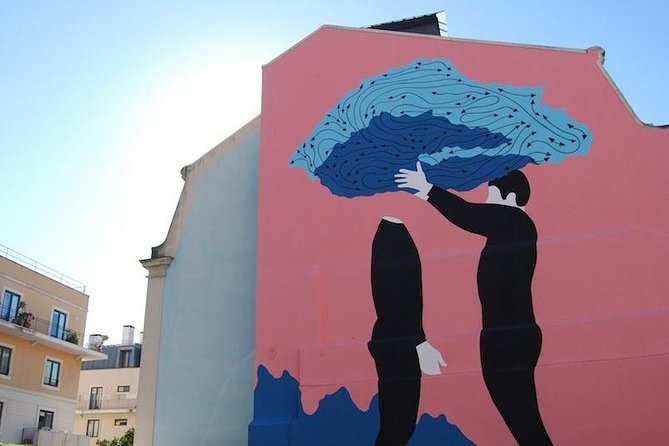
Finally, the tour heads into Lx Factory, a creative factory area with plenty of outdoor and semi-outdoor street art. Here, you’ll find more than a dozen works and some big names, including Bordalo II with his huge bee made from garbage.
This is a good ending because it shifts the mood from “find the mural” to “browse the scene.” Even if your head is full by this point, this stop gives you room to wander and make your own connections: reuse themes, humor, and the way Lisbon’s street art can carry social meaning without taking itself too seriously.
And yes, Bordalo II is exactly the right artist to close with. A garbage-made bee is funny, but it’s also a nudge about waste and attention—what we throw away and what we keep noticing.
If your group likes photos, this is where you’ll want to slow down. Don’t just shoot the big bee. Look around for smaller pieces nearby so you end the tour with a set of images that show variety.
What 2 to 3 hours feels like in real Lisbon time
The tour runs about 2 to 3 hours, which is just long enough to make the art feel connected without turning it into an all-day project. That range also helps if you’re juggling other plans like a food stop, a viewpoint, or a museum.
The route is designed for easy movement by private transportation, so you’re not counting every step. Still, it’s an outdoor art experience. You’ll be looking at walls and standing at stops, so bring a comfortable mindset: this is not a “sit on a couch” tour.
Traffic can affect photo time at the stops. One of the best tips I can give is to treat your camera setup like you’re ready to go fast. If the guide can stop and hold position, you’ll want to capture the mural details quickly and then give the guide room to move you along.
If you’re traveling with a more relaxed pace, you’ll still enjoy it. But if you’re the type who wants every mural taken from the perfect angle, you’ll probably appreciate having a guide who’s willing to adjust stops when possible. Past tours have praised guides for allowing stops that make photography easier when conditions allow.
Pickup, meeting points, and the easiest way to start
Pickup is offered, and the tour can pick you up at Lisbon hotels and Aibnbs near the historic centre, in the three cruise terminals, and even in nearby restaurants or other close-to-central spots that serve guests. They also suggest two very practical meeting anchors: Time Out Market and Alto do Parque Eduardo VII.
Why does this matter? Because Lisbon pickups are smoother when you start from a place with good access and clear instructions. If you’re staying in a maze of narrow streets, central meeting points can save you time.
The tour ends back at the meeting point, which is another small but meaningful detail. You won’t be stuck wondering how to get yourself home while your legs are deciding whether they want to walk.
Tip: decide ahead of time whether you want to meet at a known public location (like Time Out Market) or you want the pickup to come to your door area. If you’ll be out exploring nearby, public meeting points keep you from playing phone tag.
Price and value: what you’re really paying for
The price is $93.73 per person for a 2 to 3 hour private guided street art experience, including private guide and private transportation. That can look steep until you compare it to what you’d spend doing the same route on your own.
Here’s where the value shows up:
- You’re paying for guided context, not just movement between murals
- You’re paying to avoid the friction of transit planning across multiple neighborhoods
- You’re getting English interpretation, which can make meaning pop fast when you’re staring at tags, symbols, and styles
This isn’t a budget “drop you off and hope for the best” experience. The setup is closer to a tailored art walk, just with fewer stairs.
Also, booking tends to happen ahead of time—on average, people book around 45 days in advance. If you want a specific time window, don’t wait until the last minute.
If you’re traveling with a small group, a private setup can become the best value. Even when it’s just you or two people, you’re still getting a dedicated guide, which usually beats “average group tour” for street art where observation matters.
Who this Tuk Tuk art tour suits best
This works best if you:
- Like street art that has names and meaning, not only color
- Want to cover multiple neighborhoods without a big transit hassle
- Prefer a guided route so you know what you’re looking at while you’re looking at it
It’s also a strong choice if you enjoy Lisbon viewpoints and neighborhoods beyond the postcard core. The Graça area stop ties the art to the city’s viewpoint culture.
The main mismatch is comfort and eligibility. The tour is not recommended for pregnant women or people with reduced mobility, and children under 7 aren’t allowed. If anyone in your party has movement challenges, you should take that seriously and plan an alternative.
There’s also a max capacity of 400 kg and 6 seats, which suggests it’s kept small and controlled. That often makes the tour feel more responsive to your group.
Should you book Tuk Tuk Lisbon for urban art?
Book it if you want street art in a format that feels efficient, guided, and photo-friendly. This tour lines up major artists—Pichi&Avo, André Saraiva, Vhils, and international crews—plus the literature-themed wall art in Graça. It’s a practical way to see a lot of Lisbon art without spending your energy on navigation.
Skip it if you need a fully step-free experience or if your group includes someone who can’t handle outdoor viewing conditions. Also, if you’re the type who only wants a quick hit of art and hates waiting at stops, this might feel like a little too much structure.
If your goal is to see Lisbon’s walls as stories, not just decoration, this is a very good bet.
FAQ
How long is the Tuk Tuk Lisbon urban art tour?
It runs about 2 to 3 hours.
How much does the tour cost?
The price is $93.73 per person.
Is the tour offered in English?
Yes, it’s offered in English.
Is pickup available?
Yes. Pickup is available at Lisbon hotels and Aibnbs near the historic centre, in the cruise terminals, and at other nearby places close to the historic centre that serve guests.
Where can I meet if I don’t want pickup?
They suggest meeting at Time Out Market or at Alto do Parque Eduardo VII, since both are usually functional meeting points.
Is this a private tour?
Yes. It’s private, and only your group participates.
Do I need to buy monument tickets or museum tickets?
No. Monument tickets are not included.
Are food and drinks included?
No. Food and drinks are not included.
Are children allowed?
Children under 7 are not allowed.
Is the tour suitable for reduced mobility or pregnancy?
It’s not recommended for pregnant women or people with reduced mobility.
Is free cancellation available?
Yes. You can cancel up to 24 hours in advance for a full refund.