REVIEW · CRUISES & BOAT TOURS
Sight Sailing in Lisbon
Book on Viator →Operated by Lisbon Sight Sailing · Bookable on Viator
Lisbon looks even better from the water. This private sailing trip on the Tagus River gives you a smooth, scenic way to see Lisbon’s major sights from the skyline-up perspective. You’ll start with a welcome drink on board and settle in while your local guide points out what you’re looking at and why it matters.
I especially like the mix of big-name landmarks with human-scale storytelling. The wine tasting and Portuguese gastronomy onboard add something practical and fun, not just sightseeing photos. In the crew comments I saw names like Luis, Tomas, Bruno, and Fernando credited for being friendly and engaging while they explain Lisbon’s history.
One possible drawback: you’re mostly viewing monuments and neighborhoods from the water. If you want to step inside places like Jerónimos Monastery or Lisbon Cathedral, this sail won’t replace those stops—you’ll just get the river view and the story.
In This Review
- Key things I’d note before you book
- Boarding on the Tagus: what the first 30 minutes feels like
- 2 hours 30 minutes: a smart length for sailing Lisbon
- Belem Tower and the Monument of the Discoveries: Lisbon’s power seen from water
- Earthquake memory and Terreiro do Paço: why Praça do Comércio matters
- April 25 Bridge and the Two-Banks Lisbon view
- Almada’s Christ-King and Ajuda Palace: viewpoints that change the story
- Alfama and the riverfront stair-step: castles, pantheons, and old churches
- Jerónimos Monastery and the maritime legacy you can taste in the air
- Modern Lisbon along the river: MAAT, Central Tejo, and the art-tech shift
- Palácio politics, folk culture, and old wealth: what museums you can spot
- Cais do Sodré and Santa Apolónia: where river travel and city life meet
- The “behind the scenes” Tagus control and dolphin observatory
- Price and value: what you really get for $226.41
- Who should book this Lisbon sailing
- Should you book Sight Sailing in Lisbon?
- FAQ
- How long is the sailing experience?
- How much does it cost per person?
- Is this tour private?
- What’s included onboard?
- What is the meeting point?
- Is hotel pickup or drop-off included?
- Can I refund or change my booking if my plans change?
- Do you get a ticket on your phone?
Key things I’d note before you book
- Welcome drink right at boarding so you start relaxing immediately
- Private guide storytelling tied to Lisbon’s landmarks, not a generic script
- Wine tasting plus Portuguese gastronomy included as part of the experience
- April 25th Bridge and Almada viewpoints for the two-banks perspective
- Sunset energy and calm moments that work especially well for romantic trips and celebrations
- Extras can happen if you share preferences in advance (like cocktails and canapés noted in reviews)
Boarding on the Tagus: what the first 30 minutes feels like
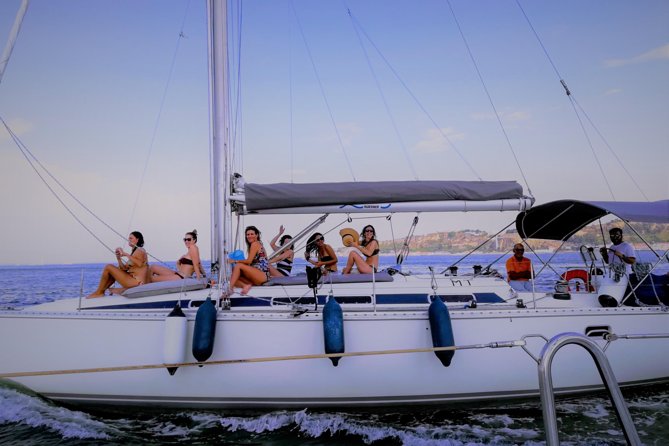
Getting on board for a Tagus sailing trip is usually the moment where the day clicks. Here, you’re greeted and given a welcome drink right when you board, so you don’t waste the start of the cruise hunting for snacks or just trying to figure out the route.
Since this is a private tour, your group sets the tone. That matters in Lisbon, where the view is so good it’s easy to get distracted—standing, pointing, reshuffling seats. On a private boat, it’s easier to settle into a comfortable spot and keep your eyes trained on the landmarks as they slide by at a relaxed pace.
Bring your “photo brain,” but also your “listen brain.” The experience is built around a local guide sharing context as you pass iconic sites. Reviews and tour notes consistently point to this as the best part, with hosts such as Luis and Tomas praised for being story tellers as well as attentive hosts. You’ll get the kind of historical and cultural details that make the skyline feel connected, not random.
You can also read our reviews of more boat tours in Lisbon



2 hours 30 minutes: a smart length for sailing Lisbon
At roughly 2 hours 30 minutes, this cruise hits a sweet spot: long enough to see a lot of the riverfront story, but not so long that it turns into a stamina test. If you’re visiting Lisbon for the first time, it’s a strong “set your bearings fast” option—because the Tagus connects so many neighborhoods and eras.
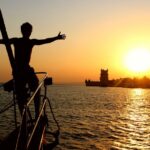
Timing also shapes what you’ll feel onboard. A sunset sail is clearly a favorite, and the reviews back that up: people mention unforgettable views and glowing light near dusk. You might even catch dolphins around sunset, which shows up in feedback as a lucky bonus.
Still, plan for reality. The water is the water. If it’s gusty, the boat will move—so bring a light layer even if it’s warm on land. And if you’re the type who hates waiting around for the perfect moment, this tour’s structure helps: there’s a steady flow of landmarks and commentary rather than long idle stretches.
Belem Tower and the Monument of the Discoveries: Lisbon’s power seen from water
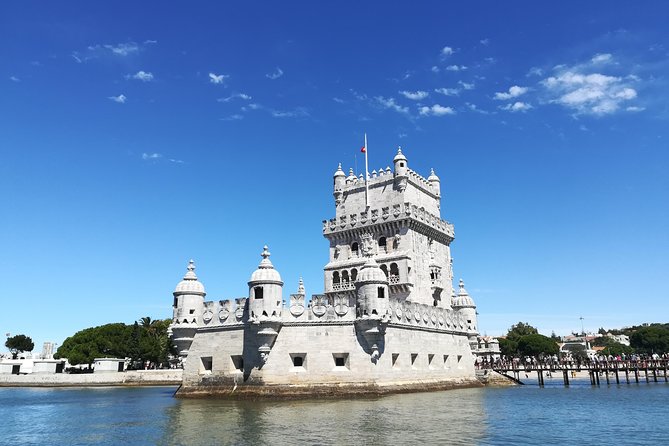
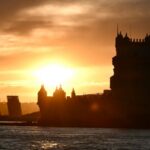
Two of Lisbon’s most recognizable emblems show up early in the story: Belém Tower and the Monument of the Discoveries. From the river, Belém Tower feels especially striking because it’s tied to geography—built at the narrowest point of the Tagus estuary, originally meant to defend Lisbon from the water approach. The interesting detail here is that it was once surrounded by water, and even though that setting has changed, you can still see how it was designed to protect a maritime gateway.
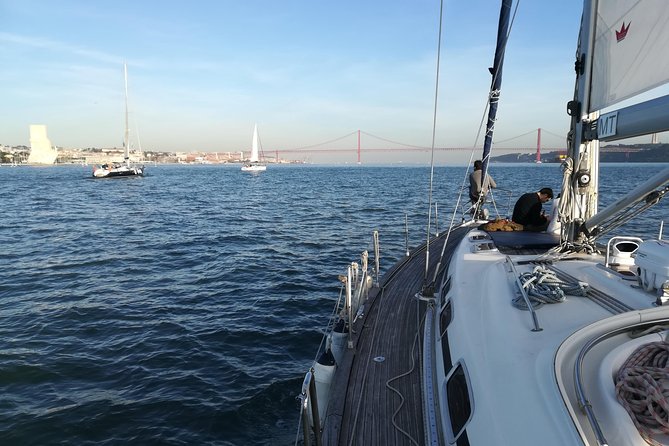
The Discoveries Monument is different in tone: it’s built like a ship, with ramps and a prow crowned by Henry the Navigator. The monument also includes stone figures representing people linked to the Age of Discoveries—names like Fernão de Magalhães, Luís de Camões, Pedro Álvares Cabral, and Vasco da Gama. It’s the kind of landmark that’s impressive in a postcard, but more memorable when someone explains how many historical threads are packed into one sculpted composition.
A small historical detail worth remembering: the original Discoveries Monument was built in 1940 for the Portuguese World Exhibition, using materials meant to be temporary, and dismantled three years later. That adds a layer of meaning as you watch the structure from the water—this isn’t just a symbol, it’s a timeline.
Earthquake memory and Terreiro do Paço: why Praça do Comércio matters
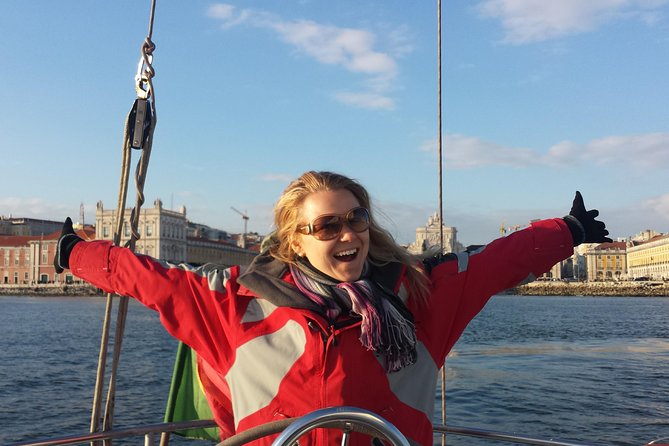
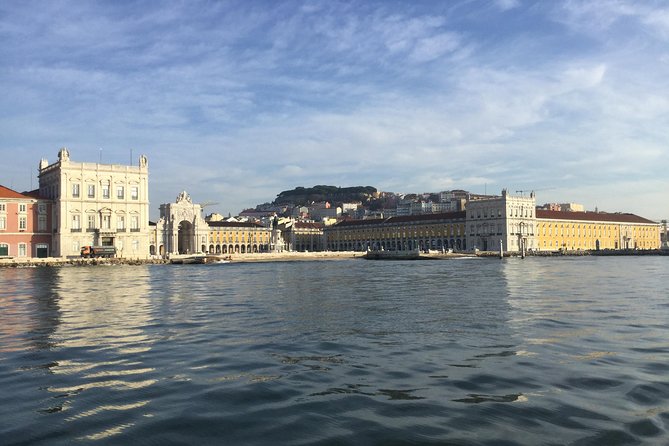
Lisbon has a habit of turning catastrophe into architecture. One moment you’ll hear about is the 1755 earthquake, which started around 9:30 a.m. on November 1. The story explains how thousands of buildings collapsed, especially in downtown areas and the hillside toward Chiado.
What I like about this part of the cruise is how it connects history to today’s riverfront layout. The earthquake shaped reconstruction, including the creation of Terreiro do Paço, a grand square open onto the Tagus estuary (and tied closely to the Praça do Comércio area you’ll hear referenced). It’s not only a memorial story; it’s also a place where modern Lisbon still gathers for major events year-round, including New Year’s Eve fireworks.
From the boat, you get a different feel for why an open square facing the river makes sense. It’s not just pretty geometry. It’s about visibility, access, and public space—built in response to what Lisbon learned the hard way.
April 25 Bridge and the Two-Banks Lisbon view
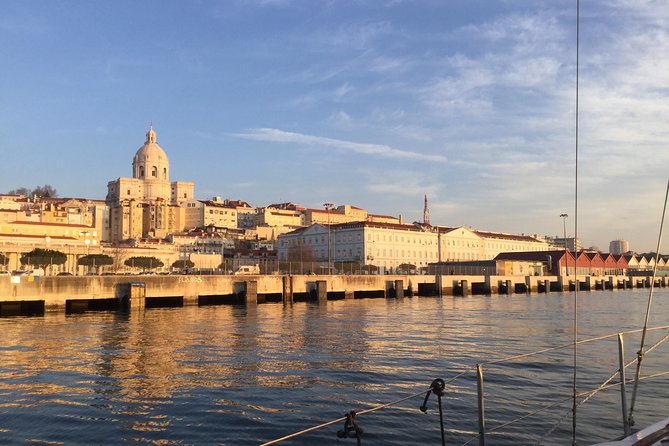
The April 25th Bridge is one of those landmarks that you don’t have to be a bridge nerd to appreciate. It’s sometimes nicknamed the Portuguese Golden Gate Bridge because it resembles the San Francisco suspension bridge, and it even points to a shared construction story involving a North American company. You’ll also hear that it was originally called Ponte Salazar.
From the sailing boat, the real value is the way the bridge anchors the whole scene. You’re seeing Lisbon’s engineering footprint as well as its connection to the other side of the river—Lisbon and Almada. In other words, you’re not just looking at a structure. You’re seeing the city as a system.
Also, it’s built into the cruise pacing: you pass it, and then the view shifts to the opposite bank. That’s when the skyline stops being a single city image and becomes a two-part panorama.
You can also read our reviews of more sailing experiences in Lisbon



Almada’s Christ-King and Ajuda Palace: viewpoints that change the story
Once your route brings you toward Almada, the conversation expands beyond Lisbon proper. The headline here is Christ-King, a monument with a 75-metre-high portico and a statue of the Most Holy Redeemer with open arms facing Lisbon, topping out at a total height of 82 metres including the pedestal. Even if you’re not a religious architecture fan, the scale is the point—the monument is a major attraction in Almada.
The detail that makes it more than just a statue: it was built to fulfill a vow made in 1940 by the Portuguese episcopate asking God to free Portugal from involvement in World War II. António Oliveira Salazar’s government stayed neutral, which helps explain why a religious monument became tied to the country’s political stance.
Then there’s Ajuda Palace, a 19th-century landmark designed as a royal residence and now a national museum. On the cruise, you’ll get the payoff of its location: stunning views over the Tagus and Lisbon. Even without stepping inside, the palace works as a “you are here” marker for Lisbon’s higher ground and how the city climbs away from the river.
Alfama and the riverfront stair-step: castles, pantheons, and old churches
Lisbon’s oldest neighborhood, Alfama, shows up as more than a name. You’ll hear about its cobbled, narrow streets and its position on the hill next to São Jorge Castle, with the Tagus as one of its borders. From a boat, you can’t walk Alfama’s lanes, but you can still feel the steep structure of the neighborhood—how the city grew around the need to look outward.
That connects to São Jorge Castle, founded in the 10th and 11th centuries when Lisbon was a Muslim port city, later conquered in 1147 by D. Afonso Henriques. The skyline view from this hill is a big reason people love seeing the castle from below and from the water.
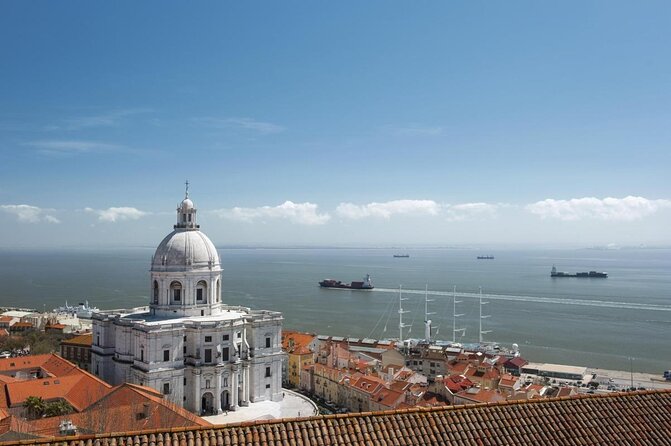
You’ll also hear about the National Pantheon, also known as the Church of Santa Engrácia, located in Alfama. It’s treated as a National Monument and used as the resting place of exceptional Portuguese people. Again, you won’t see it like a photo-tour stop from street level, but the river view helps you understand how Alfama’s religious and cultural landmarks cluster on the hill.
And for the oldest church: the Lisbon Cathedral (construction began in the late 12th century after the Moors were conquered). The big practical detail with cathedrals is what’s inside, and here that’s the treasury—valuable objects across multiple halls. From the water, you’ll get the main structure and context; if you want the treasury, that’s when you’d pair the sail with a land visit.
Jerónimos Monastery and the maritime legacy you can taste in the air
Another key river-adjacent stop is Jerónimos Monastery, a 16th-century Portuguese architecture masterpiece. It’s a national monument in a historic setting along the Tagus, and the cruise framing matters: it’s tied to departures of Portuguese navigators.
If you’re a person who likes names, this is your stop. You’ll hear about Vasco da Gama and Luís de Camões as major figures associated with the site. And even if you never step inside during the cruise, it helps to connect the monument to the fact that Lisbon’s maritime identity wasn’t abstract—it was a system of people, voyages, and ambition.
Modern Lisbon along the river: MAAT, Central Tejo, and the art-tech shift
Not all of Lisbon’s story is old stone. Two stops highlight the city’s modern turn along the waterfront: Central Tejo and the MAAT (Museum of Art, Architecture and Technology).
Central Tejo used to be a thermoelectric plant supplying electricity to the entire Lisbon region. Built in 1908 with productive activity from 1909 to 1972, it later opened to the public as the Electricity Museum in 1990, then reopened definitively in 2006 after restoration. The key value here is the transformation story—industry turned into public cultural space.
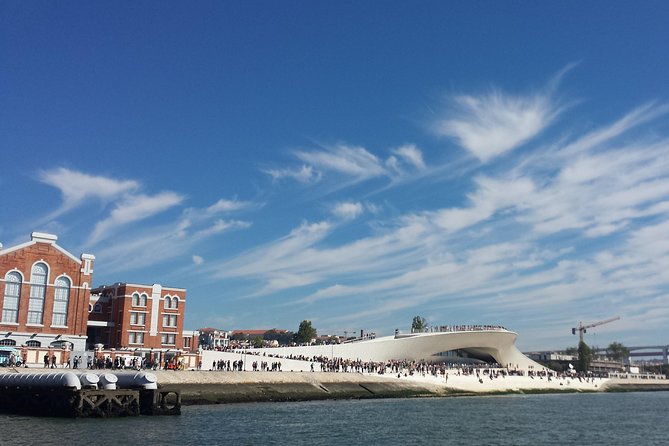
MAAT adds a different vibe. Opened in 2016 and designed by British architect Amanda Levete, it focuses on exhibitions with contemporary artists, architects, and thinkers. From the river, these buildings help you understand that Lisbon’s skyline isn’t only about the past—it’s also about how the city repurposes new ideas into public architecture.
Also keep an eye for these kinds of stops: they’re easy to ignore when you’re walking fast on land, but from the water they look intentional and powerful.
Palácio politics, folk culture, and old wealth: what museums you can spot
You’ll also hear about the National Ancient Art Museum, housed in the Palácio dos Condes de Alvor, founded in 1884. The guided angle you’ll get on board emphasizes why the building matters as much as the collection: ornate façade and Portuguese civil architecture style, plus artwork spanning more than 500 years and influences from Europe, Africa, and the Orient.
Then there’s the Folk Art Museum (FAM), with a story that starts in the 19th century and runs through the Portuguese World Exhibition in 1940. The pavilion became a museum and opened July 15, 1948. If you’re the kind of traveler who loves how public spaces preserve everyday culture, this is one of those details that makes the skyline feel like a living archive, not just a set of landmarks.
Cais do Sodré and Santa Apolónia: where river travel and city life meet
Two riverfront areas that help round out the cruise picture are Cais do Sodré and Santa Apolónia Station.
Cais do Sodré is described as one of the most historic and iconic places in Lisbon, with a privileged Tagus-facing location. Historically, in the 17th century it was known as the Port of Vessels where ships left for Portuguese colonies, and later in the 19th century it became a zone of bars and entertainment venues that pulled in sailors and adventurers. From the boat, it helps explain why Lisbon’s riverfront has always been a meeting point—trade today becomes nightlife later.
Santa Apolónia is another anchor. It’s one of Portugal’s oldest train stations, inaugurated in 1865 in a building that used to be a convent. It was planned as a railway and river station, and since 2007 it’s been the end of a metro line. The cruise notes also point out that it’s very close to the cruise port terminal and part of it is now home to the five-star The Editory Riverside Santa Apolónia, with 126 rooms themed around Portuguese railway heritage.
The “behind the scenes” Tagus control and dolphin observatory
One of the more surprising parts of the cruise is that you may get a quick look at the infrastructure that keeps the Tagus running: the Maritime Traffic Control Centre (VTS Tower). This facility manages navigation within the Administration of the Port of Lisbon’s jurisdiction, with coverage up to a radius of 16.5 nautical miles, and it advises ships approaching the estuary and managing wharves.
The tour info also highlights that the space currently accommodates a dolphin observatory on the Tagus River. If you like science and real-world operations, this is a fun contrast to the more romantic parts of the skyline. It also connects nicely to why dolphins sometimes show up during sunset sails.
Price and value: what you really get for $226.41
At $226.41 per person (for a private sailing experience of about 2 hours 30 minutes), this isn’t a budget impulse buy. The value comes from the package: a private tour, an onboard local guide, wine tasting, Portuguese gastronomy, plus bottled water and alcoholic beverages, with all fees and taxes included.
For many people, the cost per hour is easier to swallow when you realize you’re not paying extra for food, drinks, and guiding. You’re also paying for the format—private time on the water with a guided narrative aimed at Lisbon landmarks like Belém Tower, the Discoveries Monument, April 25th Bridge, and Praça do Comércio/Terreiro do Paço.
One consideration: hotel pickup and drop-off aren’t included, so you’ll want to factor in how you’ll get to the quay and back. On the plus side, the meeting point is near public transportation, which makes it easier to keep the day simple.
Who should book this Lisbon sailing
This is a strong match if you want:
- A view-first way to see Lisbon’s signature landmarks (instead of trying to pack everything into walking tours)
- A shared group experience with a private feel, especially for birthdays, honeymoon time, and group celebrations noted in onboard feedback
- A combination of history storytelling and actual onboard comfort, including drinks and Portuguese bites
It may be less ideal if your top goal is interior museum time. This sail gives you skyline context and guided background, but the experience is built around the water view—not museum entry lines.
Should you book Sight Sailing in Lisbon?
If your ideal Lisbon day includes a Tagus River cruise, a local guide who can explain what you’re seeing, and onboard wine plus Portuguese gastronomy, I think you should book. The pricing feels more reasonable when you treat it as a bundled private outing instead of a plain boat ride.
I’d skip it only if you want a lot of on-land stops or you can’t handle boat movement. If you’re flexible on that, you’ll likely walk away with the kind of Lisbon memory that’s hard to replicate from the street: a skyline you finally understand from the river.
FAQ
How long is the sailing experience?
It lasts about 2 hours 30 minutes.
How much does it cost per person?
The price is $226.41 per person.
Is this tour private?
Yes. It’s a private tour/activity, and only your group participates.
What’s included onboard?
Included are all fees and taxes, a local guide, wine tasting, an opportunity to taste Portuguese gastronomy, bottled water, and alcoholic beverages.
What is the meeting point?
Meet at Av. Brasília 5, 1350-353 Lisboa, Portugal.
Is hotel pickup or drop-off included?
No. Hotel pickup and drop-off are not included.
Can I refund or change my booking if my plans change?
No. The experience is non-refundable and cannot be changed for any reason. If you cancel or request an amendment, the amount you paid won’t be refunded.
Do you get a ticket on your phone?
Yes. You receive a mobile ticket.