REVIEW · LISBON
Lisbon Trendy Downtown – From Romantic Chic to Postmodern Glamour
Book on Viator →Operated by Lisbon Art & Soul · Bookable on Viator
Lisbon’s downtown tells a story at every corner. This walking tour strings together Chiado and Baixa so you see the post-1755 rebuild in real places, not just on plaques, while a professional photographer helps you leave with photos that actually look like Lisbon. I love the way the guide reads the city through details like tilework, shopfront clues, and building shapes that hint at what used to be there. I also love the photo support, because downtown lighting can be tricky and you do not want to rely on random selfies. A possible drawback: you’re on your feet for a few hours, and with stops measured in minutes, it’s best for people who like moving through a route rather than lingering.
You’ll start at Estação Ferroviária do Sul e Sueste and finish in Praça Luís de Camões. Along the way you’ll hit major squares such as Praca do Comercio and Praca Dom Pedro IV, plus neighborhood textures like tiny shops built into the Carmo Wall and the famous Bertrand bookstore. Expect a guided group walk (private for your group) with mobile tickets, and plan your breaks around the schedule.
Key points before you go
- Pro photographer included: you’ll get help framing and capturing downtown scenes as you walk.
- 1755 tsunami context at key stops: Praca do Comercio and other landmarks come with the rebuild story.
- Shop-and-street culture stops: Hospital for Dolls, Luvaria Ulisses, and department-store memories.
- Santa Justa and public squares: classic landmarks are paired with less-obvious details you might miss alone.
- Downtown route that fits most schedules: about 3 to 4 hours, with free-admission stops listed in the plan.
In This Review
- What this Lisbon downtown walk is really about
- Meeting point at Estação Ferroviária do Sul e Sueste, then straight into Baixa/Chiado
- Praca do Comercio (Terreiro do Paco): the rebuilt Royal Square that sets the tone
- Santa Justa Elevator area: seeing the 19th-century Lisbon glow-up up close
- Praca Dom Pedro IV: the most popular square, with waves underfoot
- Praca da Figueira and the Hospital for Dolls: shopping with a story
- Igreja de S Domingos: the dramatic facade, then the contrast inside
- Luvaria Ulisses and the Carmo Wall: tiny shop energy in a huge structure
- Armazens do Chiado and Bertrand: classic names, downtown personality
- Escultura de Fernando Pessoa and Praça Luís de Camões: romantic Lisbon in motion
- The photographer factor: better photos without turning the day into a photoshoot
- Price and value: what $29.64 buys in Lisbon downtown time
- Who this tour suits best
- Small practical tips that make the route easier
- Should you book Lisbon Trendy Downtown?
- FAQ
- How long is the walking tour?
- Where does the tour start and end?
- Is the tour suitable for most people?
- Is there a photography component?
- Are there any admissions or tickets required for the stops?
- What is included in the price?
- What is not included?
- Do I need to be there with a minimum group size?
What this Lisbon downtown walk is really about
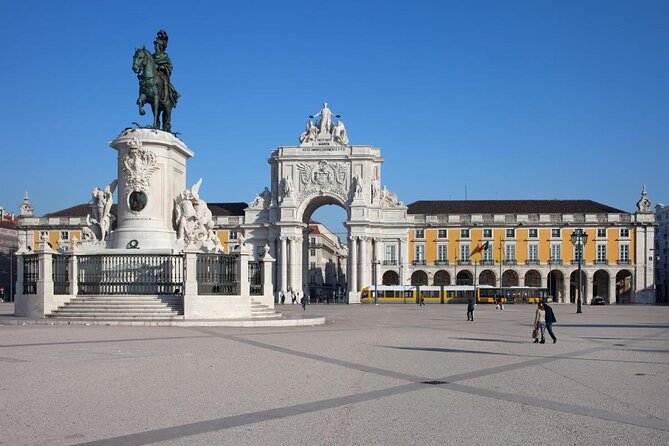
This is not a generic highlights tour where you point at buildings and move on. The heart of the experience is understanding how Lisbon’s center changed after the 1755 catastrophe, and then noticing how those changes still show up in squares, facades, and even in the shops.
Chiado and Baixa have a special rhythm. You get grand views from major plazas, then you step into tighter streets where the details do the talking. That mix is exactly why a walking format works so well here. You’re close enough to see decorative elements on storefronts and pavement patterns, and the guide can connect them to the bigger story without turning it into a lecture.
The tour is priced at $29.64 per person, and for that you get a local guide plus a professional photographer guide. That matters because you’re paying for interpretation and documentation, not just motion. It’s also booked fairly far ahead on average, which usually means the timing matches what many people want in Lisbon: a downtown walk early in the trip so you can understand where you are.
Meeting point at Estação Ferroviária do Sul e Sueste, then straight into Baixa/Chiado
Your day kicks off at Estação Ferroviária do Sul e Sueste, Av. Infante Dom Henrique 1B, 1100-016 Lisboa. From there, the plan is set up for you to walk right into the downtown grid—useful if you want your first Lisbon day to feel like you’re learning the city instead of just seeing it.
You’ll end at Praça Luís de Camões. That finish location is a smart choice because it’s a natural “hangout” square, so it’s easy to continue your evening afterward. In other words, the tour doesn’t dump you in a dead zone.
One practical note: because the itinerary has frequent, time-boxed stops, arriving on time matters. In a place this busy, a late start can ripple through the whole route.
You can also read our reviews of more tours and experiences in Lisbon.



Praca do Comercio (Terreiro do Paco): the rebuilt Royal Square that sets the tone
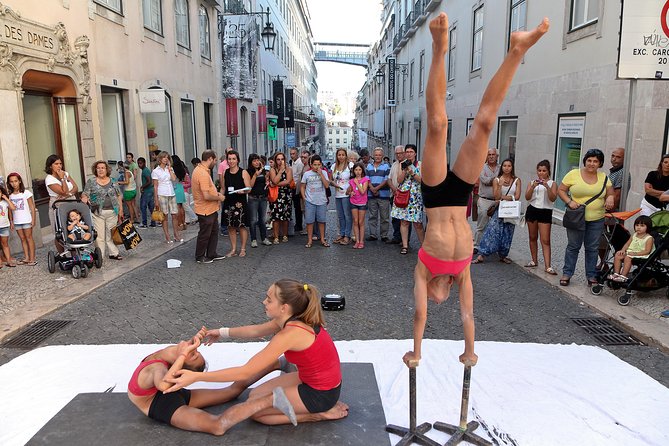
The first stop is Praca do Comercio, also known as Terreiro do Paco. This is the place to begin if you want the tour theme to be more than a slogan. You get the Royal Square feeling—majestic buildings, fine sculptures, and a scenic pier—together with the key historical context: this area was rebuilt after the 1755 tsunami.
Why this matters: starting here anchors everything that follows. When you later see other structures across Chiado and Baixa, you’ll understand the repeated pattern—Lisbon rebuilding itself, then layering new designs over older damage.
This stop is listed as about 20 minutes and free admission. You won’t get stuck. You’ll get oriented.
Santa Justa Elevator area: seeing the 19th-century Lisbon glow-up up close
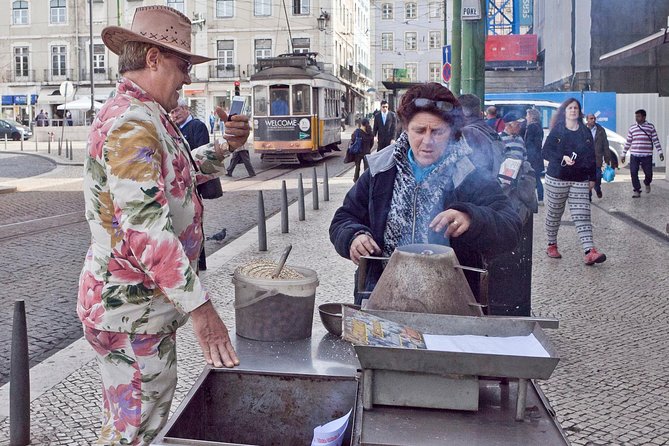
Next comes Elevador de Santa Justa. Even if you don’t have time to take a long detour on your own, the stop is positioned to show how downtown evolved after the 1755 disaster, with the lift acting as a symbol of 19th-century ambition.
In the plan, you’ll also notice nearby stops that connect to the daily-life side of downtown: a classic pastry stop like Pastelaria A Camponesa and an Animatógrafo reference. The takeaway here isn’t just a landmark name. It’s how Lisbon’s tourist heart overlaps with lived-in routines—sweet shops, street entertainment, and architecture all in the same frame.
It’s about 15 minutes, listed with free admission. If you’re the type who loves lingering at a single viewpoint, this portion may feel short. But as part of a multi-stop walk, it keeps your day moving.
Praca Dom Pedro IV: the most popular square, with waves underfoot
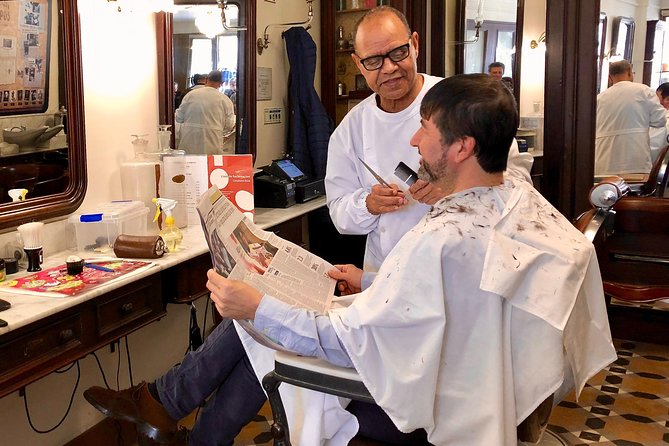
Then you’ll head to Praça Dom Pedro IV, described as Lisbon’s most popular square, and it makes sense. The setting features an 18th-century building frame, the National Theater, and a wave pattern pavement that looks great in photos and is easy to overlook when you’re walking fast.
This square also pays off because it connects “big Lisbon” with “small Lisbon.” You get the main stage from the facades, and you also get the ground-level design that makes downtown feel handcrafted. The guide can point out what to look for so you don’t miss the details you’d otherwise walk right past.
Stop time is about 15 minutes and free admission. If you’re hungry for coffee or a quick pause afterward, this is the kind of place where you can naturally branch out.
Praca da Figueira and the Hospital for Dolls: shopping with a story

Praca Da Figueira is next, and this is the stop that adds texture. It’s described as having some of the most original shops in town, including a Hospital for Dolls.
I like this kind of moment because it shifts the tour from “look at buildings” to “look at commerce and craft.” Lisbon’s storefronts carry memory. A shop can be a tiny museum, even if it’s selling something small and practical.
This stop is about 15 minutes, and it’s listed as free admission. If you’re shopping for small souvenirs or you enjoy quirky cultural finds, this is worth your camera time.

Igreja de S Domingos: the dramatic facade, then the contrast inside
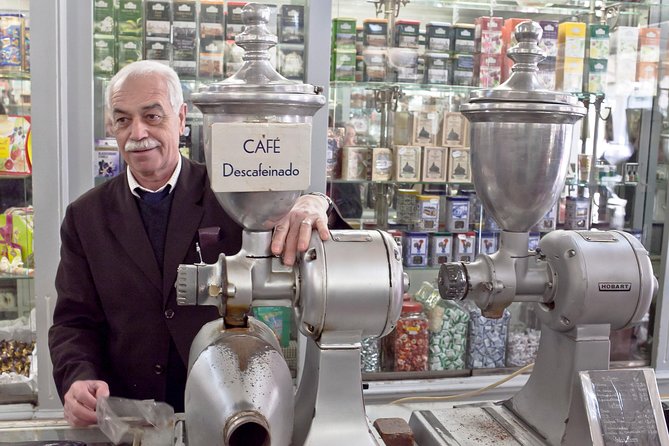
The itinerary includes Igreja de São Domingos. On the outside, the focus is the majestic facade. Then the tour points out the contrast that’s part of the church’s character: overwhelming ruins inside.
It also mentions a masonic churchyard nearby and notes that some of the best cherry liqueur is just around the corner. That’s an important practical detail—when a tour tells you there’s something nearby, it helps you plan a real break without guessing.
This is about 15 minutes and free admission. A quick heads-up: churches can have conditions about photography or quiet behavior, and those rules can vary. Keep it respectful and follow any on-site guidance.
Luvaria Ulisses and the Carmo Wall: tiny shop energy in a huge structure
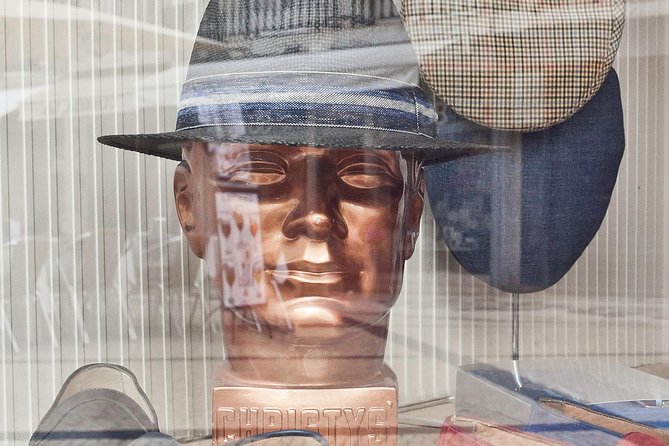
Now you get a wonderfully Lisbon contrast: Luvaria Ulisses, described as extremely tiny, directly dug into the massive Carmo Wall. The plan also references “de parisian” style Grandes Armazéns, and it notes they were rebuilt after a ravaging fire in 1988.
This stop is a great example of what makes the tour feel more than a postcard walk. You’re seeing how structures get used and reused. You’re also seeing how damage and rebuilding aren’t one-time events in the city’s life. Lisbon keeps changing, and its commercial corners reflect that.
Stop time is about 15 minutes and free admission.
Armazens do Chiado and Bertrand: classic names, downtown personality
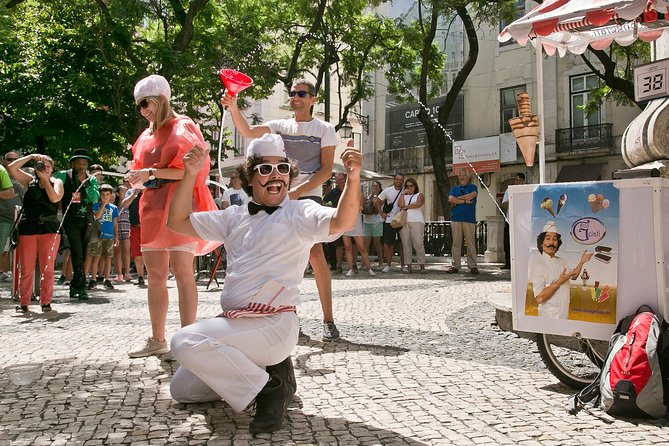
Then you’ll move into Armazens do Chiado, with references to department-store memories and specific names like Antigos Armazéns Grandella, Chiado, Paris em Lisboa, and Ramiro Leão. These are the kinds of references that make sense if the guide is pointing out what used to be where and how the evidence still shows.
After that comes Bertrand, described as the most cosmopolitan street in town after the 1755 earthquake, and it includes Bertrand, noted as the oldest bookstore in the world, plus Brasileira, a muster point for artists and writers for the last hundred years.
Why this is such a good use of a walking tour: it connects place to people. Bookstores and coffee houses aren’t just stops. They’re Lisbon’s social infrastructure. If you like intellectual city corners—places where ideas drift along with steam—you’ll enjoy how the guide links these addresses to the city’s character.
This segment is about 15 to 20 minutes (20 minutes in the plan) and free admission.
Escultura de Fernando Pessoa and Praça Luís de Camões: romantic Lisbon in motion
At Escultura de Fernando Pessoa, the tour ties together Lisbon’s legendary coffee houses, writers, and intellectual culture. Pessoa is more than a name here. The tour framing helps you see him as part of the city’s daily vibe—where literature isn’t kept behind glass.
Then you reach Praça Luís de Camões, described as epitomizing Romantic Lisbon and now one of the most lively places in town. The walking tour ends here, and it’s a practical finish. You’ll feel the pulse of the city right after you’ve learned how its downtown story connects together.
Stop time is short—about 10 minutes for Praça Luís de Camões—but it works as a landing pad for your next move.
The photographer factor: better photos without turning the day into a photoshoot
One thing that can make or break a tour like this is the photo component. Here, a professional photographer accompanies you, and the goal is practical: you’ll get help making vacation photos that look intentional.
You can see why people love this addition. Downtown Lisbon has busy backgrounds, shifting light, and lots of angles you’ll only notice if someone points them out. The photographer guidance turns those “I hope one came out” moments into real keepers.
Also, because you’re already walking with a guide, you’re not stopping randomly just to pose. You’re capturing scenes as you go, aligned with what the guide is showing you.
Price and value: what $29.64 buys in Lisbon downtown time
At $29.64 per person for a 3 to 4 hour guided walk, the value comes from three places:
1) Two guides-worth of attention: you get a local guide plus professional photographic help.
2) A structured route through major and side details: squares, churches, and shop culture, not just a skyline tour.
3) Free admission listed at the key stops: the plan marks the relevant stops with free admission tickets.
If you’re the kind of person who tends to feel like tours are too superficial for the price, this format is a better match. It’s not trying to cover every monument. It’s choosing a route where the story and the visuals overlap.
If you’re hoping for a slow, sit-down experience with long museum time, you may feel the schedule is tight. This tour favors momentum.
Who this tour suits best
I think this works best for:
- First-time Lisbon visitors who want an orientation through the Baixa and Chiado storytelling.
- People who like architecture and street-level details—tiles, pavement patterns, facades, and storefront clues.
- Anyone who wants better photos but doesn’t want to spend the whole day thinking about camera angles.
It’s also a solid choice for couples and solo visitors. And it’s private for your group, so the experience isn’t diluted by strangers outside your booking.
Small practical tips that make the route easier
- Wear comfortable walking shoes. The route covers multiple squares and neighborhood textures over several hours.
- Keep your phone charged for the mobile ticket. The tour uses mobile tickets.
- If you want a snack, plan it around breaks near the squares. Drinks and food aren’t included.
- Bring a light layer. Lisbon mornings and afternoons can change fast near the water and open plazas.
Should you book Lisbon Trendy Downtown?
Book it if you want a downtown walk that connects architecture and daily life, and you care about leaving with photos that look like Lisbon, not like a quick snapshot. The route is structured around major places—Praca do Comercio, Santa Justa, Praca Dom Pedro IV—then it moves into the city’s character stops like Bertrand and the tiny Luvaria Ulisses inside the Carmo Wall.
Skip it or adjust your expectations if you prefer long stays at one landmark, or you want a food-and-drink-focused tour. This one is built for movement, interpretation, and seeing the city’s center as a rebuilt, lived-in whole.
FAQ
How long is the walking tour?
It’s scheduled for about 3 to 4 hours.
Where does the tour start and end?
It starts at Estação Ferroviária do Sul e Sueste (Av. Infante Dom Henrique 1B) and ends at Praça Luís de Camões (Baixa/Chiado underground station entrance area).
Is the tour suitable for most people?
The tour notes that most travelers can participate.
Is there a photography component?
Yes. A professional photographer guides you during the walk.
Are there any admissions or tickets required for the stops?
The itinerary lists several stops with free admission tickets, and you’ll see those marked in the plan. Other costs like food and drinks are not included.
What is included in the price?
A local guide and professional photographer guide are included.
What is not included?
Drinks and food are not included (and you’ll need to purchase alcoholic drinks if you want them).
Do I need to be there with a minimum group size?
Yes, there is a minimum of 2 people per booking. Children must be accompanied by an adult.